Catalog
This catalog lists every species from Persian mythology available for
simulation in stdferdowsim — 36 species and 360 demographic models.
Each has made-up but population-genetically plausible genomes and demographic
histories featuring admixture graphs, ghost populations, extinction-recolonization,
and complex reticulate topologies with up to 8 populations.
Species are drawn from Ferdowsi’s Shahnameh (Book of Kings), Zoroastrian cosmology, and broader Persian/Iranian mythology.
Demography schematic diagrams (one per model) are shown below when available.
To generate them, run from the repo root: python docs/generate_demography_figures.py
(requires demesdraw; install with uv sync --extra docs).
Which chromosome (
Genomeobject)?Which model of demographic history (
DemographicModelobject)?
Example: simulate Simurgh samples under the ghost-admixture model:
$ stdferdowsim SimAvi -d GhostAdmixture_3F10 -o simurgh.trees -L 100000 Main:10 Secondary:10
Shahnameh Creatures & Heroes
Simurgh (Simurgh avianus) — The mythical bird of the Alborz mountains, who raised Zal, Rostam’s father. Ancient, wise, a bridge between worlds. In the Shahnameh, the Simurgh is both healer and teacher, connecting otherwise separate lineages — a natural metaphor for admixture.
Genome summary
- ID:
SimAvi- Species:
Simurgh avianus
- Common name:
Simurgh (mythical bird)
- Assembly:
Alborz1.0(GCA_FERD_SimAvi)- Ploidy:
2
- Generation time:
200 years
- Population size:
15,000
Chromosomes
Name |
Length (bp) |
Mutation rate |
Recombination rate |
|---|---|---|---|
1 |
20,000,000 |
1.20e-08 |
8.00e-08 |
2 |
18,000,000 |
1.20e-08 |
8.00e-08 |
3 |
16,000,000 |
1.20e-08 |
8.00e-08 |
4 |
14,000,000 |
1.20e-08 |
8.00e-08 |
5 |
12,000,000 |
1.20e-08 |
8.00e-08 |
6 |
10,000,000 |
1.20e-08 |
8.00e-08 |
alborz_mitogenome |
17,000 |
3.36e-08 |
0.00e+00 |
Demographic models
Constant_1F10
Single population constant-size model
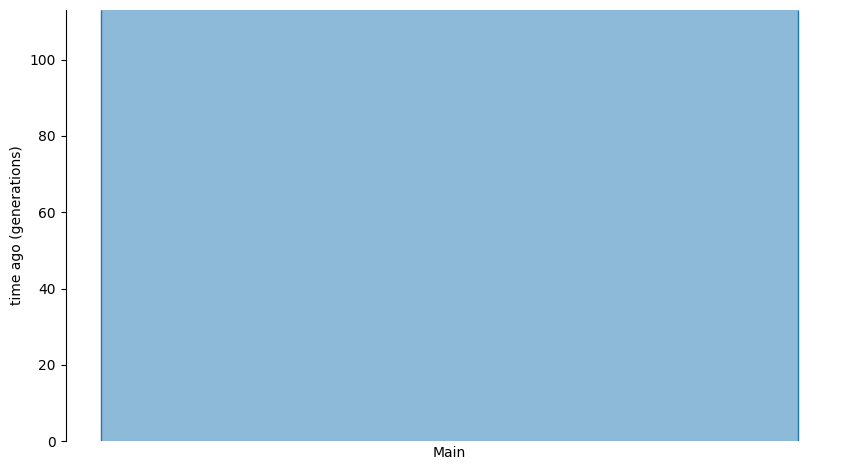
Populations: Main
Single population of Simurgh (mythical bird) at constant size N=15000.
ThreeEpoch_1F10
Single population three-epoch model with bottleneck
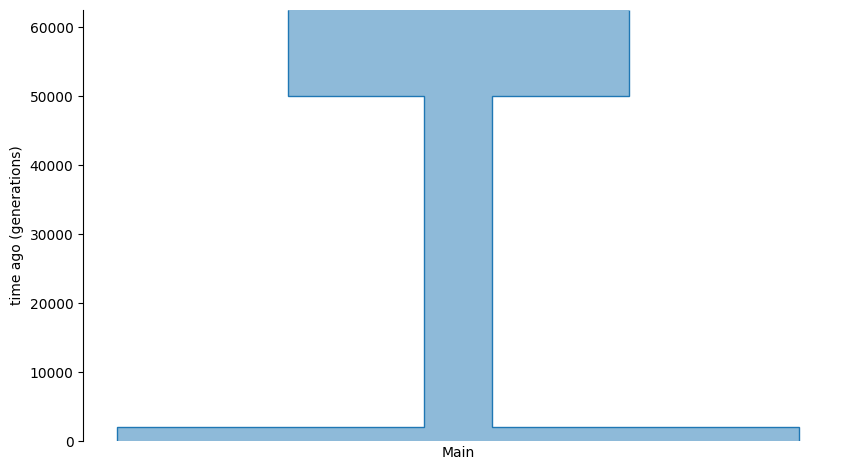
Populations: Main
Single pop of Simurgh (mythical bird). Modern N=15000, bottleneck 1500 at 2000 gen, ancestral 7500 at 50000 gen.
TwoPopSplit_2F10
Two population split with symmetric migration
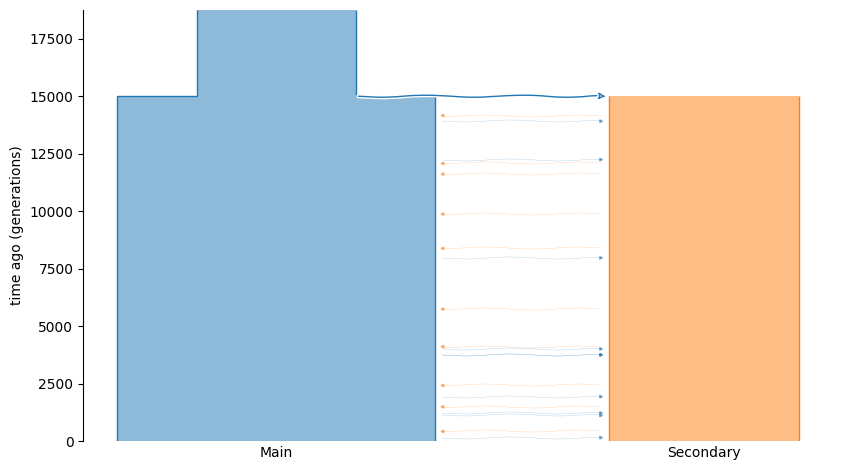
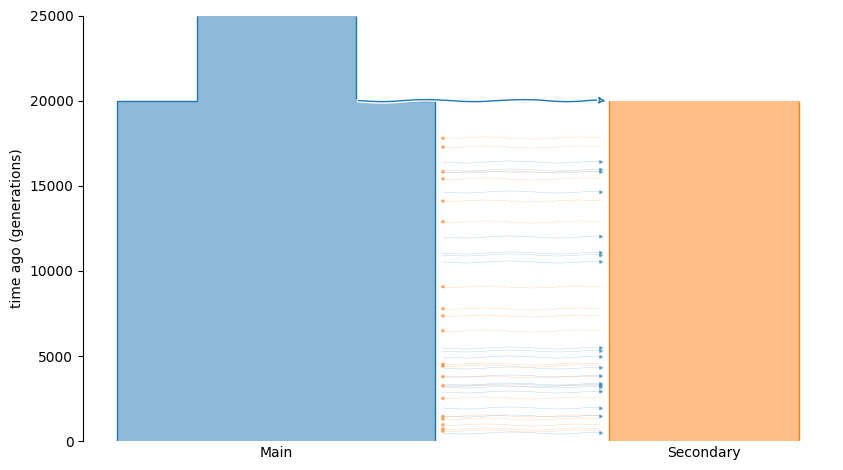
Populations: Main, Secondary
Two pops of Simurgh (mythical bird). Main N=15000, Secondary N=9000. Split 15000 gen ago.
GhostAdmixture_3F10
Two sampled pops + extinct ghost with pulse admixture
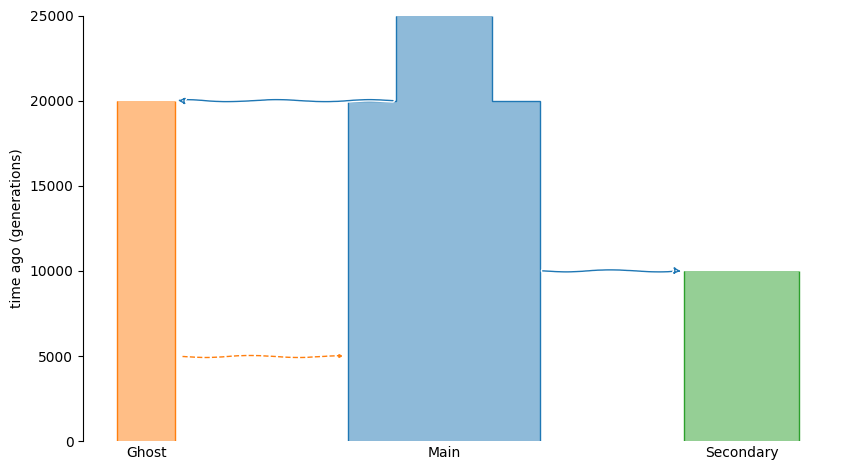
Populations: Main, Secondary, Ghost
Ghost contributes 15%% pulse admixture to Main at 5000 gen. Non-tree-like history.
ThreePopAdmix_3F10
Three populations with bidirectional pulse admixture
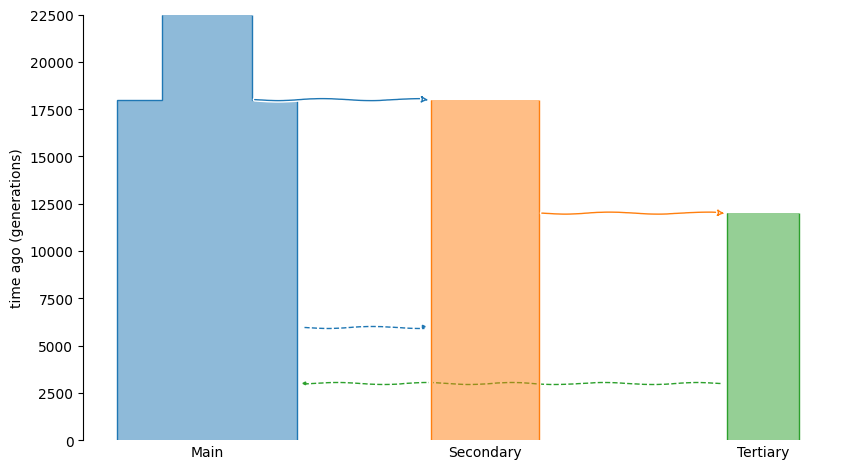
Populations: Main, Secondary, Tertiary
10%% Tertiary->Main at 3000 gen, 5%% Main->Secondary at 6000 gen. Admixture graph.
FourRegion_4F10
Four-population stepping-stone across Iranian plateau
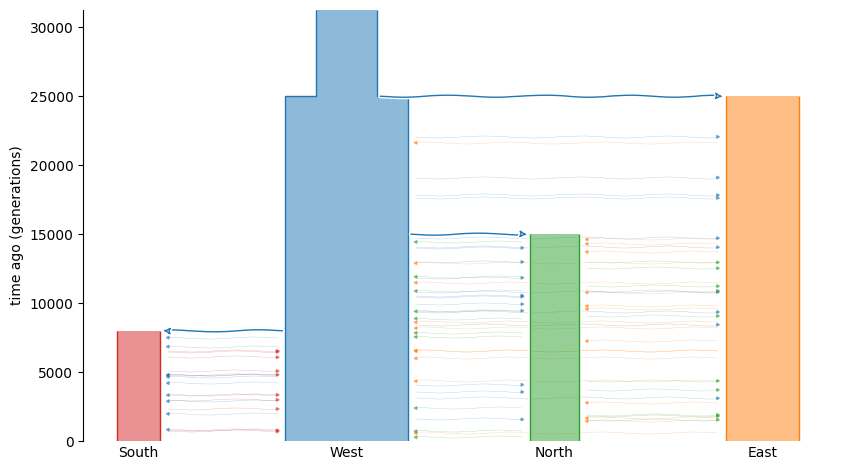
Populations: West, East, North, South
West, East, North, South populations with stepping-stone migration.
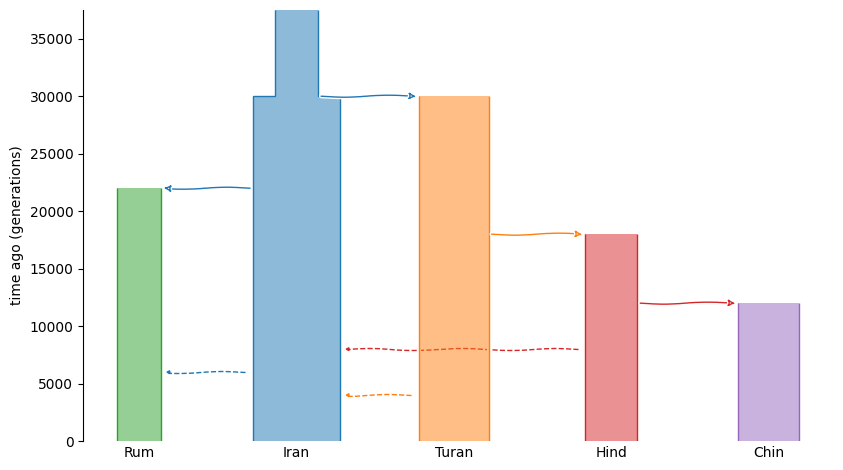
FiveRealm_5F10
Five-population admixture graph (Iran-Turan-Rum-Hind-Chin)
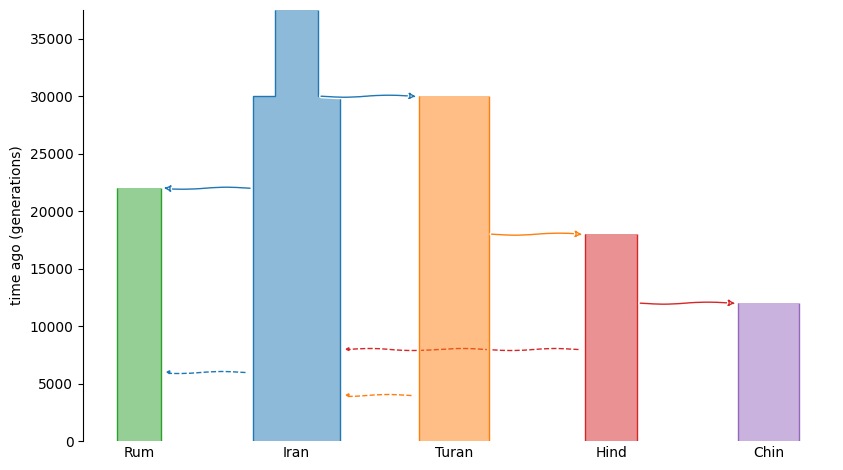
Populations: Iran, Turan, Rum, Hind, Chin
Five Shahnameh realms with pulse admixture events. Tests 5-pop graph inference.
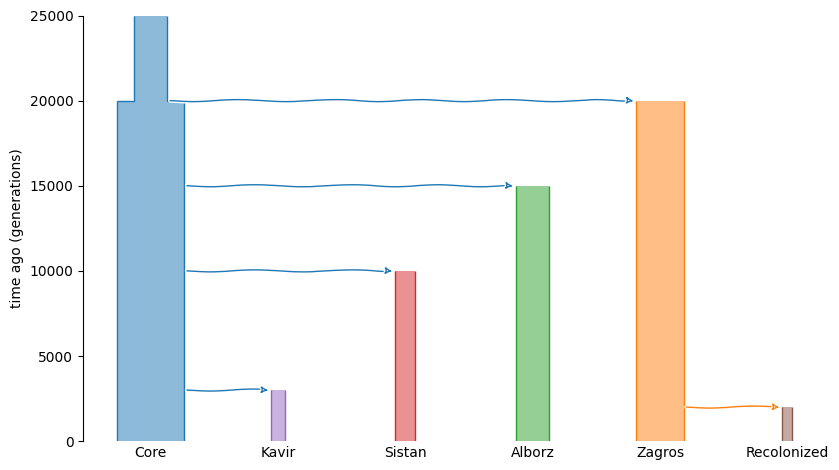
SixPopExtRecolon_6F10
Six-population model with extinction and recolonization
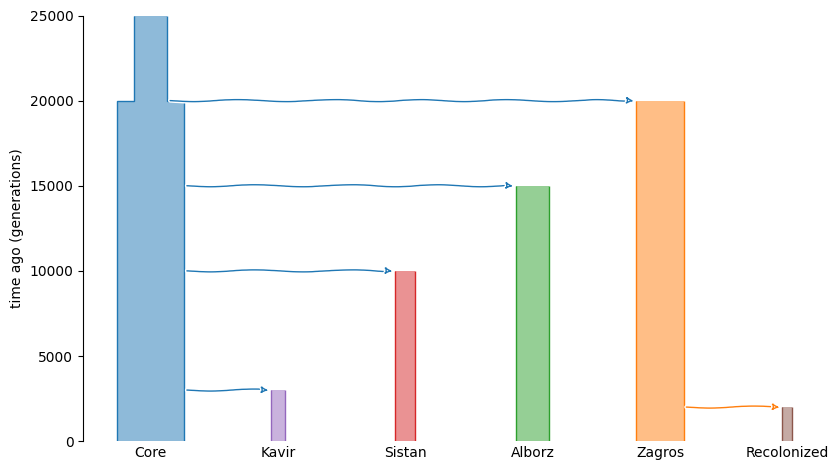
Populations: Core, Zagros, Alborz, Kavir, Sistan, Recolonized
Kavir goes extinct at 3000 gen, recolonized from Zagros at 2000 gen.
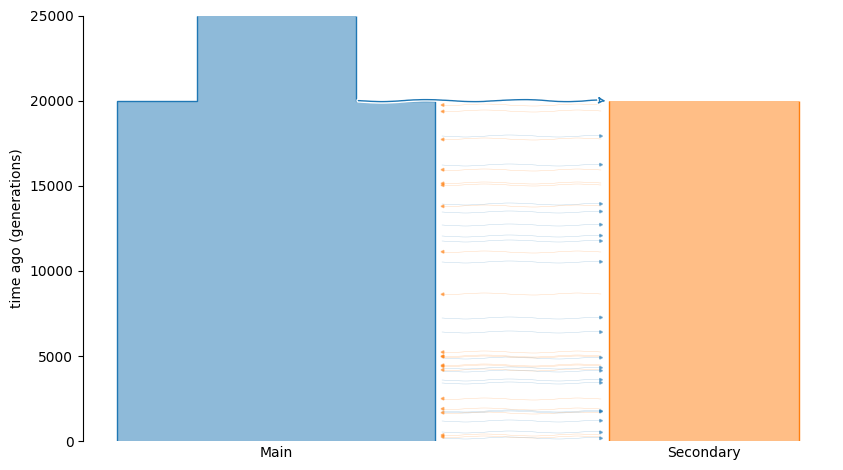
AsymReversal_2F10
Two-pop with migration direction reversal over time
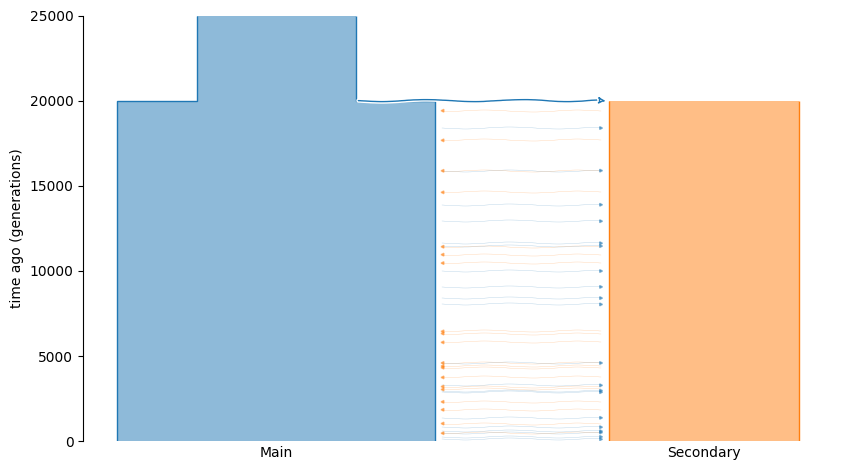
Populations: Main, Secondary
Migration reverses direction at 5000 gen ago. Tests temporal asymmetry.
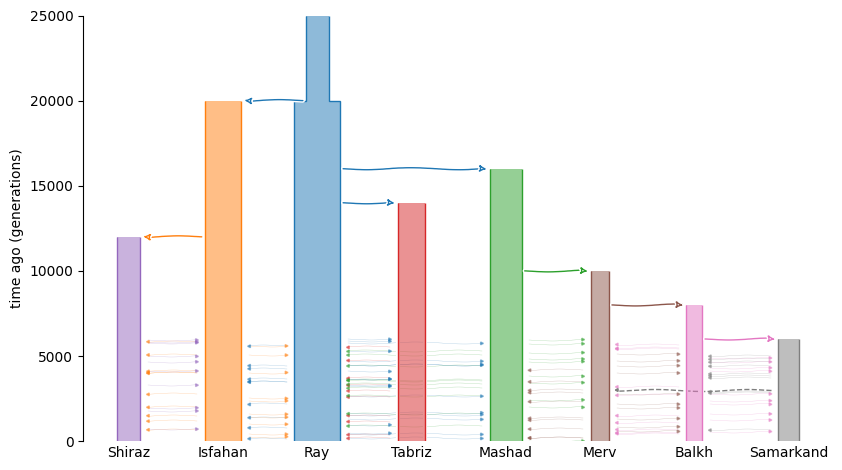
SilkRoad_8F10
Eight-population Silk Road stepping-stone model
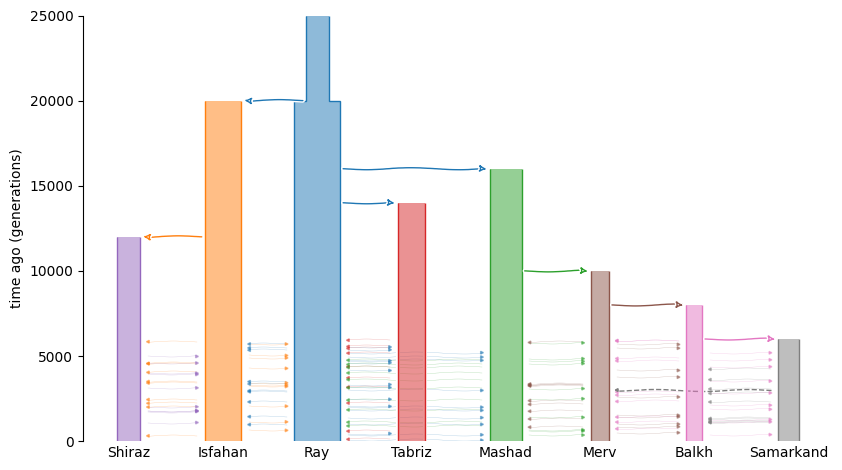
Populations: Ray, Isfahan, Shiraz, Tabriz, Mashad, Merv, Balkh, Samarkand
Eight cities along the Silk Road with stepping-stone migration and admixture.
Div (Divus mazandarensis) — The demons of Mazandaran, deeply diverged from
the Iranian hero lineages. The Div-e Sepid (White Demon) is the most powerful.
In stdferdowsim, Divs represent ancient, deeply diverged populations.
Genome summary
- ID:
DivMaz- Species:
Divus mazandarensis
- Common name:
Div (demon of Mazandaran)
- Assembly:
DivSefid1.0(GCA_FERD_DivMaz)- Ploidy:
2
- Generation time:
80 years
- Population size:
50,000
Chromosomes
Name |
Length (bp) |
Mutation rate |
Recombination rate |
|---|---|---|---|
1 |
20,000,000 |
3.00e-08 |
2.00e-08 |
2 |
18,000,000 |
3.00e-08 |
2.00e-08 |
3 |
16,000,000 |
3.00e-08 |
2.00e-08 |
4 |
14,000,000 |
3.00e-08 |
2.00e-08 |
5 |
12,000,000 |
3.00e-08 |
2.00e-08 |
mazand_mitogenome |
17,000 |
8.40e-08 |
0.00e+00 |
Demographic models
Constant_1F10
Single population constant-size model
Populations: Main
Single population of Div (demon of Mazandaran) at constant size N=50000.
ThreeEpoch_1F10
Single population three-epoch model with bottleneck
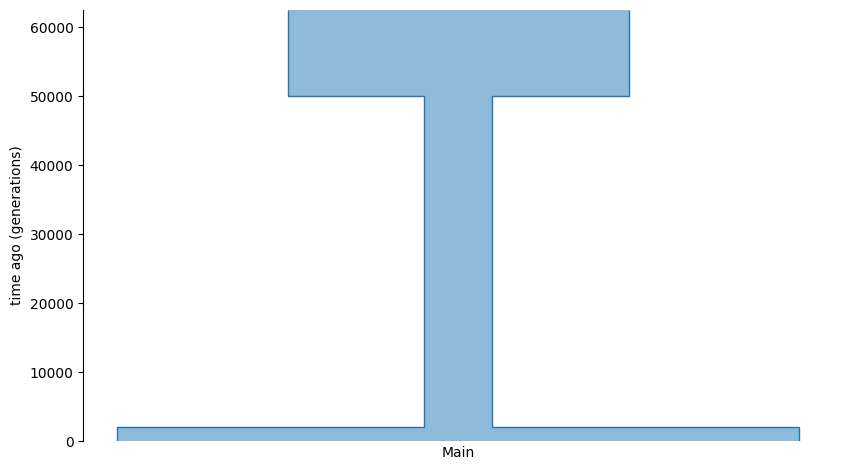
Populations: Main
Single pop of Div (demon of Mazandaran). Modern N=50000, bottleneck 5000 at 2000 gen, ancestral 25000 at 50000 gen.
TwoPopSplit_2F10
Two population split with symmetric migration
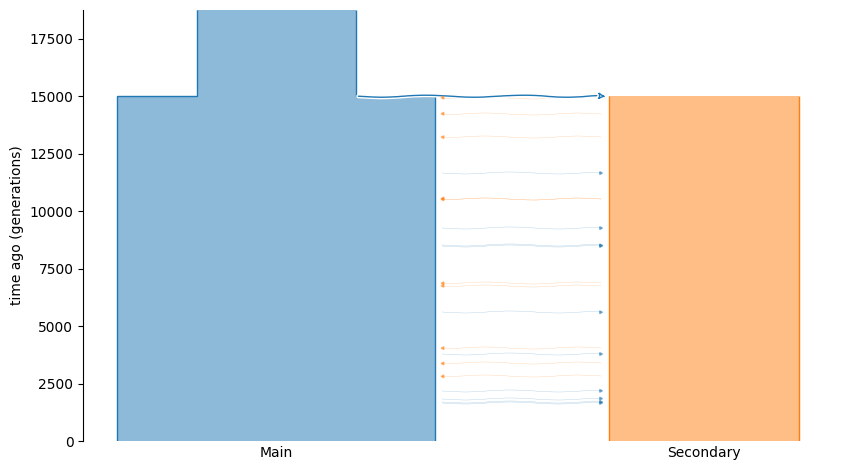
Populations: Main, Secondary
Two pops of Div (demon of Mazandaran). Main N=50000, Secondary N=30000. Split 15000 gen ago.
GhostAdmixture_3F10
Two sampled pops + extinct ghost with pulse admixture
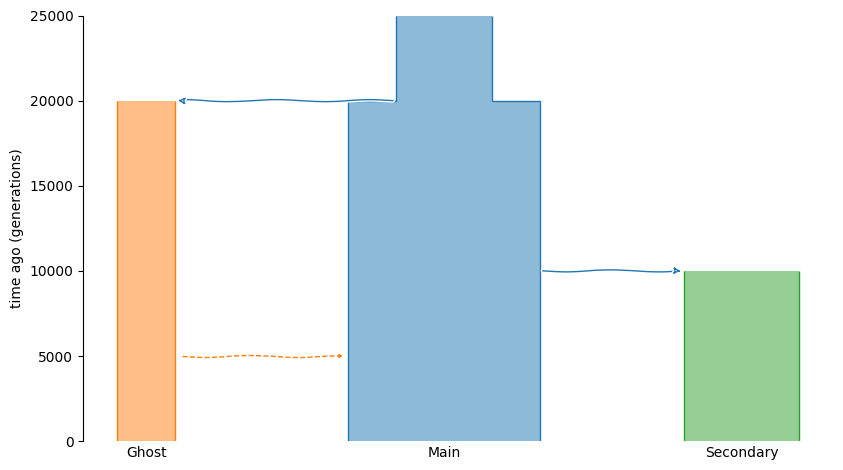
Populations: Main, Secondary, Ghost
Ghost contributes 15%% pulse admixture to Main at 5000 gen. Non-tree-like history.
ThreePopAdmix_3F10
Three populations with bidirectional pulse admixture
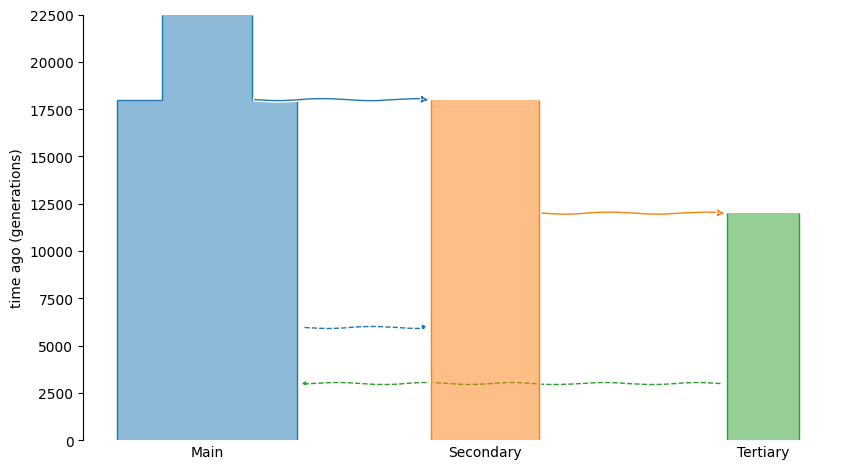
Populations: Main, Secondary, Tertiary
10%% Tertiary->Main at 3000 gen, 5%% Main->Secondary at 6000 gen. Admixture graph.
FourRegion_4F10
Four-population stepping-stone across Iranian plateau
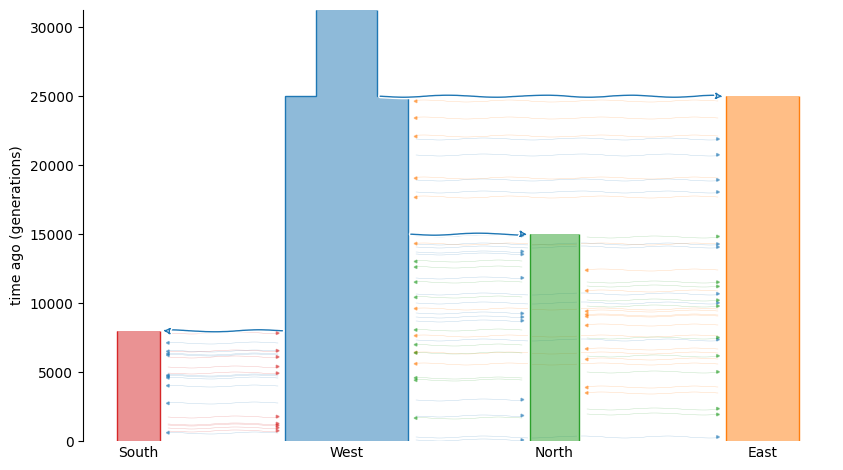
Populations: West, East, North, South
West, East, North, South populations with stepping-stone migration.
FiveRealm_5F10
Five-population admixture graph (Iran-Turan-Rum-Hind-Chin)
Populations: Iran, Turan, Rum, Hind, Chin
Five Shahnameh realms with pulse admixture events. Tests 5-pop graph inference.
SixPopExtRecolon_6F10
Six-population model with extinction and recolonization
Populations: Core, Zagros, Alborz, Kavir, Sistan, Recolonized
Kavir goes extinct at 3000 gen, recolonized from Zagros at 2000 gen.
AsymReversal_2F10
Two-pop with migration direction reversal over time
Populations: Main, Secondary
Migration reverses direction at 5000 gen ago. Tests temporal asymmetry.
SilkRoad_8F10
Eight-population Silk Road stepping-stone model
Populations: Ray, Isfahan, Shiraz, Tabriz, Mashad, Merv, Balkh, Samarkand
Eight cities along the Silk Road with stepping-stone migration and admixture.
Azhdaha (Azhdaha draconius) — The Persian dragon, associated with Mount Damavand. Zahhak, possessed by Ahriman, grew serpents from his shoulders. Long-lived, rare — small Ne, very long generation time.
Genome summary
- ID:
AzhDra- Species:
Azhdaha draconius
- Common name:
Azhdaha (dragon)
- Assembly:
Damavand1.0(GCA_FERD_AzhDra)- Ploidy:
2
- Generation time:
500 years
- Population size:
5,000
Chromosomes
Name |
Length (bp) |
Mutation rate |
Recombination rate |
|---|---|---|---|
1 |
20,000,000 |
5.00e-09 |
3.00e-08 |
2 |
18,000,000 |
5.00e-09 |
3.00e-08 |
3 |
16,000,000 |
5.00e-09 |
3.00e-08 |
4 |
14,000,000 |
5.00e-09 |
3.00e-08 |
5 |
12,000,000 |
5.00e-09 |
3.00e-08 |
damavand_mitogenome |
17,000 |
1.40e-08 |
0.00e+00 |
Demographic models
Constant_1F10
Single population constant-size model
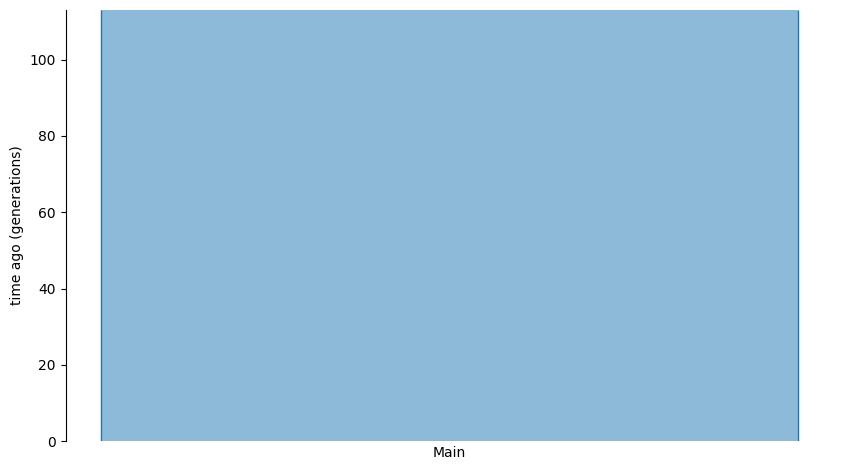
Populations: Main
Single population of Azhdaha (dragon) at constant size N=5000.
ThreeEpoch_1F10
Single population three-epoch model with bottleneck
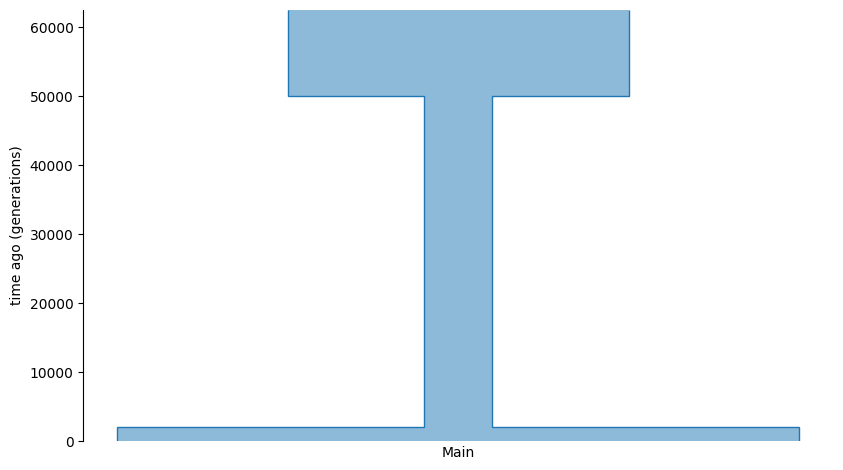
Populations: Main
Single pop of Azhdaha (dragon). Modern N=5000, bottleneck 500 at 2000 gen, ancestral 2500 at 50000 gen.
TwoPopSplit_2F10
Two population split with symmetric migration
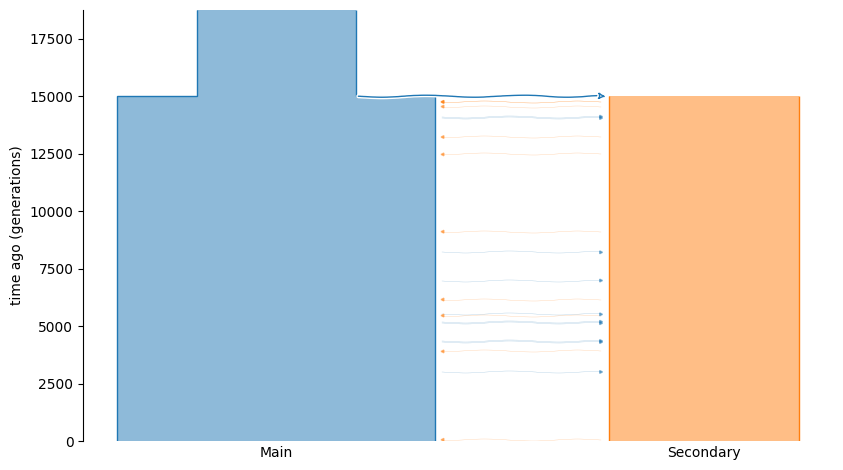
Populations: Main, Secondary
Two pops of Azhdaha (dragon). Main N=5000, Secondary N=3000. Split 15000 gen ago.
GhostAdmixture_3F10
Two sampled pops + extinct ghost with pulse admixture
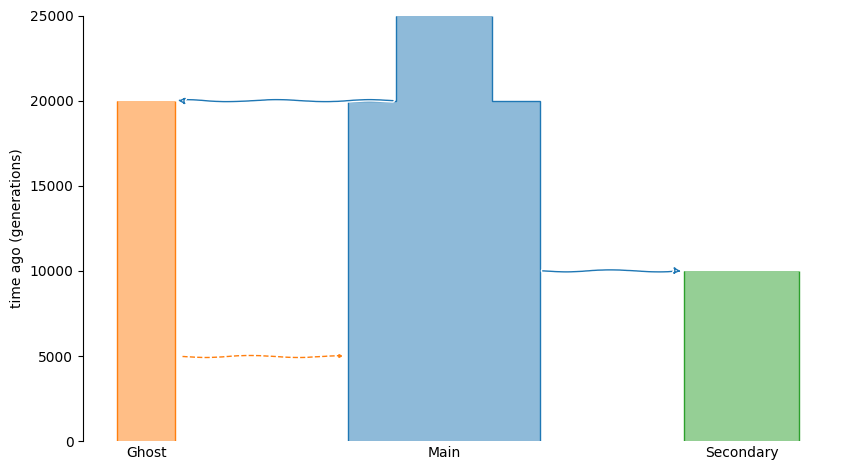
Populations: Main, Secondary, Ghost
Ghost contributes 15%% pulse admixture to Main at 5000 gen. Non-tree-like history.
ThreePopAdmix_3F10
Three populations with bidirectional pulse admixture
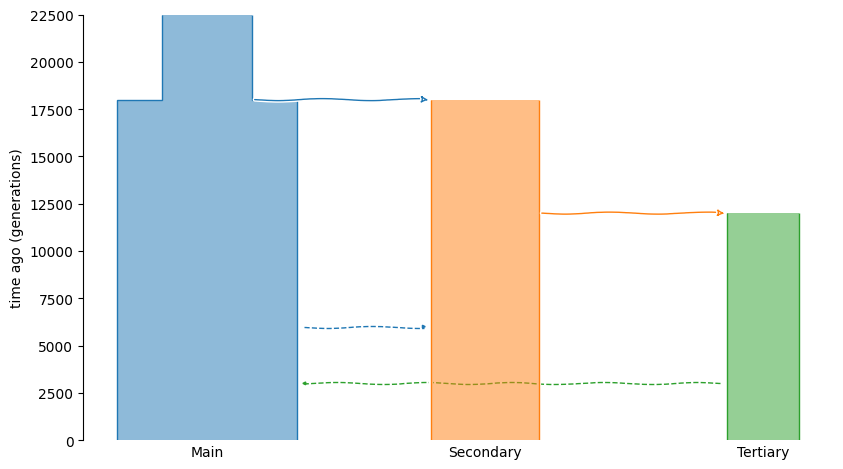
Populations: Main, Secondary, Tertiary
10%% Tertiary->Main at 3000 gen, 5%% Main->Secondary at 6000 gen. Admixture graph.
FourRegion_4F10
Four-population stepping-stone across Iranian plateau
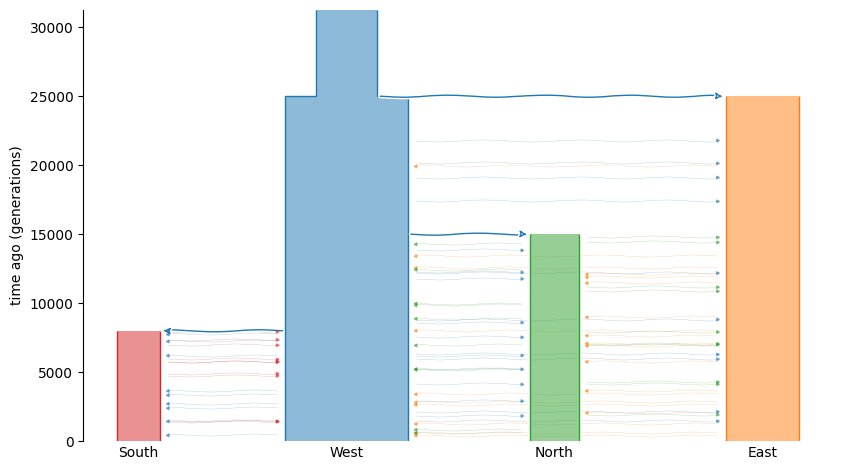
Populations: West, East, North, South
West, East, North, South populations with stepping-stone migration.
FiveRealm_5F10
Five-population admixture graph (Iran-Turan-Rum-Hind-Chin)
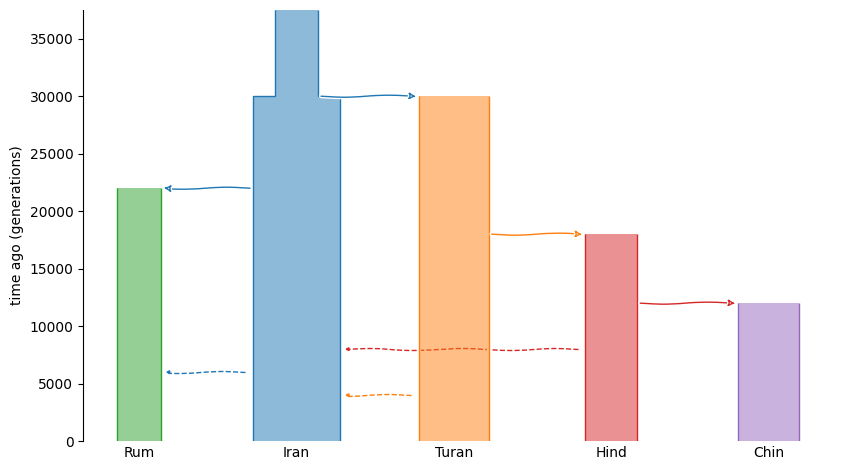
Populations: Iran, Turan, Rum, Hind, Chin
Five Shahnameh realms with pulse admixture events. Tests 5-pop graph inference.
SixPopExtRecolon_6F10
Six-population model with extinction and recolonization
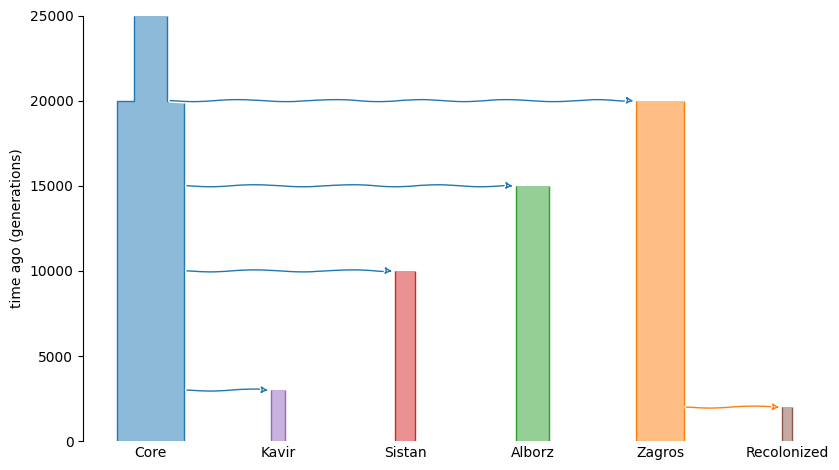
Populations: Core, Zagros, Alborz, Kavir, Sistan, Recolonized
Kavir goes extinct at 3000 gen, recolonized from Zagros at 2000 gen.
AsymReversal_2F10
Two-pop with migration direction reversal over time
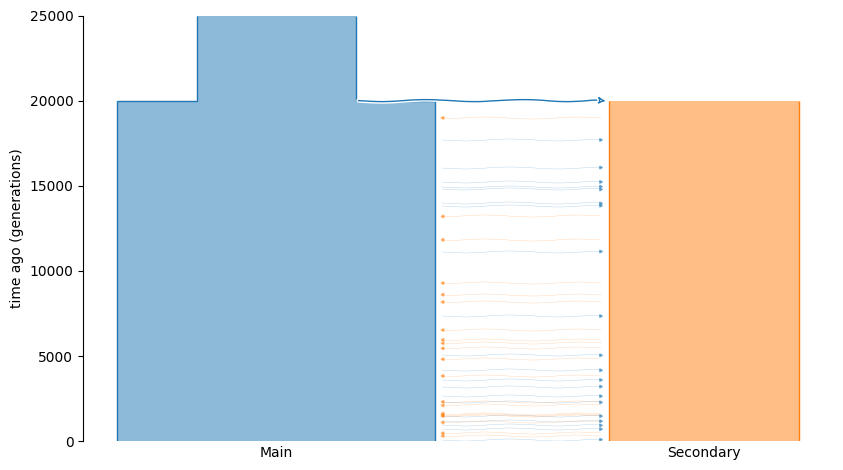
Populations: Main, Secondary
Migration reverses direction at 5000 gen ago. Tests temporal asymmetry.
SilkRoad_8F10
Eight-population Silk Road stepping-stone model
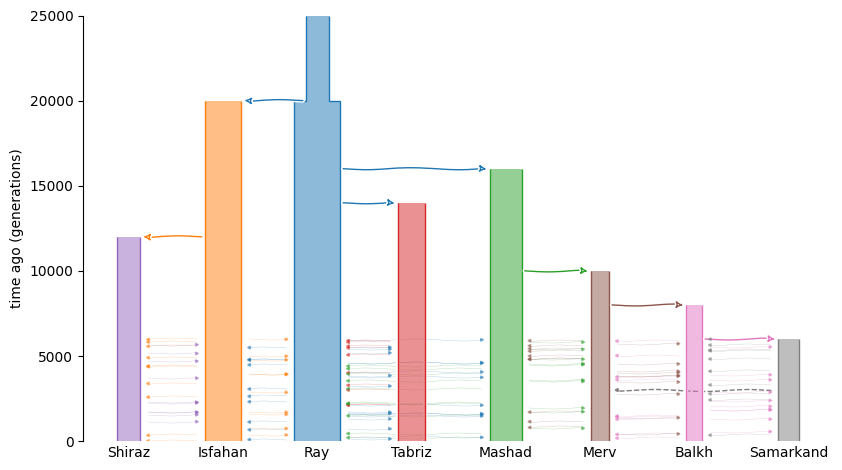
Populations: Ray, Isfahan, Shiraz, Tabriz, Mashad, Merv, Balkh, Samarkand
Eight cities along the Silk Road with stepping-stone migration and admixture.
Rostam-lineage (Rostam heroicus) — The greatest hero of the Shahnameh, from Zabulestan. His lineage spans many generations: Zal, Rostam, Faramarz. Mixed ancestry (Zal raised by Simurgh, married to Rudabeh of Kabul).
Genome summary
- ID:
RosHer- Species:
Rostam heroicus
- Common name:
Rostam-lineage (hero dynasty)
- Assembly:
Zabulestan1.0(GCA_FERD_RosHer)- Ploidy:
2
- Generation time:
35 years
- Population size:
25,000
Chromosomes
Name |
Length (bp) |
Mutation rate |
Recombination rate |
|---|---|---|---|
1 |
20,000,000 |
2.00e-08 |
2.50e-08 |
2 |
18,000,000 |
2.00e-08 |
2.50e-08 |
3 |
16,000,000 |
2.00e-08 |
2.50e-08 |
4 |
14,000,000 |
2.00e-08 |
2.50e-08 |
5 |
12,000,000 |
2.00e-08 |
2.50e-08 |
zabul_mitogenome |
17,000 |
5.60e-08 |
0.00e+00 |
Demographic models
Constant_1F10
Single population constant-size model
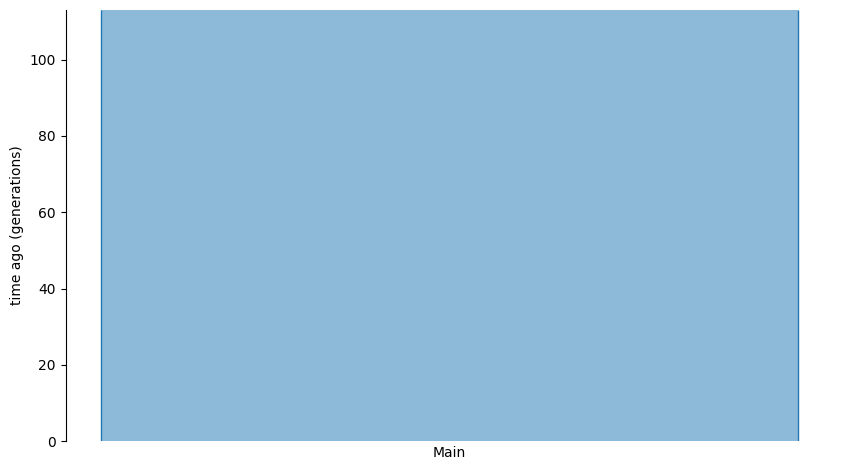
Populations: Main
Single population of Rostam-lineage (hero dynasty) at constant size N=25000.
ThreeEpoch_1F10
Single population three-epoch model with bottleneck
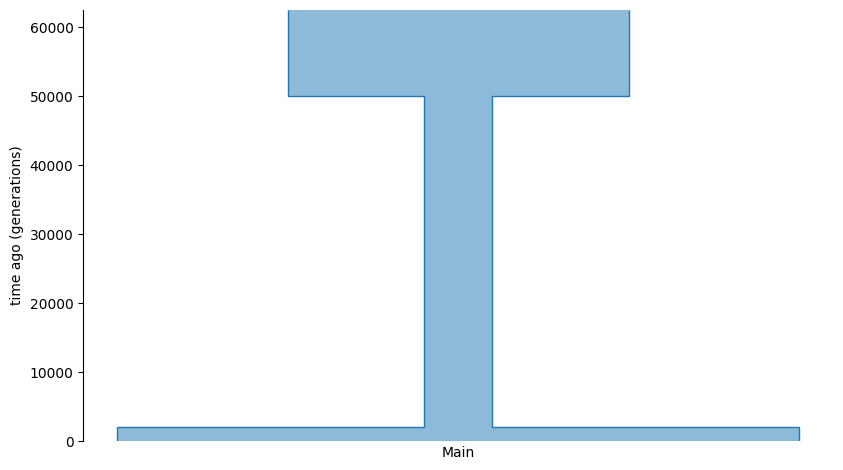
Populations: Main
Single pop of Rostam-lineage (hero dynasty). Modern N=25000, bottleneck 2500 at 2000 gen, ancestral 12500 at 50000 gen.
TwoPopSplit_2F10
Two population split with symmetric migration
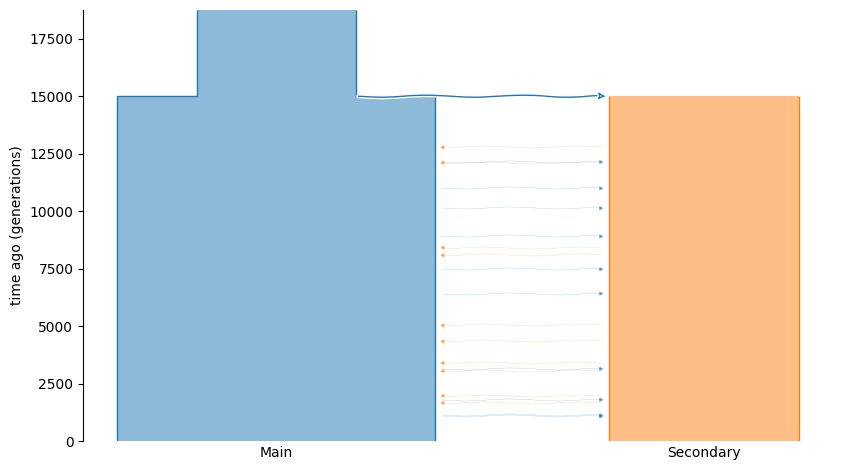
Populations: Main, Secondary
Two pops of Rostam-lineage (hero dynasty). Main N=25000, Secondary N=15000. Split 15000 gen ago.
GhostAdmixture_3F10
Two sampled pops + extinct ghost with pulse admixture
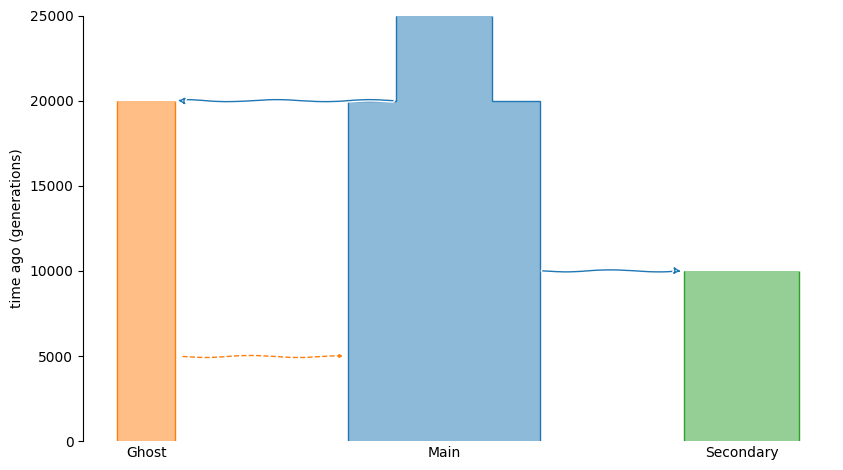
Populations: Main, Secondary, Ghost
Ghost contributes 15%% pulse admixture to Main at 5000 gen. Non-tree-like history.
ThreePopAdmix_3F10
Three populations with bidirectional pulse admixture
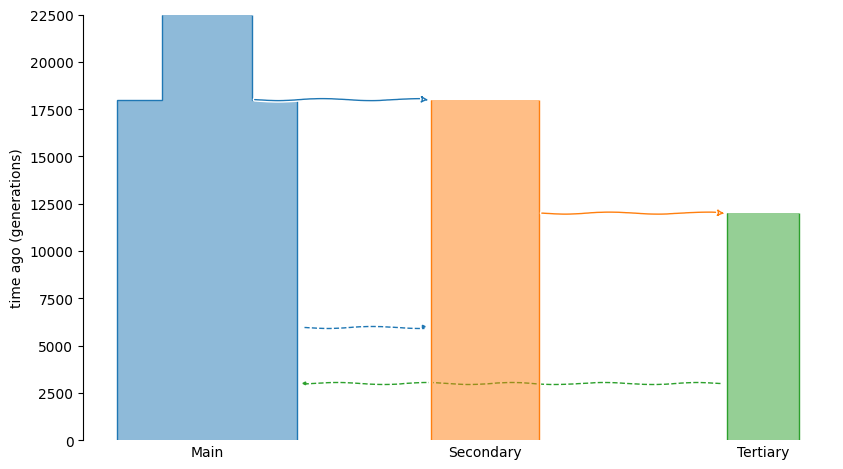
Populations: Main, Secondary, Tertiary
10%% Tertiary->Main at 3000 gen, 5%% Main->Secondary at 6000 gen. Admixture graph.
FourRegion_4F10
Four-population stepping-stone across Iranian plateau
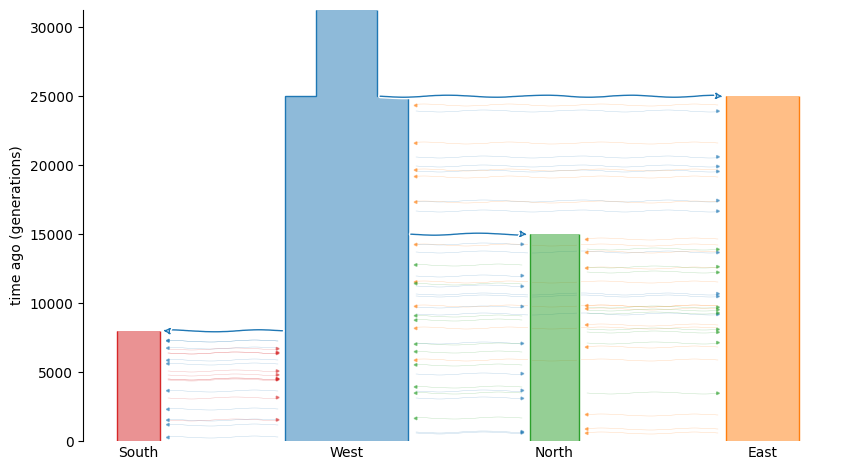
Populations: West, East, North, South
West, East, North, South populations with stepping-stone migration.
FiveRealm_5F10
Five-population admixture graph (Iran-Turan-Rum-Hind-Chin)
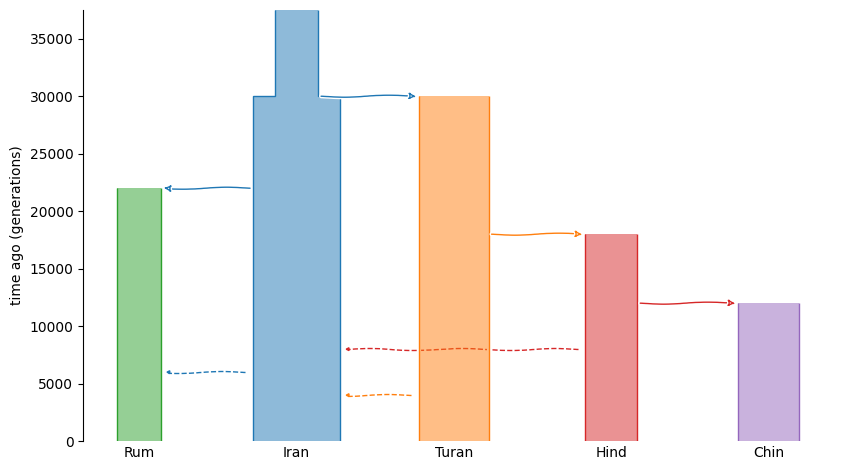
Populations: Iran, Turan, Rum, Hind, Chin
Five Shahnameh realms with pulse admixture events. Tests 5-pop graph inference.
SixPopExtRecolon_6F10
Six-population model with extinction and recolonization
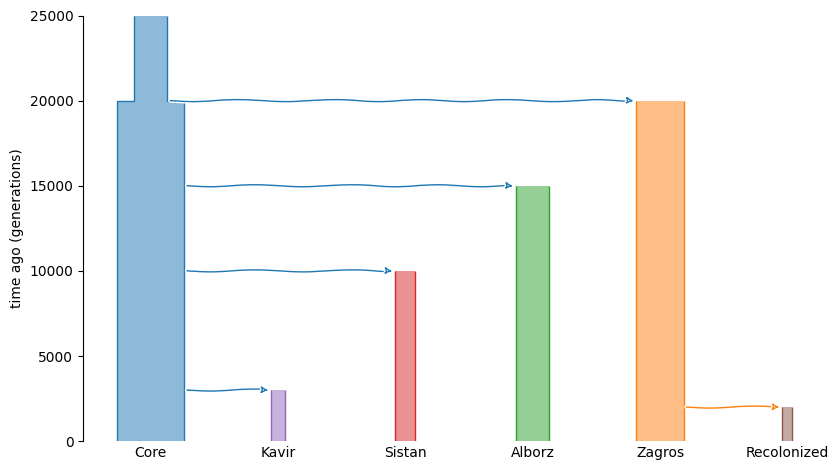
Populations: Core, Zagros, Alborz, Kavir, Sistan, Recolonized
Kavir goes extinct at 3000 gen, recolonized from Zagros at 2000 gen.
AsymReversal_2F10
Two-pop with migration direction reversal over time
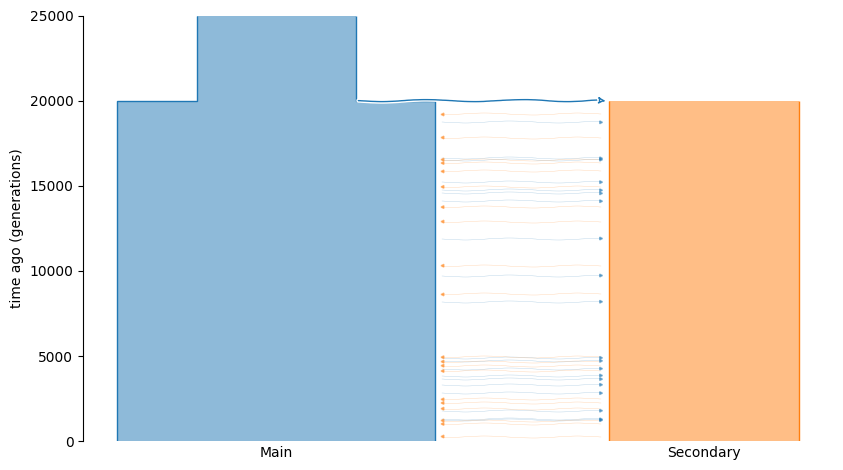
Populations: Main, Secondary
Migration reverses direction at 5000 gen ago. Tests temporal asymmetry.
SilkRoad_8F10
Eight-population Silk Road stepping-stone model
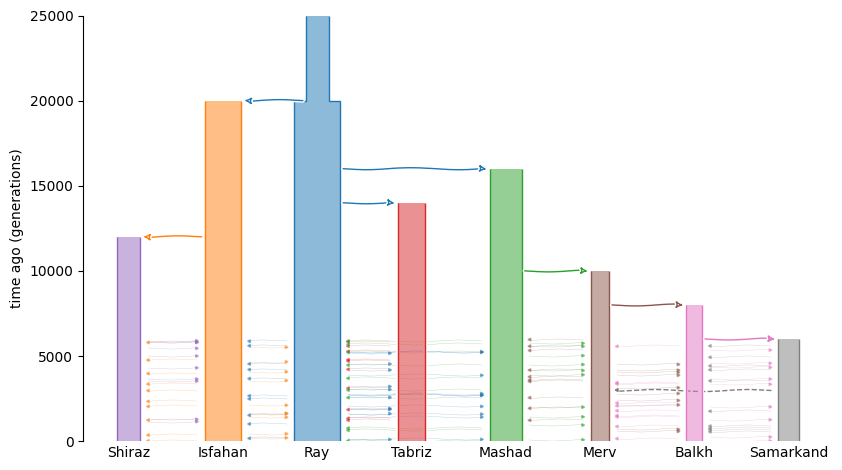
Populations: Ray, Isfahan, Shiraz, Tabriz, Mashad, Merv, Balkh, Samarkand
Eight cities along the Silk Road with stepping-stone migration and admixture.
Rakhsh (Rakhsh equinus) — Rostam’s legendary horse, the only steed strong enough to carry him. Small population, unique lineage.
Genome summary
- ID:
RakEqu- Species:
Rakhsh equinus
- Common name:
Rakhsh (Rostam’s mythical steed)
- Assembly:
Rakhsh1.0(GCA_FERD_RakEqu)- Ploidy:
2
- Generation time:
25 years
- Population size:
3,000
Chromosomes
Name |
Length (bp) |
Mutation rate |
Recombination rate |
|---|---|---|---|
1 |
20,000,000 |
2.20e-08 |
1.50e-08 |
2 |
18,000,000 |
2.20e-08 |
1.50e-08 |
3 |
16,000,000 |
2.20e-08 |
1.50e-08 |
4 |
14,000,000 |
2.20e-08 |
1.50e-08 |
5 |
12,000,000 |
2.20e-08 |
1.50e-08 |
rakhsh_mitogenome |
17,000 |
6.16e-08 |
0.00e+00 |
Demographic models
Constant_1F10
Single population constant-size model
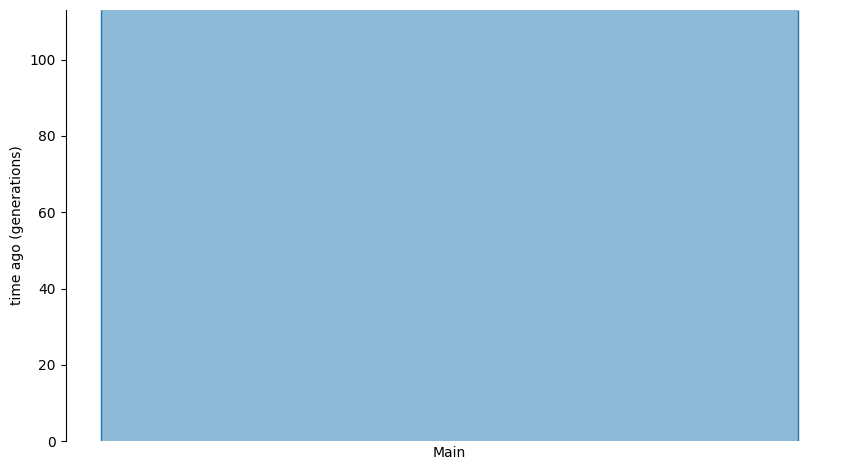
Populations: Main
Single population of Rakhsh (Rostam’s mythical steed) at constant size N=3000.
ThreeEpoch_1F10
Single population three-epoch model with bottleneck
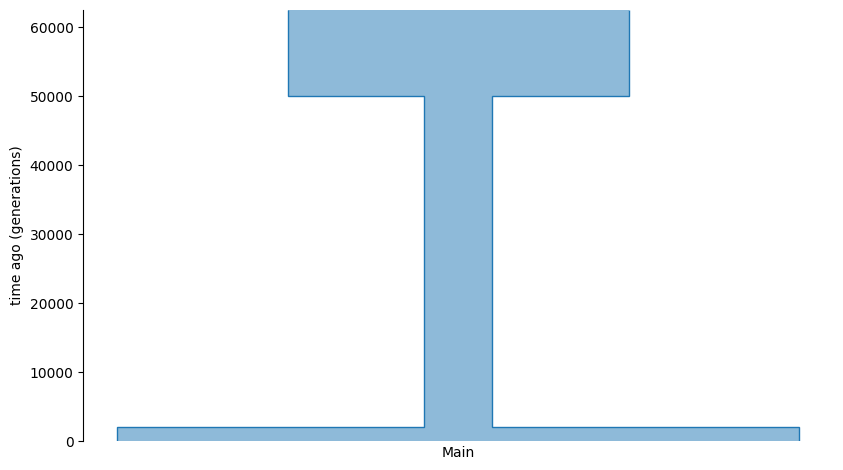
Populations: Main
Single pop of Rakhsh (Rostam’s mythical steed). Modern N=3000, bottleneck 300 at 2000 gen, ancestral 1500 at 50000 gen.
TwoPopSplit_2F10
Two population split with symmetric migration
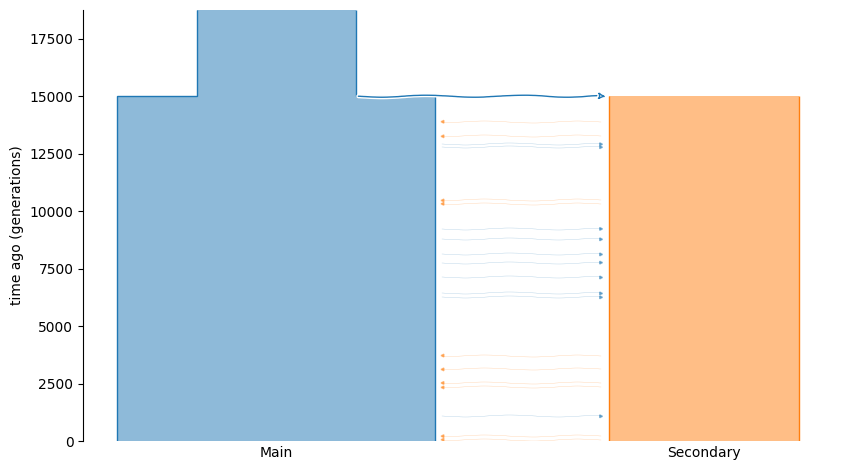
Populations: Main, Secondary
Two pops of Rakhsh (Rostam’s mythical steed). Main N=3000, Secondary N=1800. Split 15000 gen ago.
GhostAdmixture_3F10
Two sampled pops + extinct ghost with pulse admixture
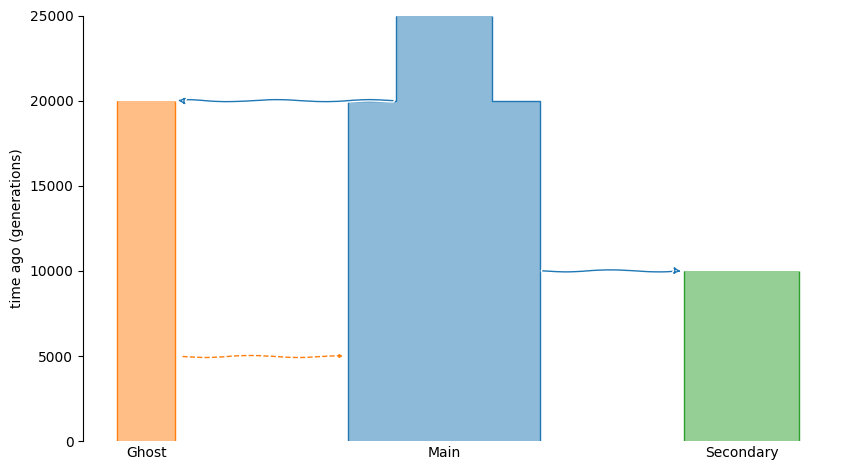
Populations: Main, Secondary, Ghost
Ghost contributes 15%% pulse admixture to Main at 5000 gen. Non-tree-like history.
ThreePopAdmix_3F10
Three populations with bidirectional pulse admixture
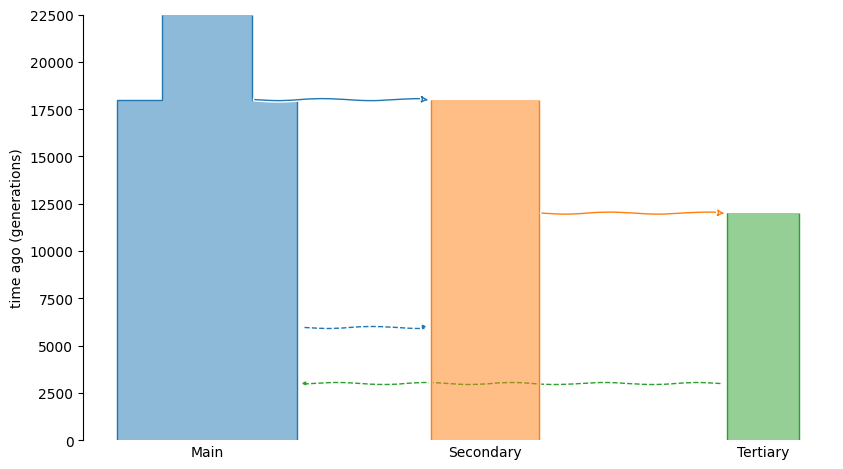
Populations: Main, Secondary, Tertiary
10%% Tertiary->Main at 3000 gen, 5%% Main->Secondary at 6000 gen. Admixture graph.
FourRegion_4F10
Four-population stepping-stone across Iranian plateau
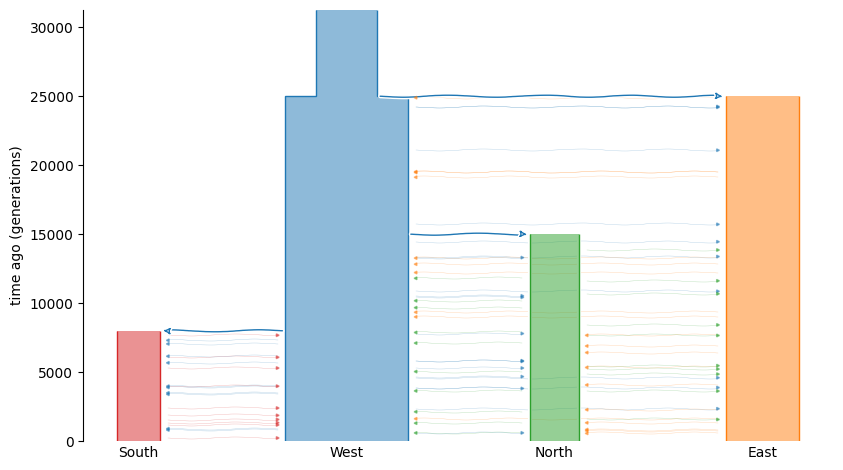
Populations: West, East, North, South
West, East, North, South populations with stepping-stone migration.
FiveRealm_5F10
Five-population admixture graph (Iran-Turan-Rum-Hind-Chin)
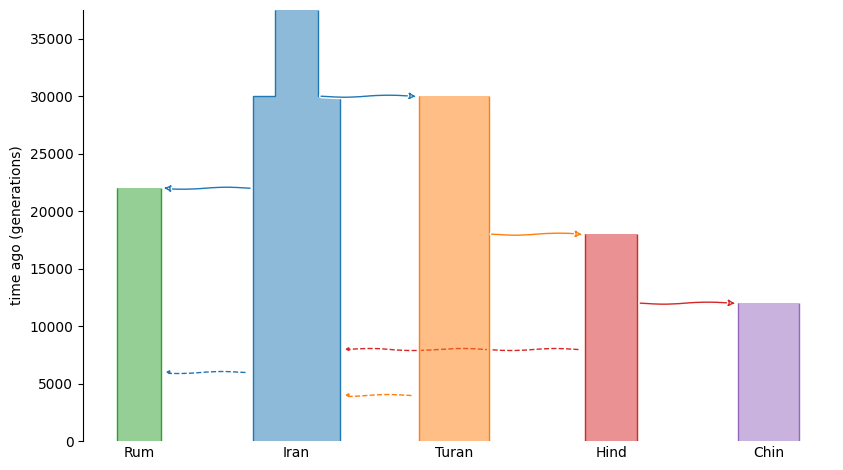
Populations: Iran, Turan, Rum, Hind, Chin
Five Shahnameh realms with pulse admixture events. Tests 5-pop graph inference.
SixPopExtRecolon_6F10
Six-population model with extinction and recolonization
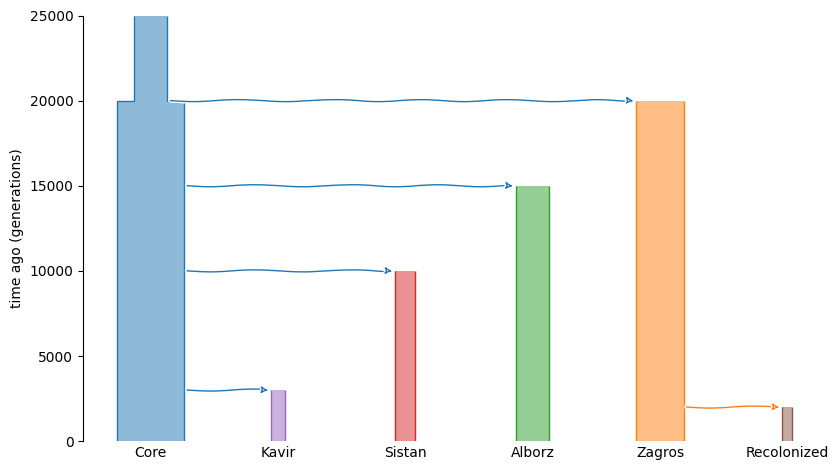
Populations: Core, Zagros, Alborz, Kavir, Sistan, Recolonized
Kavir goes extinct at 3000 gen, recolonized from Zagros at 2000 gen.
AsymReversal_2F10
Two-pop with migration direction reversal over time
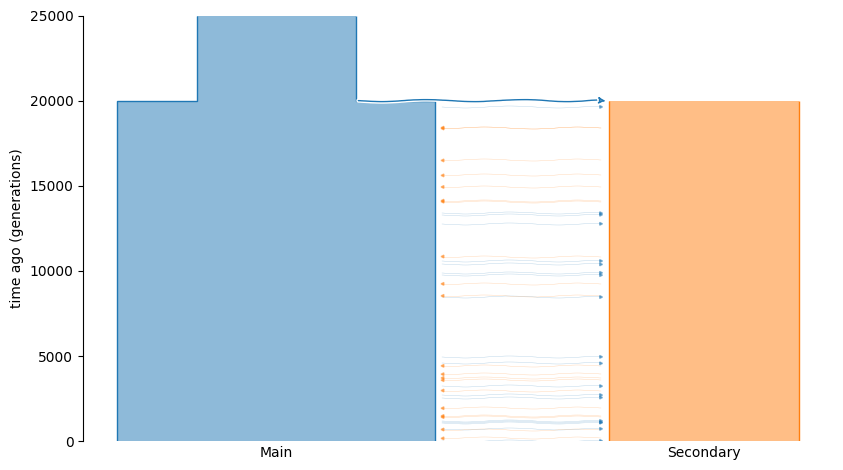
Populations: Main, Secondary
Migration reverses direction at 5000 gen ago. Tests temporal asymmetry.
SilkRoad_8F10
Eight-population Silk Road stepping-stone model
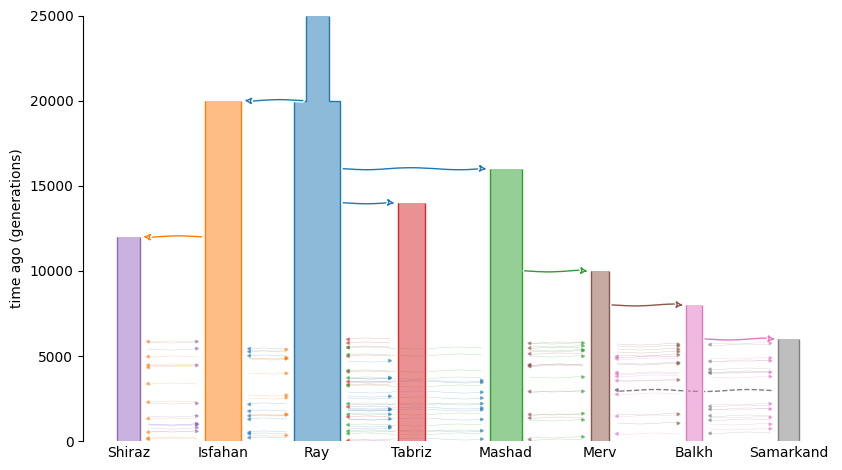
Populations: Ray, Isfahan, Shiraz, Tabriz, Mashad, Merv, Balkh, Samarkand
Eight cities along the Silk Road with stepping-stone migration and admixture.
Zal (Zal albinus) — Born with white hair, abandoned on the Alborz, raised by Simurgh. A living admixture between human and divine lineages.
Genome summary
- ID:
ZalAlb- Species:
Zal albinus
- Common name:
Zal (white-haired, raised by Simurgh)
- Assembly:
ZalNest1.0(GCA_FERD_ZalAlb)- Ploidy:
2
- Generation time:
35 years
- Population size:
20,000
Chromosomes
Name |
Length (bp) |
Mutation rate |
Recombination rate |
|---|---|---|---|
1 |
20,000,000 |
1.80e-08 |
4.00e-08 |
2 |
18,000,000 |
1.80e-08 |
4.00e-08 |
3 |
16,000,000 |
1.80e-08 |
4.00e-08 |
4 |
14,000,000 |
1.80e-08 |
4.00e-08 |
5 |
12,000,000 |
1.80e-08 |
4.00e-08 |
zal_mitogenome |
17,000 |
5.04e-08 |
0.00e+00 |
Demographic models
Constant_1F10
Single population constant-size model
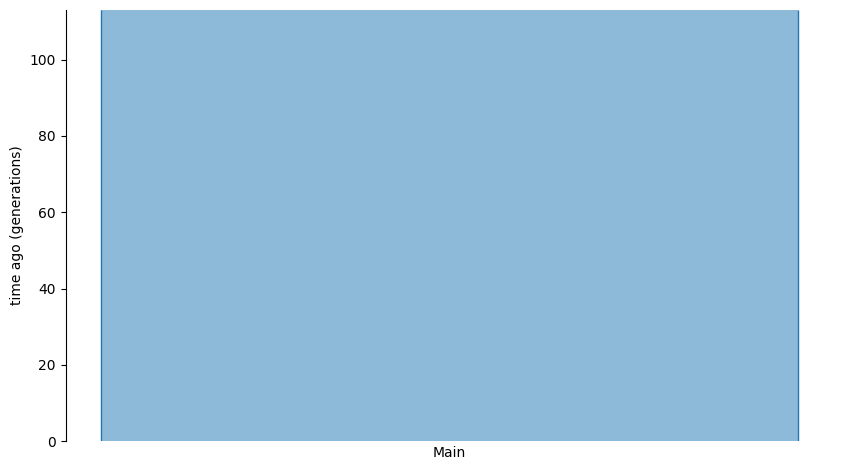
Populations: Main
Single population of Zal (white-haired, raised by Simurgh) at constant size N=20000.
ThreeEpoch_1F10
Single population three-epoch model with bottleneck
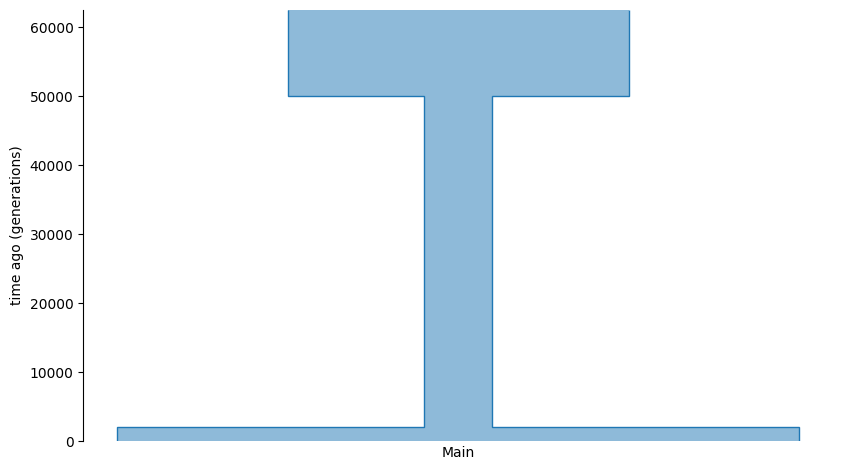
Populations: Main
Single pop of Zal (white-haired, raised by Simurgh). Modern N=20000, bottleneck 2000 at 2000 gen, ancestral 10000 at 50000 gen.
TwoPopSplit_2F10
Two population split with symmetric migration
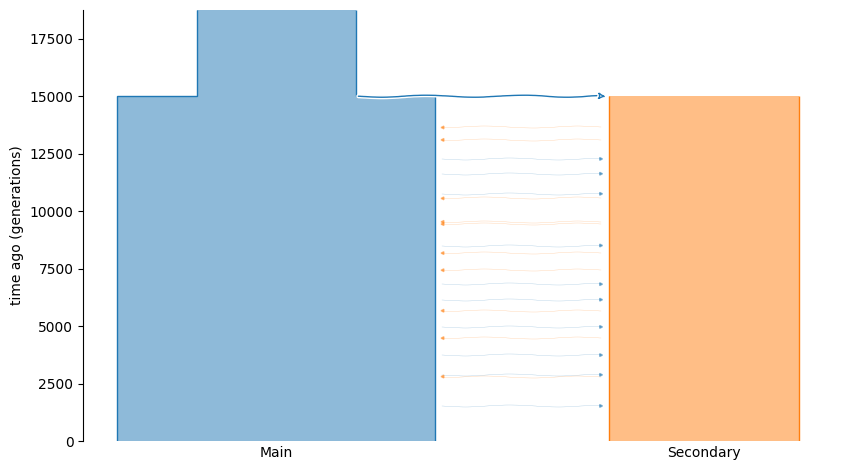
Populations: Main, Secondary
Two pops of Zal (white-haired, raised by Simurgh). Main N=20000, Secondary N=12000. Split 15000 gen ago.
GhostAdmixture_3F10
Two sampled pops + extinct ghost with pulse admixture
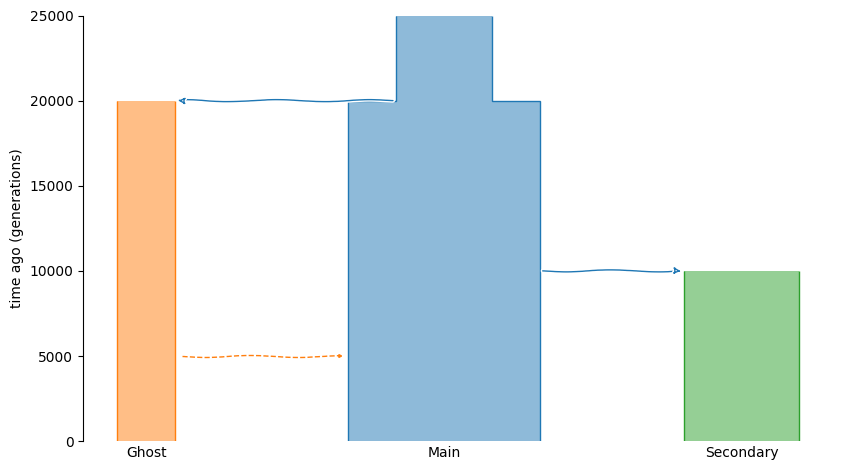
Populations: Main, Secondary, Ghost
Ghost contributes 15%% pulse admixture to Main at 5000 gen. Non-tree-like history.
ThreePopAdmix_3F10
Three populations with bidirectional pulse admixture
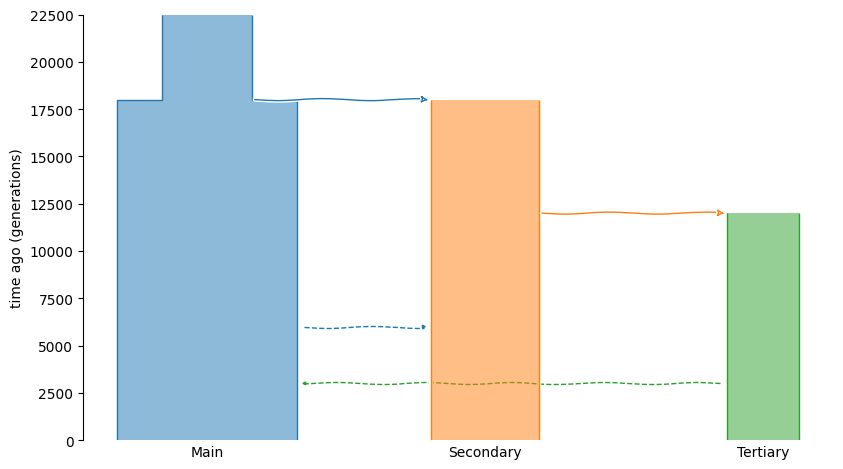
Populations: Main, Secondary, Tertiary
10%% Tertiary->Main at 3000 gen, 5%% Main->Secondary at 6000 gen. Admixture graph.
FourRegion_4F10
Four-population stepping-stone across Iranian plateau
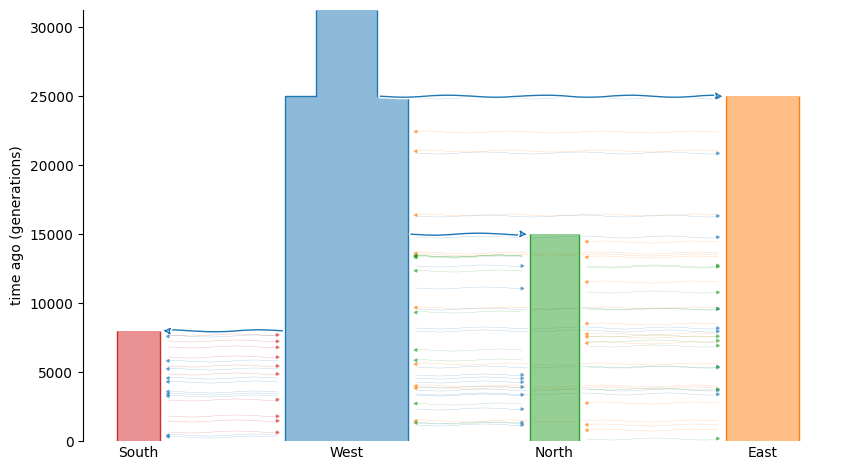
Populations: West, East, North, South
West, East, North, South populations with stepping-stone migration.
FiveRealm_5F10
Five-population admixture graph (Iran-Turan-Rum-Hind-Chin)
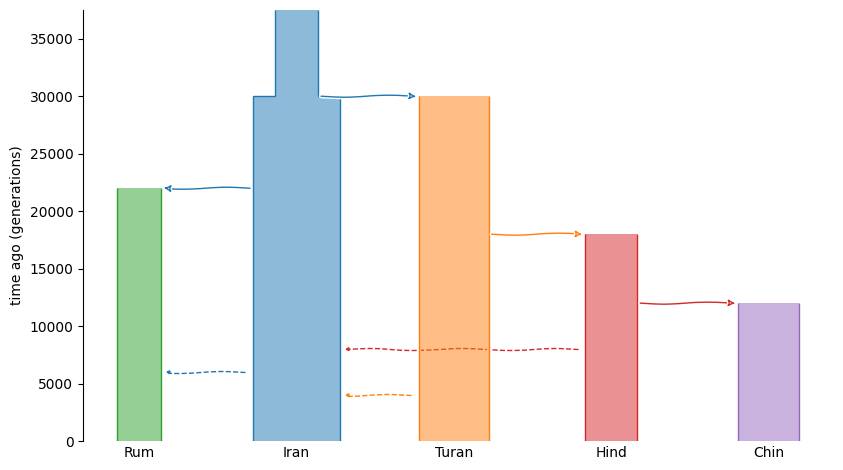
Populations: Iran, Turan, Rum, Hind, Chin
Five Shahnameh realms with pulse admixture events. Tests 5-pop graph inference.
SixPopExtRecolon_6F10
Six-population model with extinction and recolonization
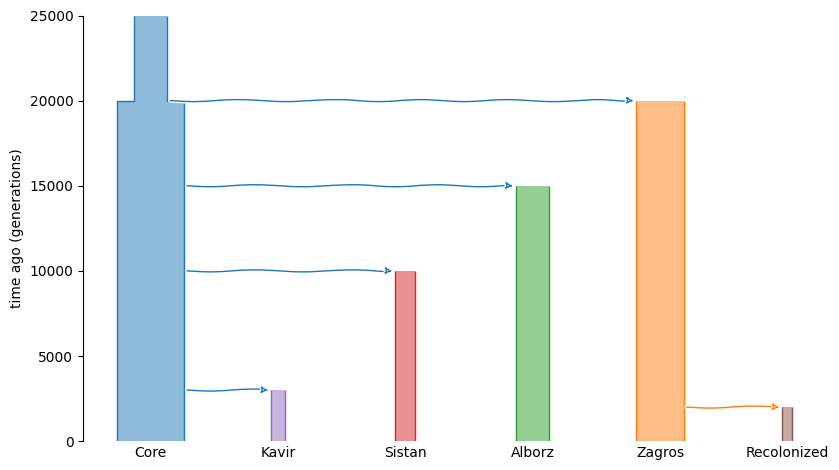
Populations: Core, Zagros, Alborz, Kavir, Sistan, Recolonized
Kavir goes extinct at 3000 gen, recolonized from Zagros at 2000 gen.
AsymReversal_2F10
Two-pop with migration direction reversal over time
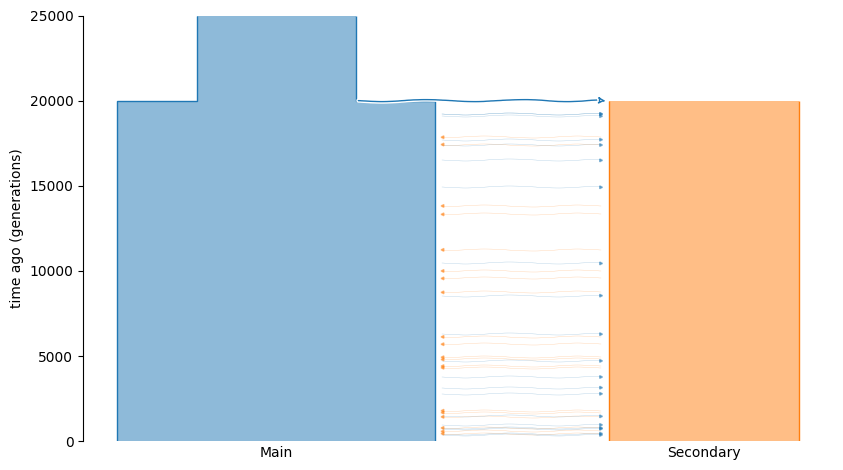
Populations: Main, Secondary
Migration reverses direction at 5000 gen ago. Tests temporal asymmetry.
SilkRoad_8F10
Eight-population Silk Road stepping-stone model
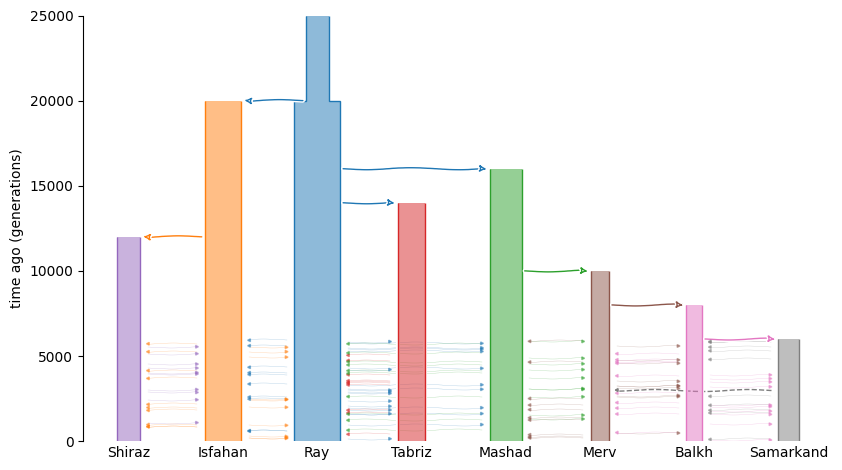
Populations: Ray, Isfahan, Shiraz, Tabriz, Mashad, Merv, Balkh, Samarkand
Eight cities along the Silk Road with stepping-stone migration and admixture.
Rudabeh (Rudabeh simurghica) — Princess of Kabul, descendant of Zahhak, married to Zal. Her lineage carries both Iranian and foreign ancestry.
Genome summary
- ID:
RudSim- Species:
Rudabeh simurghica
- Common name:
Rudabeh-lineage (Kabul princess dynasty)
- Assembly:
Kabul1.0(GCA_FERD_RudSim)- Ploidy:
2
- Generation time:
30 years
- Population size:
18,000
Chromosomes
Name |
Length (bp) |
Mutation rate |
Recombination rate |
|---|---|---|---|
1 |
20,000,000 |
2.20e-08 |
3.00e-08 |
2 |
18,000,000 |
2.20e-08 |
3.00e-08 |
3 |
16,000,000 |
2.20e-08 |
3.00e-08 |
4 |
14,000,000 |
2.20e-08 |
3.00e-08 |
5 |
12,000,000 |
2.20e-08 |
3.00e-08 |
kabul_mitogenome |
17,000 |
6.16e-08 |
0.00e+00 |
Demographic models
Constant_1F10
Single population constant-size model
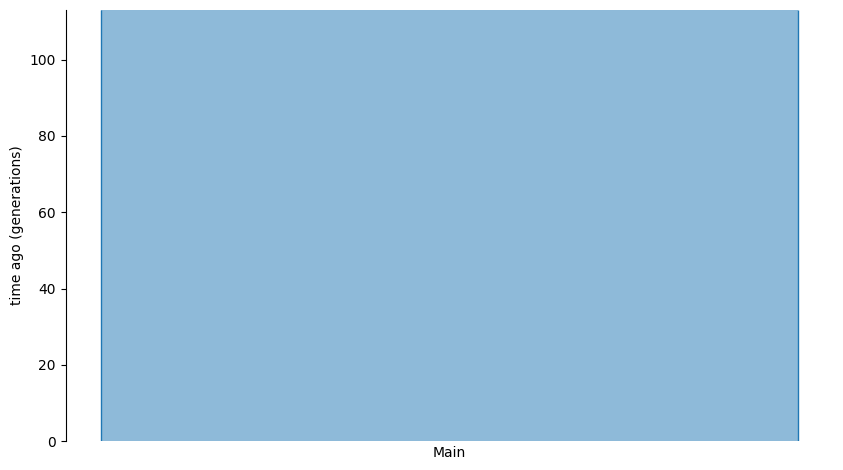
Populations: Main
Single population of Rudabeh-lineage (Kabul princess dynasty) at constant size N=18000.
ThreeEpoch_1F10
Single population three-epoch model with bottleneck
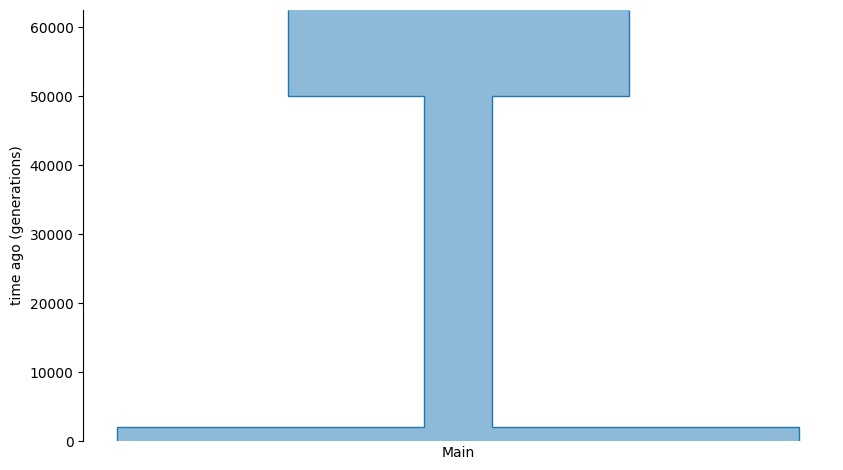
Populations: Main
Single pop of Rudabeh-lineage (Kabul princess dynasty). Modern N=18000, bottleneck 1800 at 2000 gen, ancestral 9000 at 50000 gen.
TwoPopSplit_2F10
Two population split with symmetric migration
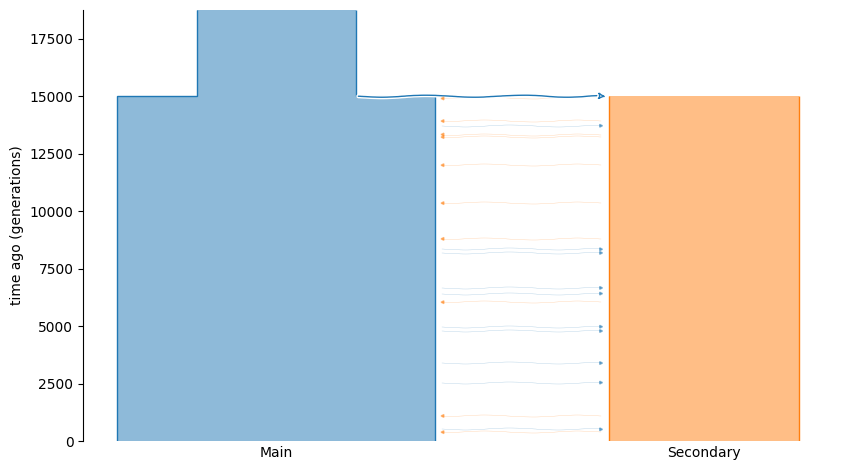
Populations: Main, Secondary
Two pops of Rudabeh-lineage (Kabul princess dynasty). Main N=18000, Secondary N=10800. Split 15000 gen ago.
GhostAdmixture_3F10
Two sampled pops + extinct ghost with pulse admixture
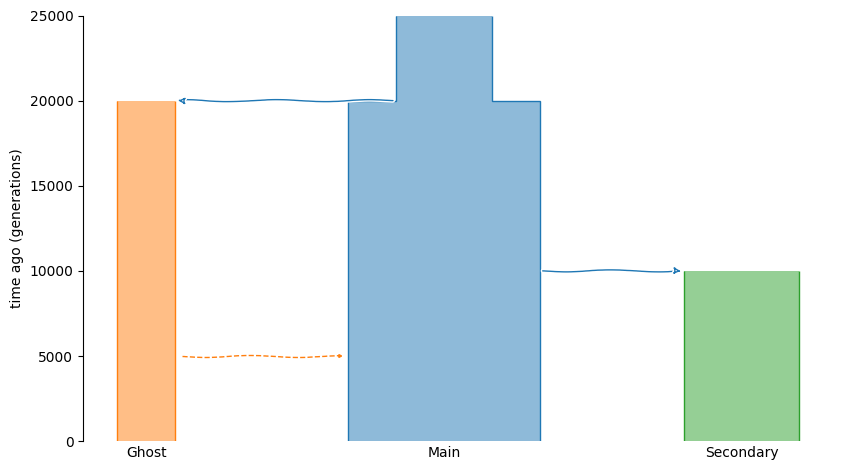
Populations: Main, Secondary, Ghost
Ghost contributes 15%% pulse admixture to Main at 5000 gen. Non-tree-like history.
ThreePopAdmix_3F10
Three populations with bidirectional pulse admixture
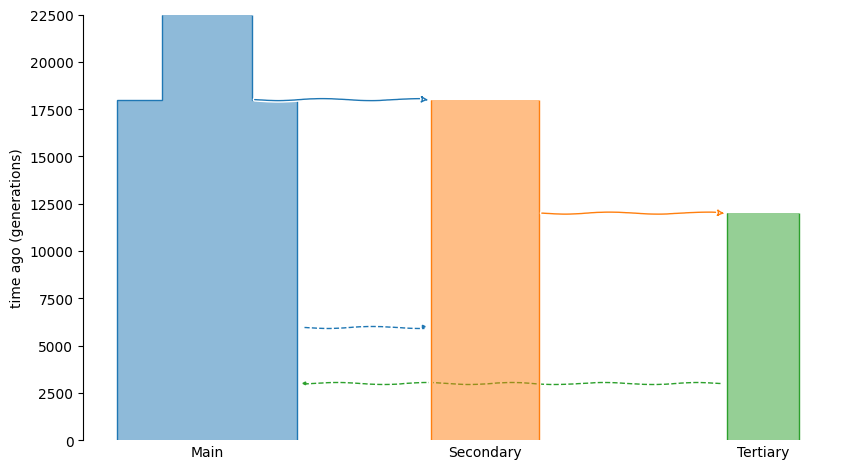
Populations: Main, Secondary, Tertiary
10%% Tertiary->Main at 3000 gen, 5%% Main->Secondary at 6000 gen. Admixture graph.
FourRegion_4F10
Four-population stepping-stone across Iranian plateau
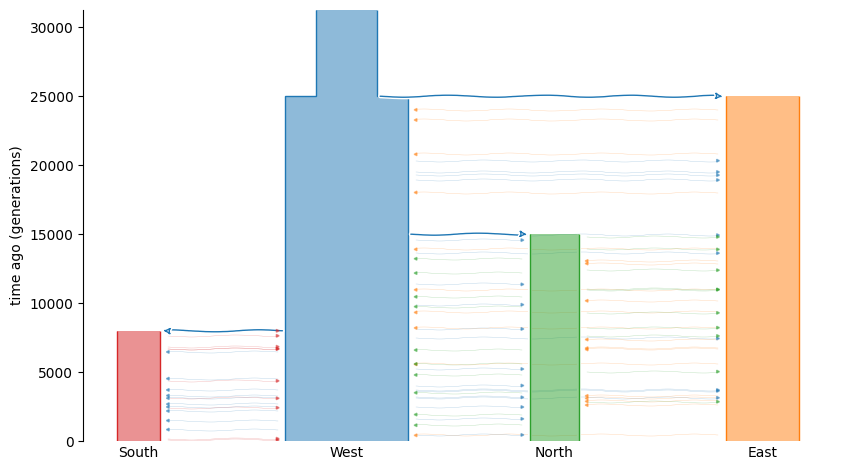
Populations: West, East, North, South
West, East, North, South populations with stepping-stone migration.
FiveRealm_5F10
Five-population admixture graph (Iran-Turan-Rum-Hind-Chin)
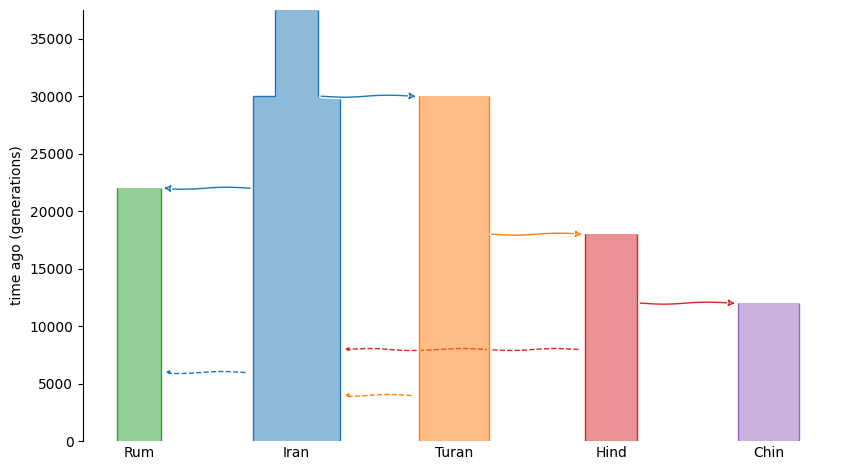
Populations: Iran, Turan, Rum, Hind, Chin
Five Shahnameh realms with pulse admixture events. Tests 5-pop graph inference.
SixPopExtRecolon_6F10
Six-population model with extinction and recolonization
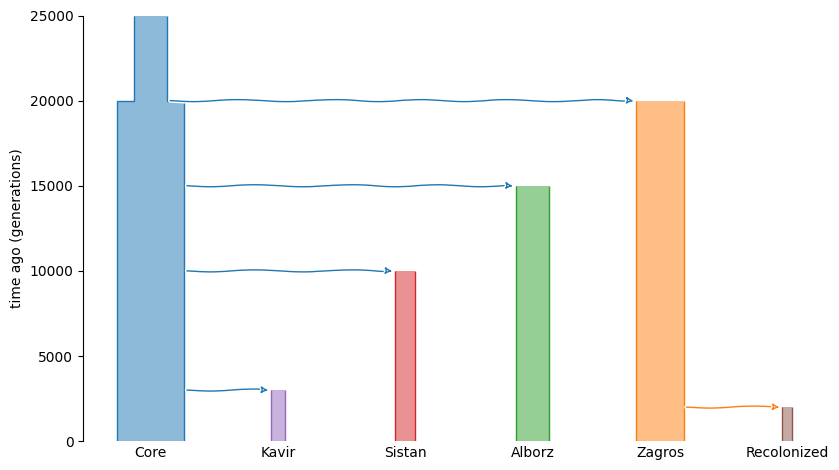
Populations: Core, Zagros, Alborz, Kavir, Sistan, Recolonized
Kavir goes extinct at 3000 gen, recolonized from Zagros at 2000 gen.
AsymReversal_2F10
Two-pop with migration direction reversal over time
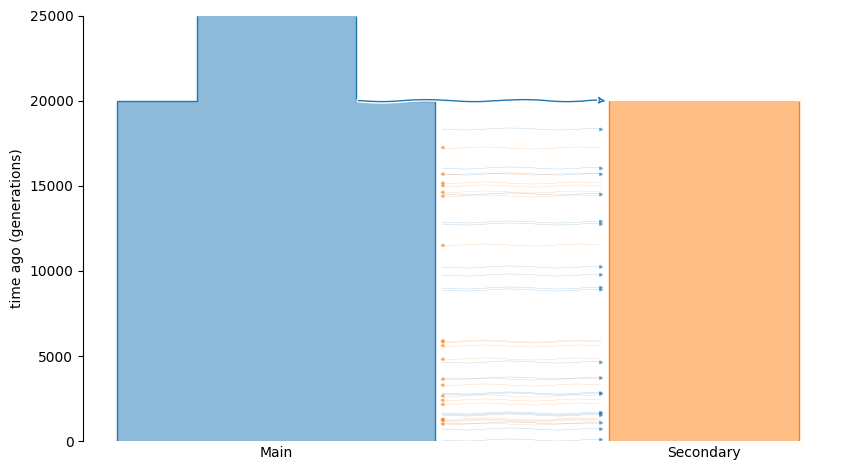
Populations: Main, Secondary
Migration reverses direction at 5000 gen ago. Tests temporal asymmetry.
SilkRoad_8F10
Eight-population Silk Road stepping-stone model
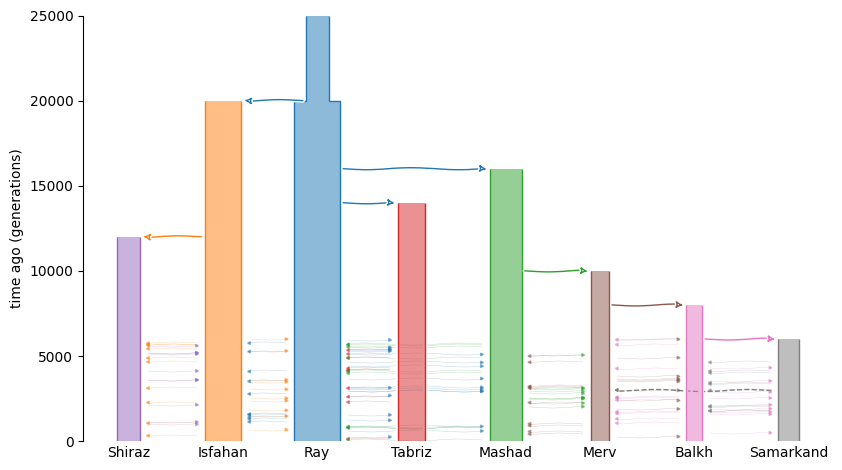
Populations: Ray, Isfahan, Shiraz, Tabriz, Mashad, Merv, Balkh, Samarkand
Eight cities along the Silk Road with stepping-stone migration and admixture.
Esfandiyar (Esfandiyar smithius) — The bronze-bodied warrior, invulnerable except for his eyes. Kayanian dynasty.
Genome summary
- ID:
EsfSmi- Species:
Esfandiyar smithius
- Common name:
Esfandiyar-kind (bronze-bodied warrior)
- Assembly:
Rouyin1.0(GCA_FERD_EsfSmi)- Ploidy:
2
- Generation time:
30 years
- Population size:
32,000
Chromosomes
Name |
Length (bp) |
Mutation rate |
Recombination rate |
|---|---|---|---|
1 |
20,000,000 |
2.00e-08 |
2.50e-08 |
2 |
18,000,000 |
2.00e-08 |
2.50e-08 |
3 |
16,000,000 |
2.00e-08 |
2.50e-08 |
4 |
14,000,000 |
2.00e-08 |
2.50e-08 |
5 |
12,000,000 |
2.00e-08 |
2.50e-08 |
rouyin_mitogenome |
17,000 |
5.60e-08 |
0.00e+00 |
Demographic models
Constant_1F10
Single population constant-size model
Populations: Main
Single population of Esfandiyar-kind (bronze-bodied warrior) at constant size N=32000.
ThreeEpoch_1F10
Single population three-epoch model with bottleneck
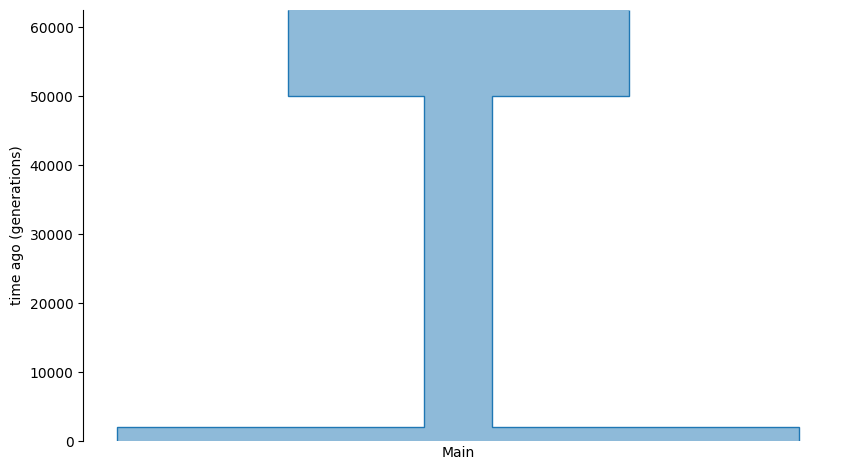
Populations: Main
Single pop of Esfandiyar-kind (bronze-bodied warrior). Modern N=32000, bottleneck 3200 at 2000 gen, ancestral 16000 at 50000 gen.
TwoPopSplit_2F10
Two population split with symmetric migration
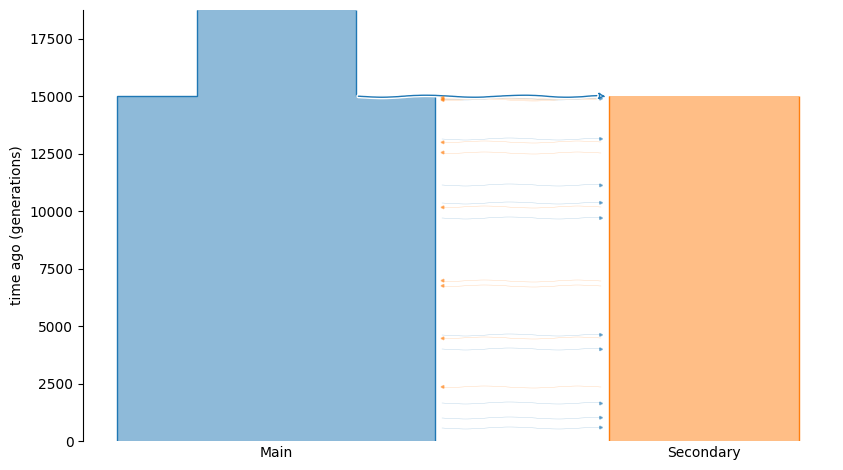
Populations: Main, Secondary
Two pops of Esfandiyar-kind (bronze-bodied warrior). Main N=32000, Secondary N=19200. Split 15000 gen ago.
GhostAdmixture_3F10
Two sampled pops + extinct ghost with pulse admixture
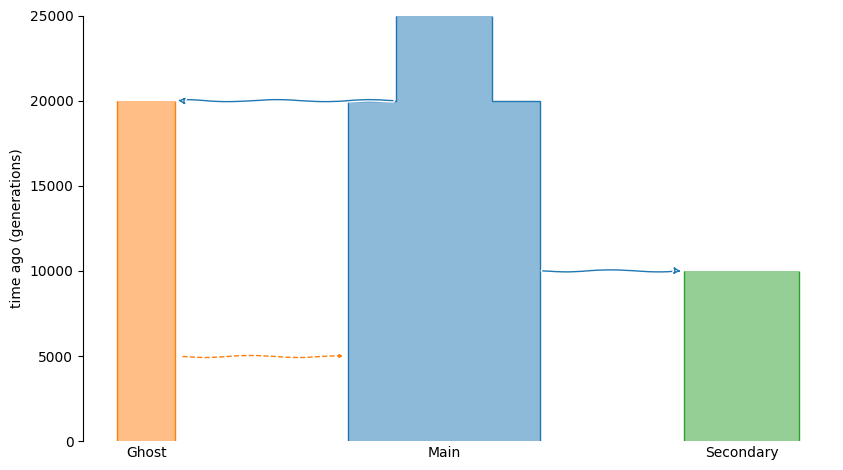
Populations: Main, Secondary, Ghost
Ghost contributes 15%% pulse admixture to Main at 5000 gen. Non-tree-like history.
ThreePopAdmix_3F10
Three populations with bidirectional pulse admixture
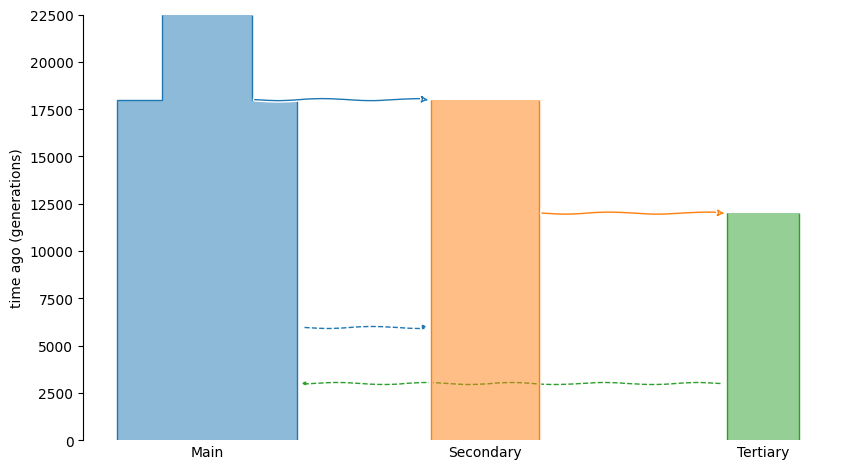
Populations: Main, Secondary, Tertiary
10%% Tertiary->Main at 3000 gen, 5%% Main->Secondary at 6000 gen. Admixture graph.
FourRegion_4F10
Four-population stepping-stone across Iranian plateau
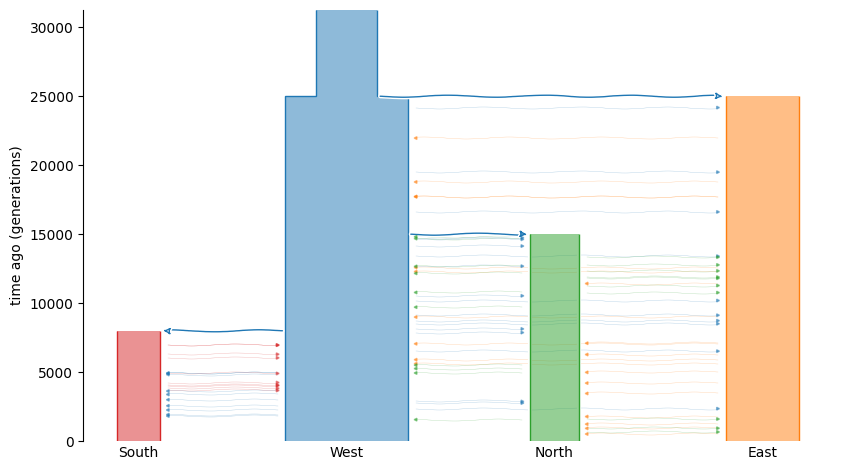
Populations: West, East, North, South
West, East, North, South populations with stepping-stone migration.
FiveRealm_5F10
Five-population admixture graph (Iran-Turan-Rum-Hind-Chin)
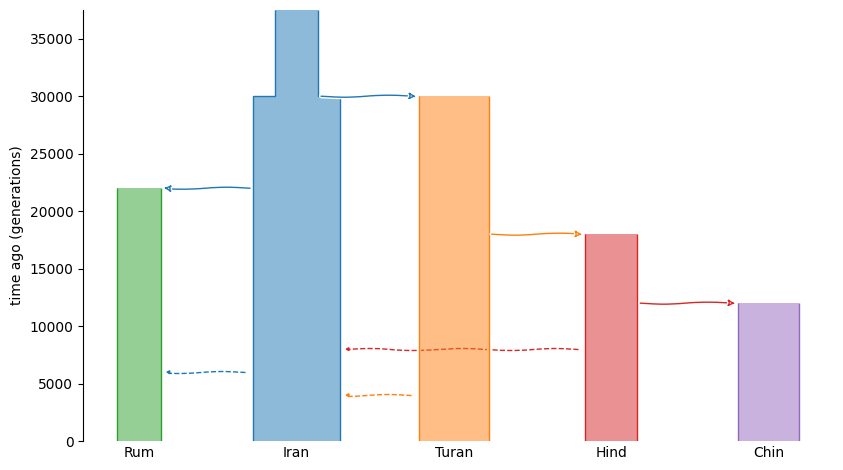
Populations: Iran, Turan, Rum, Hind, Chin
Five Shahnameh realms with pulse admixture events. Tests 5-pop graph inference.
SixPopExtRecolon_6F10
Six-population model with extinction and recolonization
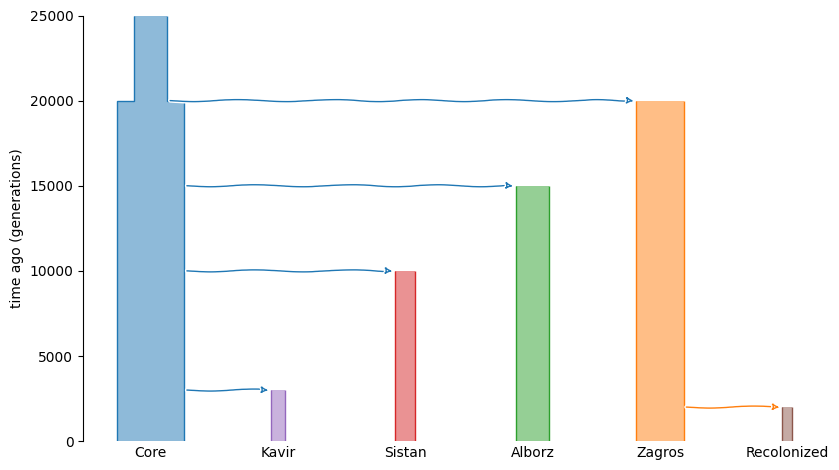
Populations: Core, Zagros, Alborz, Kavir, Sistan, Recolonized
Kavir goes extinct at 3000 gen, recolonized from Zagros at 2000 gen.
AsymReversal_2F10
Two-pop with migration direction reversal over time
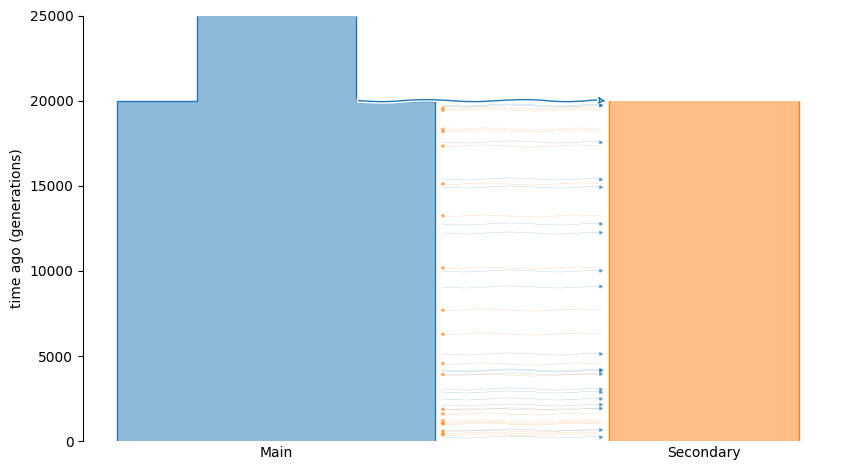
Populations: Main, Secondary
Migration reverses direction at 5000 gen ago. Tests temporal asymmetry.
SilkRoad_8F10
Eight-population Silk Road stepping-stone model
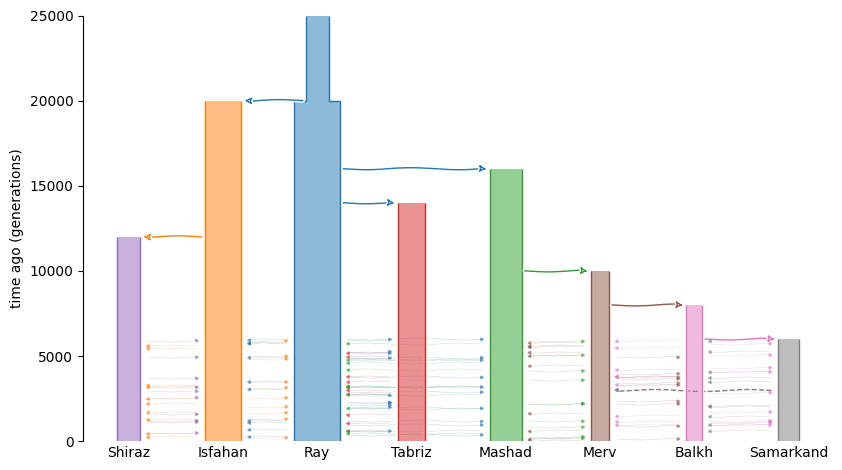
Populations: Ray, Isfahan, Shiraz, Tabriz, Mashad, Merv, Balkh, Samarkand
Eight cities along the Silk Road with stepping-stone migration and admixture.
Jamshid (Jamshid pishdadius) — King of the Pishdadian dynasty, the golden age of Iran. Eventually overthrown by Zahhak.
Genome summary
- ID:
JamPis- Species:
Jamshid pishdadius
- Common name:
Jamshid-kind (Pishdadian golden age)
- Assembly:
Persepolis1.0(GCA_FERD_JamPis)- Ploidy:
2
- Generation time:
100 years
- Population size:
60,000
Chromosomes
Name |
Length (bp) |
Mutation rate |
Recombination rate |
|---|---|---|---|
1 |
20,000,000 |
1.50e-08 |
5.00e-08 |
2 |
18,000,000 |
1.50e-08 |
5.00e-08 |
3 |
16,000,000 |
1.50e-08 |
5.00e-08 |
4 |
14,000,000 |
1.50e-08 |
5.00e-08 |
5 |
12,000,000 |
1.50e-08 |
5.00e-08 |
persepolis_mitogenome |
17,000 |
4.20e-08 |
0.00e+00 |
Demographic models
Constant_1F10
Single population constant-size model
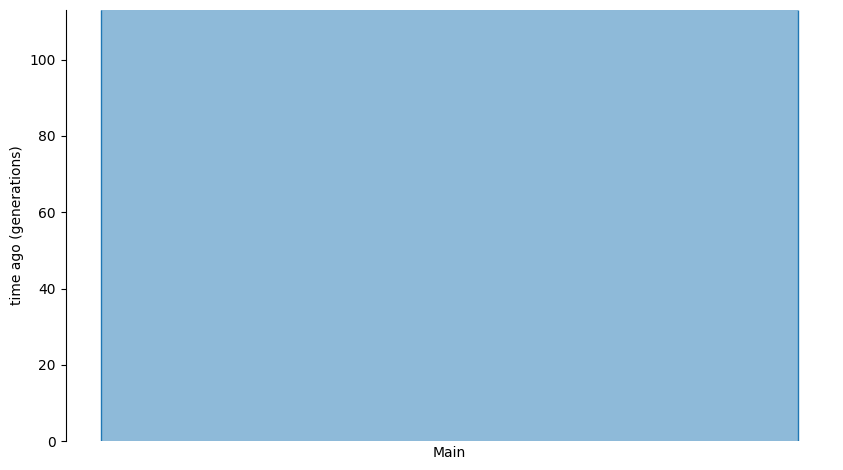
Populations: Main
Single population of Jamshid-kind (Pishdadian golden age) at constant size N=60000.
ThreeEpoch_1F10
Single population three-epoch model with bottleneck
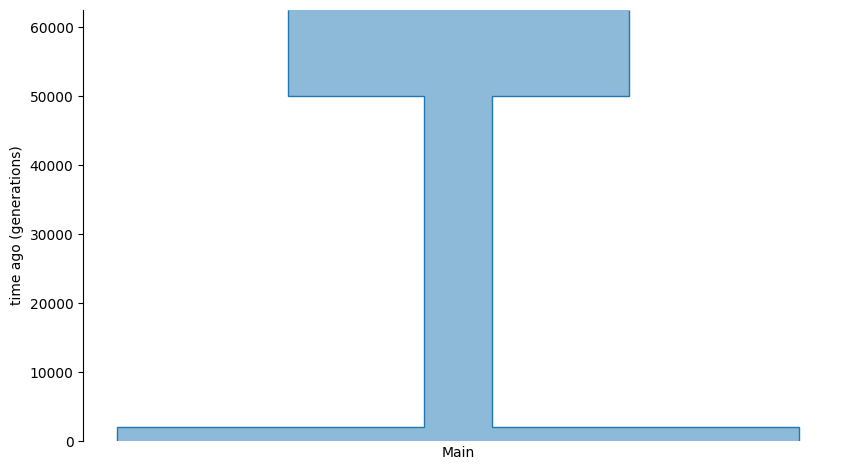
Populations: Main
Single pop of Jamshid-kind (Pishdadian golden age). Modern N=60000, bottleneck 6000 at 2000 gen, ancestral 30000 at 50000 gen.
TwoPopSplit_2F10
Two population split with symmetric migration
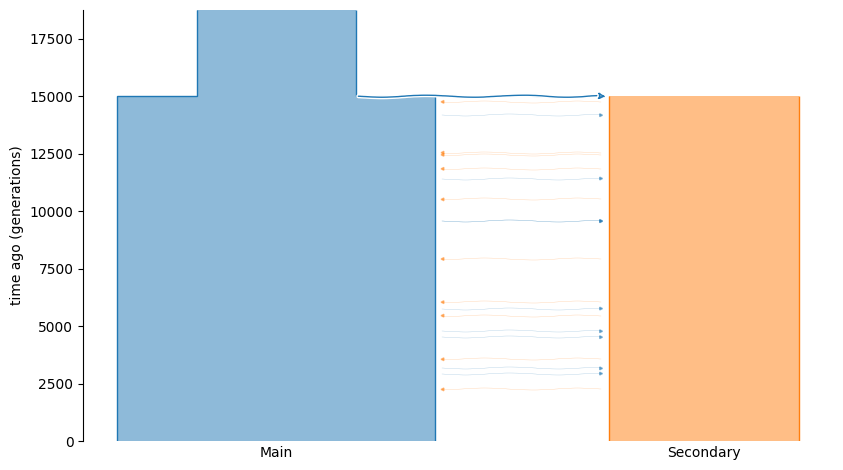
Populations: Main, Secondary
Two pops of Jamshid-kind (Pishdadian golden age). Main N=60000, Secondary N=36000. Split 15000 gen ago.
GhostAdmixture_3F10
Two sampled pops + extinct ghost with pulse admixture
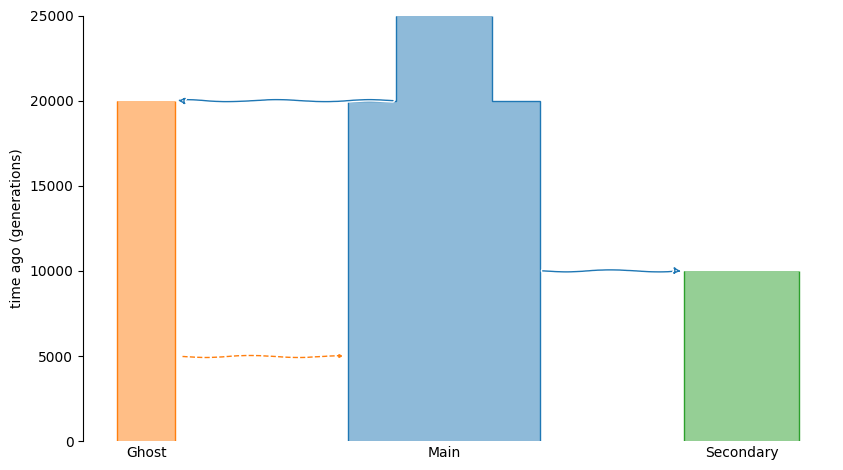
Populations: Main, Secondary, Ghost
Ghost contributes 15%% pulse admixture to Main at 5000 gen. Non-tree-like history.
ThreePopAdmix_3F10
Three populations with bidirectional pulse admixture
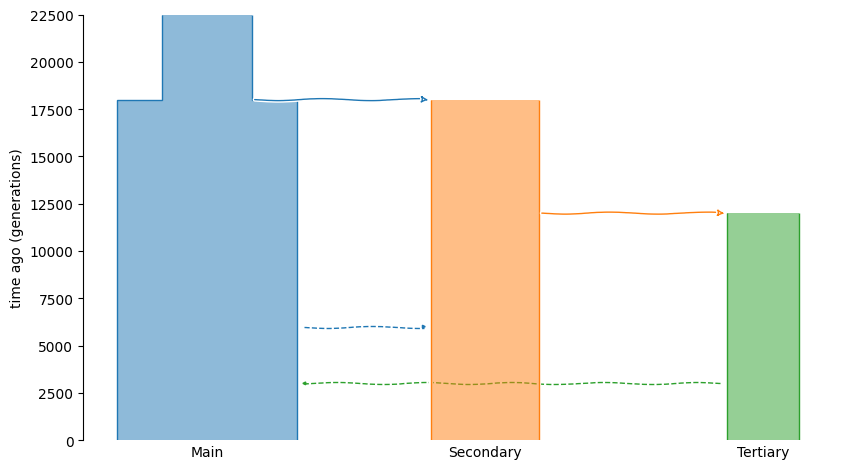
Populations: Main, Secondary, Tertiary
10%% Tertiary->Main at 3000 gen, 5%% Main->Secondary at 6000 gen. Admixture graph.
FourRegion_4F10
Four-population stepping-stone across Iranian plateau
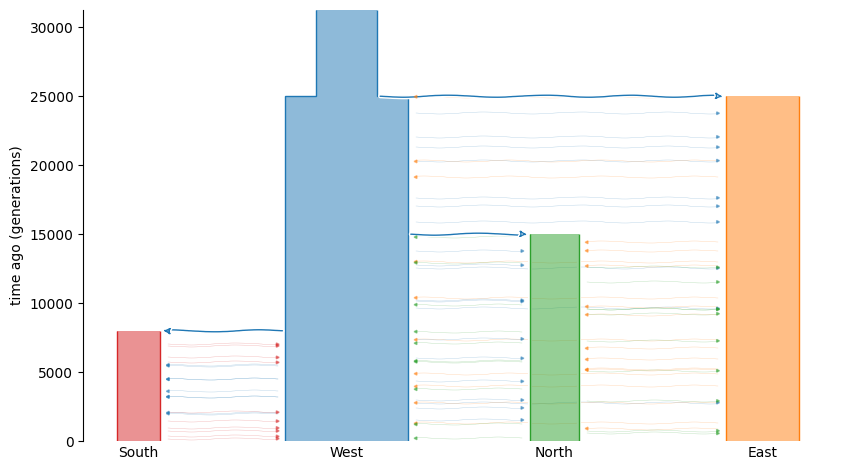
Populations: West, East, North, South
West, East, North, South populations with stepping-stone migration.
FiveRealm_5F10
Five-population admixture graph (Iran-Turan-Rum-Hind-Chin)
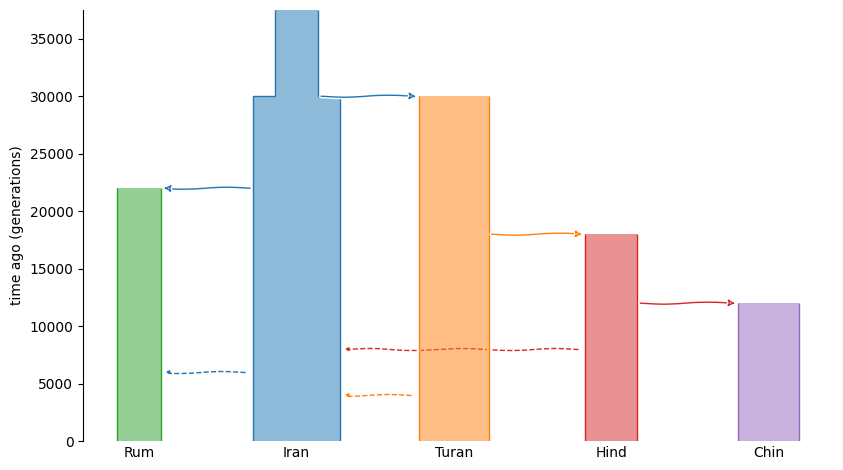
Populations: Iran, Turan, Rum, Hind, Chin
Five Shahnameh realms with pulse admixture events. Tests 5-pop graph inference.
SixPopExtRecolon_6F10
Six-population model with extinction and recolonization
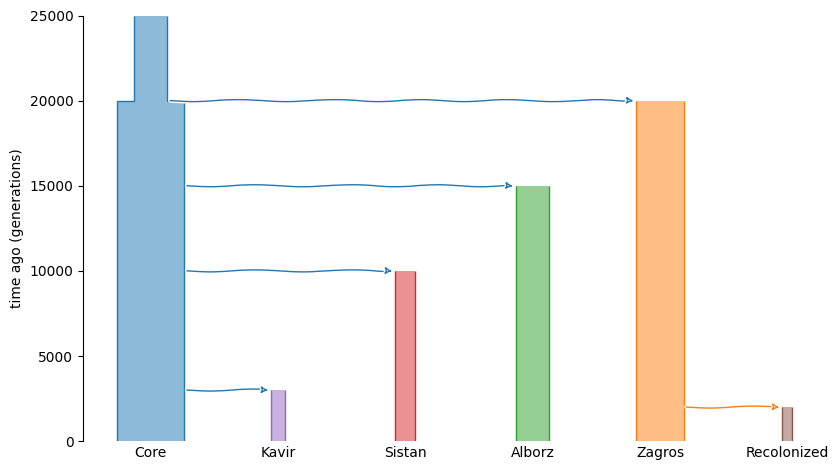
Populations: Core, Zagros, Alborz, Kavir, Sistan, Recolonized
Kavir goes extinct at 3000 gen, recolonized from Zagros at 2000 gen.
AsymReversal_2F10
Two-pop with migration direction reversal over time
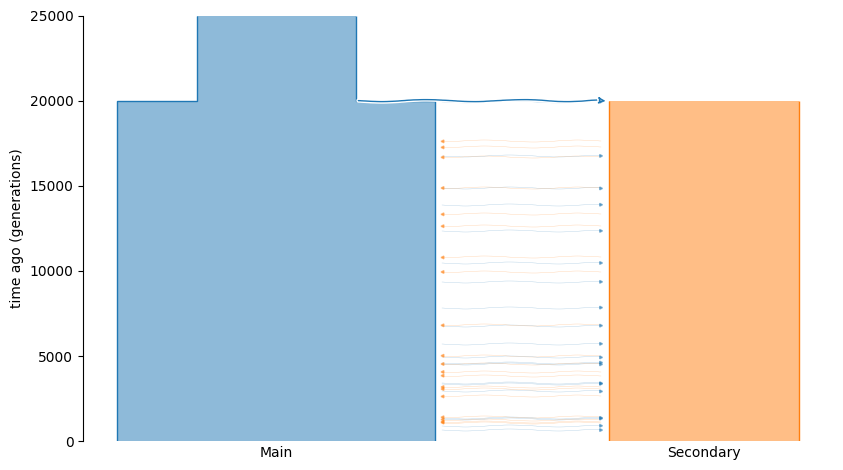
Populations: Main, Secondary
Migration reverses direction at 5000 gen ago. Tests temporal asymmetry.
SilkRoad_8F10
Eight-population Silk Road stepping-stone model
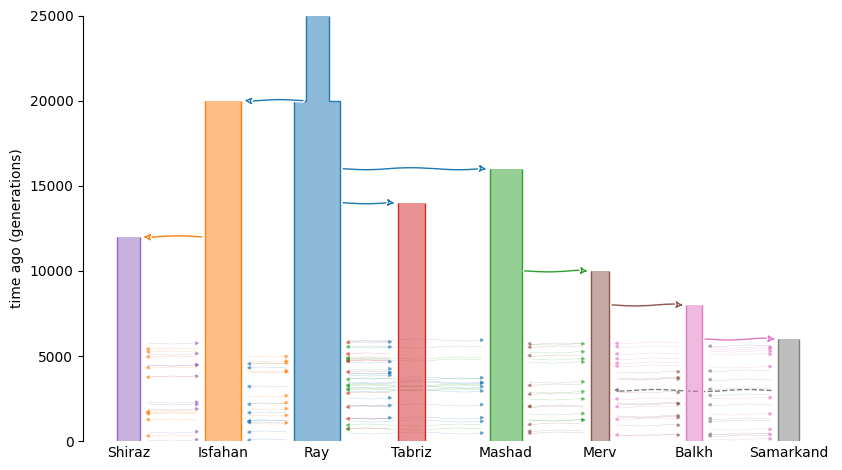
Populations: Ray, Isfahan, Shiraz, Tabriz, Mashad, Merv, Balkh, Samarkand
Eight cities along the Silk Road with stepping-stone migration and admixture.
Kayanian (Kayanian dynasticus) — The Kayanian dynasty of heroes (Kay Kavus, Kay Khosrow). The heroic age of the Shahnameh.
Genome summary
- ID:
KayDyn- Species:
Kayanian dynasticus
- Common name:
Kayanian (heroic dynasty)
- Assembly:
Kayanian1.0(GCA_FERD_KayDyn)- Ploidy:
2
- Generation time:
30 years
- Population size:
45,000
Chromosomes
Name |
Length (bp) |
Mutation rate |
Recombination rate |
|---|---|---|---|
1 |
20,000,000 |
2.00e-08 |
3.00e-08 |
2 |
18,000,000 |
2.00e-08 |
3.00e-08 |
3 |
16,000,000 |
2.00e-08 |
3.00e-08 |
4 |
14,000,000 |
2.00e-08 |
3.00e-08 |
5 |
12,000,000 |
2.00e-08 |
3.00e-08 |
kayani_mitogenome |
17,000 |
5.60e-08 |
0.00e+00 |
Demographic models
Constant_1F10
Single population constant-size model
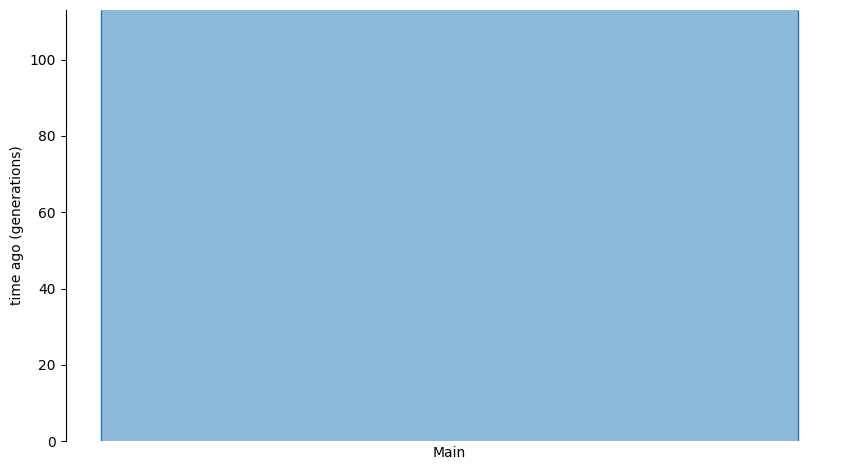
Populations: Main
Single population of Kayanian (heroic dynasty) at constant size N=45000.
ThreeEpoch_1F10
Single population three-epoch model with bottleneck
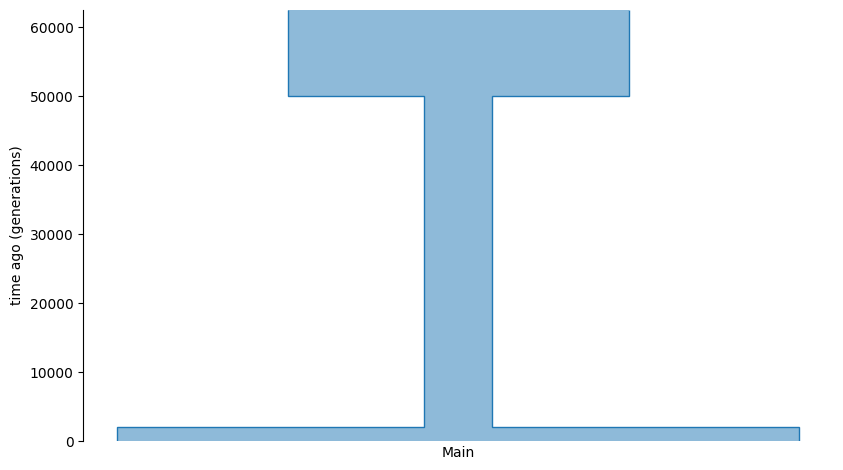
Populations: Main
Single pop of Kayanian (heroic dynasty). Modern N=45000, bottleneck 4500 at 2000 gen, ancestral 22500 at 50000 gen.
TwoPopSplit_2F10
Two population split with symmetric migration
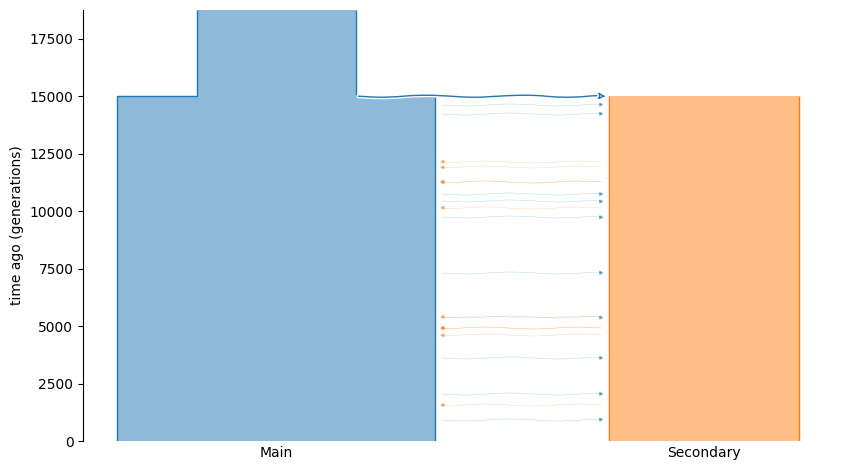
Populations: Main, Secondary
Two pops of Kayanian (heroic dynasty). Main N=45000, Secondary N=27000. Split 15000 gen ago.
GhostAdmixture_3F10
Two sampled pops + extinct ghost with pulse admixture
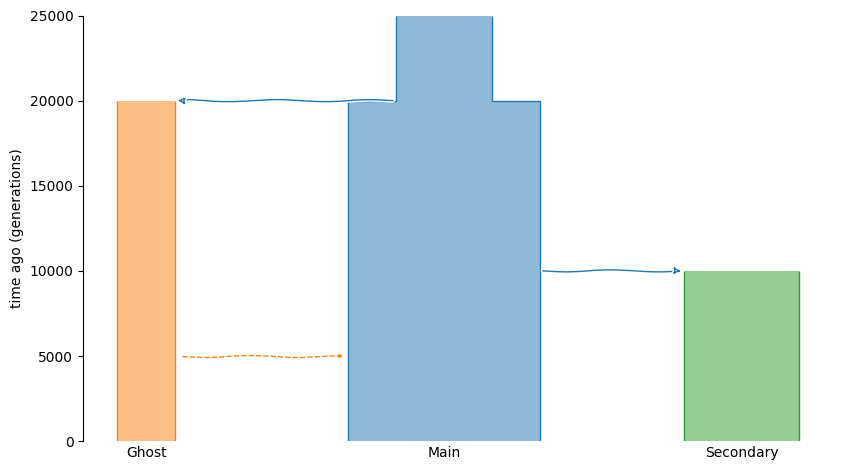
Populations: Main, Secondary, Ghost
Ghost contributes 15%% pulse admixture to Main at 5000 gen. Non-tree-like history.
ThreePopAdmix_3F10
Three populations with bidirectional pulse admixture
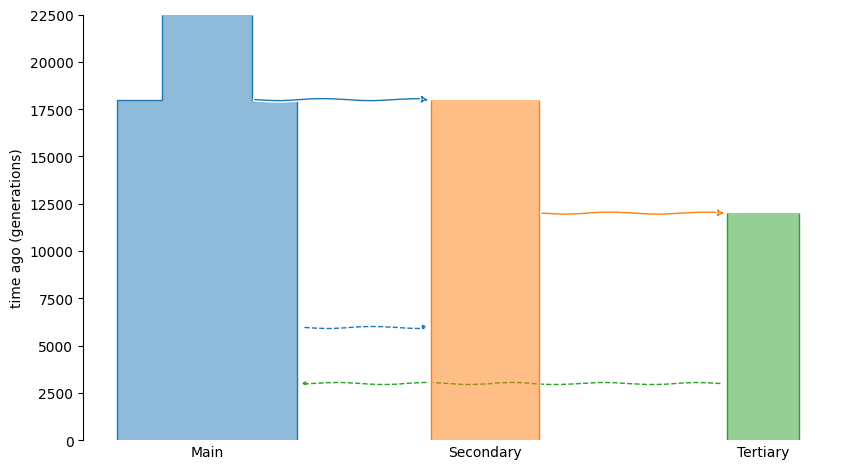
Populations: Main, Secondary, Tertiary
10%% Tertiary->Main at 3000 gen, 5%% Main->Secondary at 6000 gen. Admixture graph.
FourRegion_4F10
Four-population stepping-stone across Iranian plateau
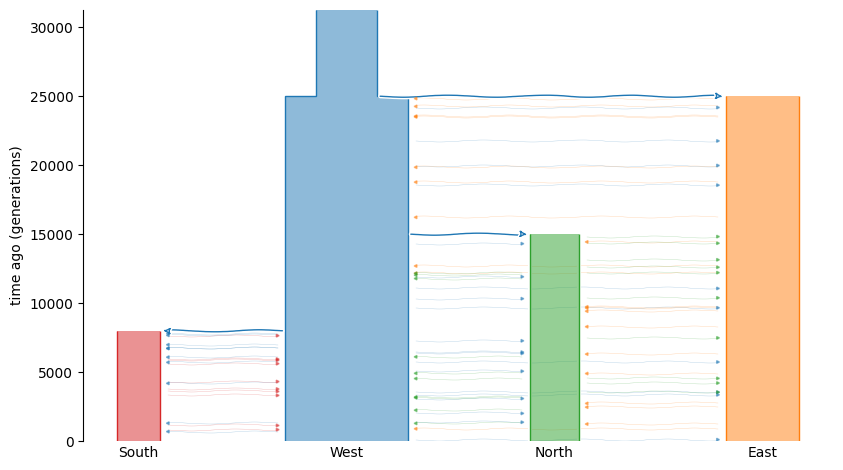
Populations: West, East, North, South
West, East, North, South populations with stepping-stone migration.
FiveRealm_5F10
Five-population admixture graph (Iran-Turan-Rum-Hind-Chin)
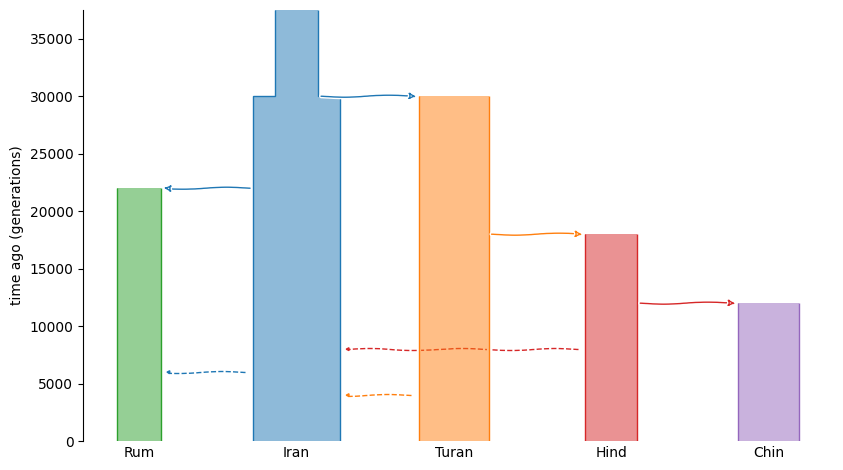
Populations: Iran, Turan, Rum, Hind, Chin
Five Shahnameh realms with pulse admixture events. Tests 5-pop graph inference.
SixPopExtRecolon_6F10
Six-population model with extinction and recolonization
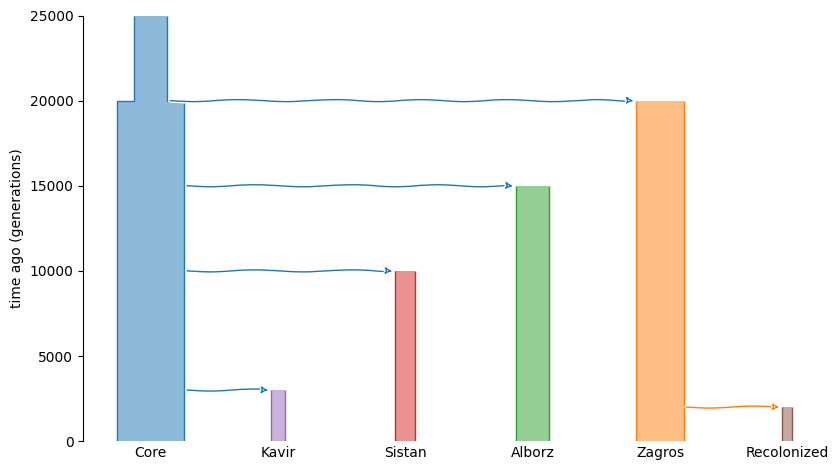
Populations: Core, Zagros, Alborz, Kavir, Sistan, Recolonized
Kavir goes extinct at 3000 gen, recolonized from Zagros at 2000 gen.
AsymReversal_2F10
Two-pop with migration direction reversal over time
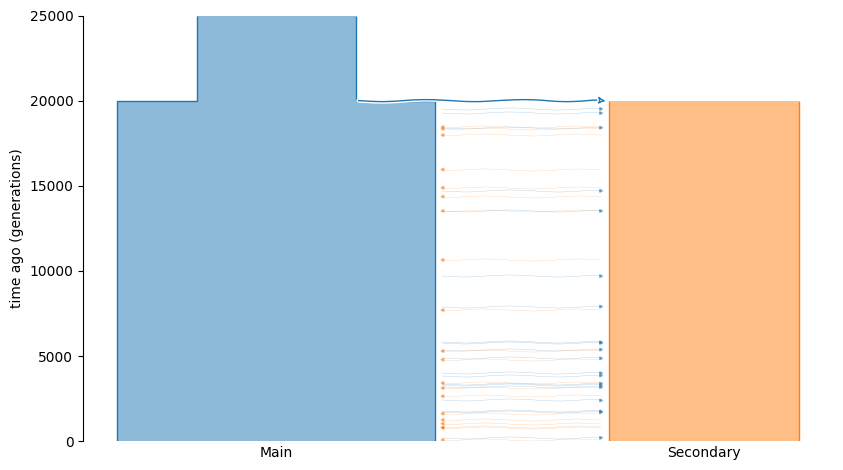
Populations: Main, Secondary
Migration reverses direction at 5000 gen ago. Tests temporal asymmetry.
SilkRoad_8F10
Eight-population Silk Road stepping-stone model
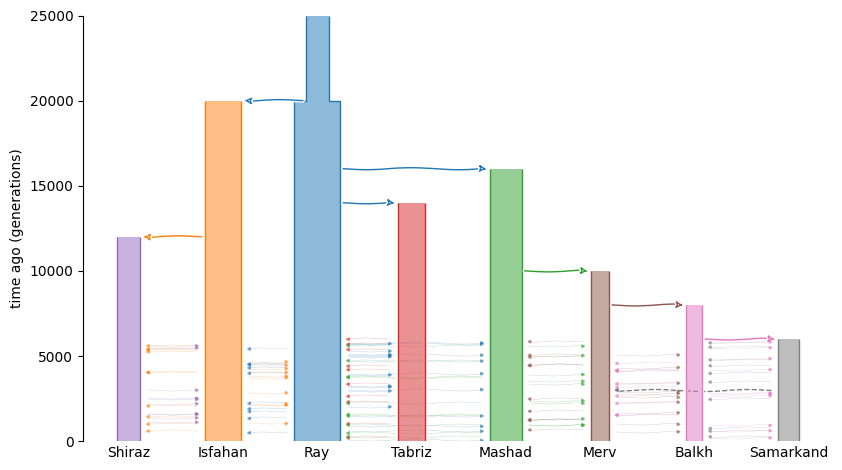
Populations: Ray, Isfahan, Shiraz, Tabriz, Mashad, Merv, Balkh, Samarkand
Eight cities along the Silk Road with stepping-stone migration and admixture.
Bahram (Bahram firesteed) — Associated with fire and victory. Bahram V (Bahram Gur) is the hunter-king of legend.
Genome summary
- ID:
BahFir- Species:
Bahram firesteed
- Common name:
Bahram-kind (fire-associated)
- Assembly:
Bahram1.0(GCA_FERD_BahFir)- Ploidy:
2
- Generation time:
30 years
- Population size:
35,000
Chromosomes
Name |
Length (bp) |
Mutation rate |
Recombination rate |
|---|---|---|---|
1 |
20,000,000 |
2.80e-08 |
3.20e-08 |
2 |
18,000,000 |
2.80e-08 |
3.20e-08 |
3 |
16,000,000 |
2.80e-08 |
3.20e-08 |
4 |
14,000,000 |
2.80e-08 |
3.20e-08 |
5 |
12,000,000 |
2.80e-08 |
3.20e-08 |
bahram_mitogenome |
17,000 |
7.84e-08 |
0.00e+00 |
Demographic models
Constant_1F10
Single population constant-size model
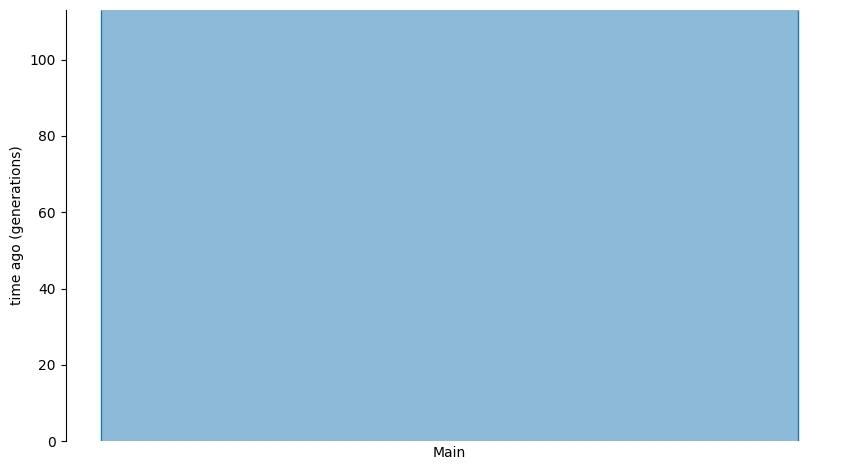
Populations: Main
Single population of Bahram-kind (fire-associated) at constant size N=35000.
ThreeEpoch_1F10
Single population three-epoch model with bottleneck
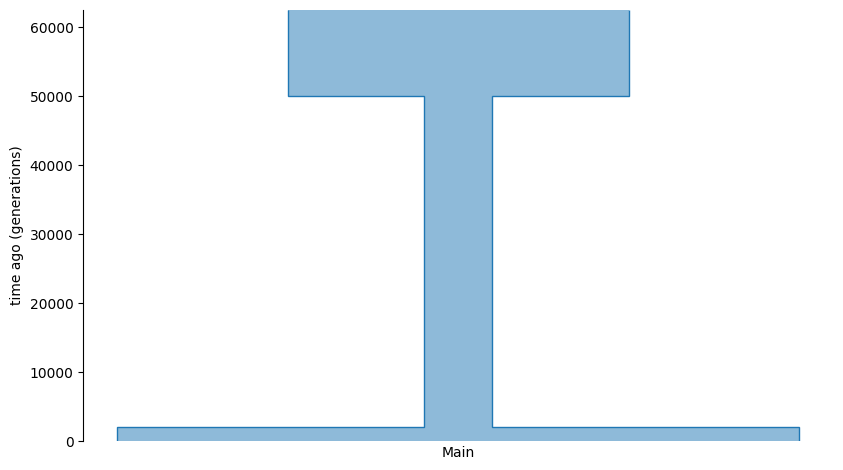
Populations: Main
Single pop of Bahram-kind (fire-associated). Modern N=35000, bottleneck 3500 at 2000 gen, ancestral 17500 at 50000 gen.
TwoPopSplit_2F10
Two population split with symmetric migration
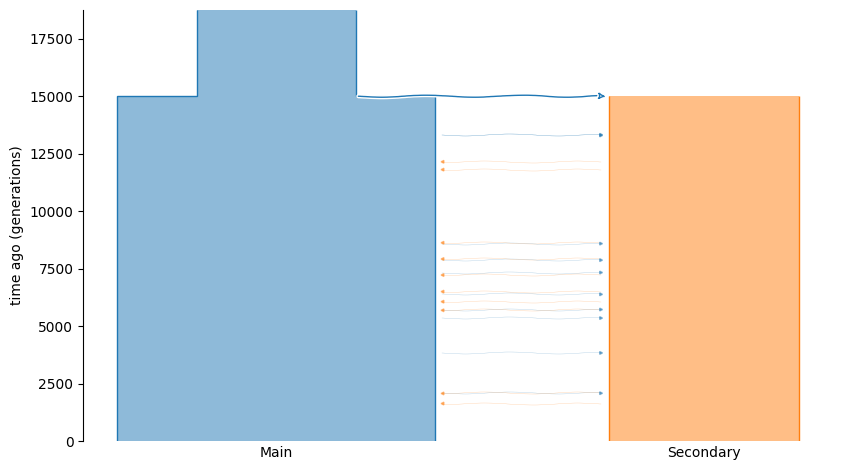
Populations: Main, Secondary
Two pops of Bahram-kind (fire-associated). Main N=35000, Secondary N=21000. Split 15000 gen ago.
GhostAdmixture_3F10
Two sampled pops + extinct ghost with pulse admixture
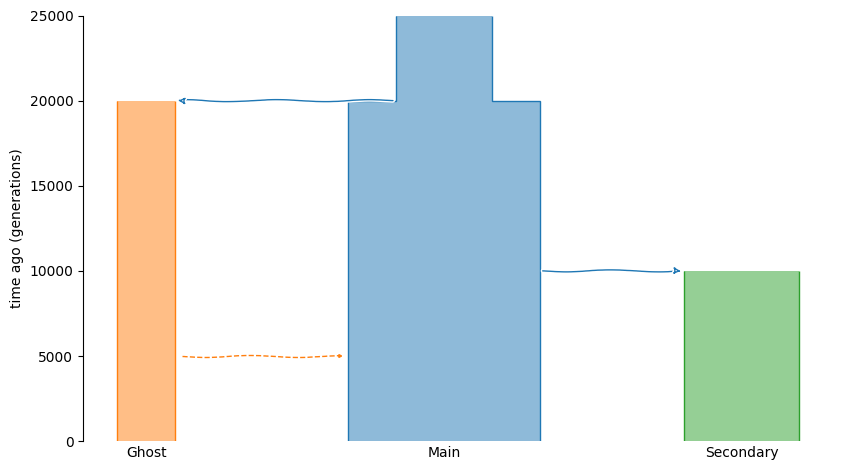
Populations: Main, Secondary, Ghost
Ghost contributes 15%% pulse admixture to Main at 5000 gen. Non-tree-like history.
ThreePopAdmix_3F10
Three populations with bidirectional pulse admixture
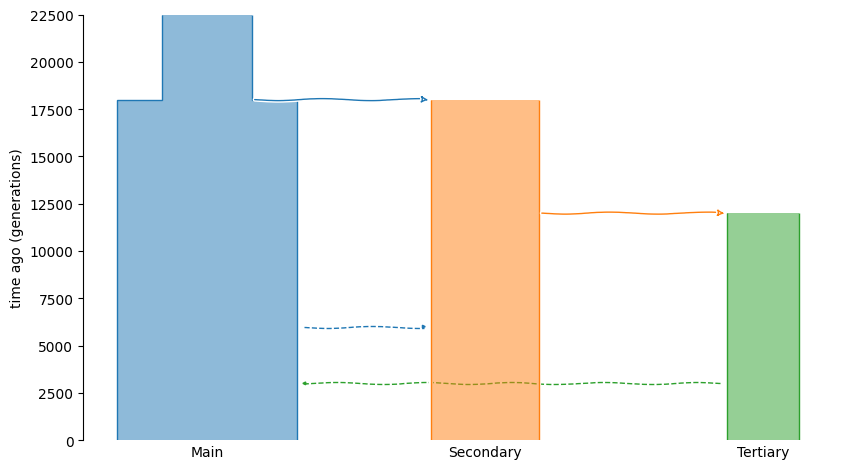
Populations: Main, Secondary, Tertiary
10%% Tertiary->Main at 3000 gen, 5%% Main->Secondary at 6000 gen. Admixture graph.
FourRegion_4F10
Four-population stepping-stone across Iranian plateau
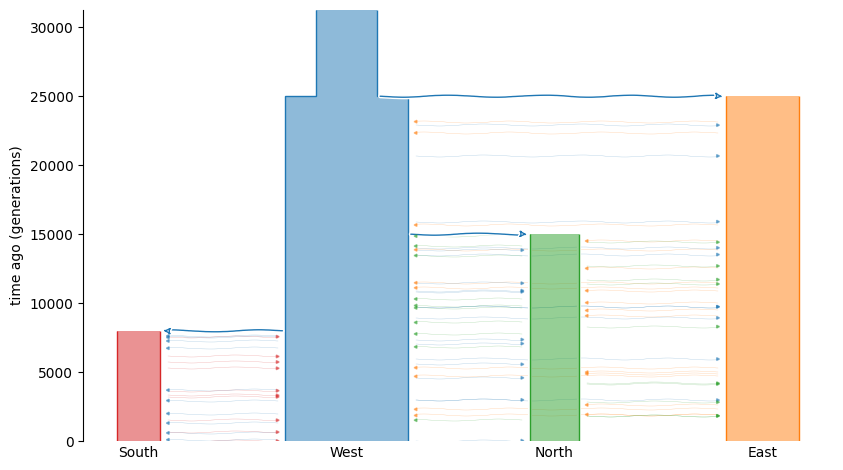
Populations: West, East, North, South
West, East, North, South populations with stepping-stone migration.
FiveRealm_5F10
Five-population admixture graph (Iran-Turan-Rum-Hind-Chin)
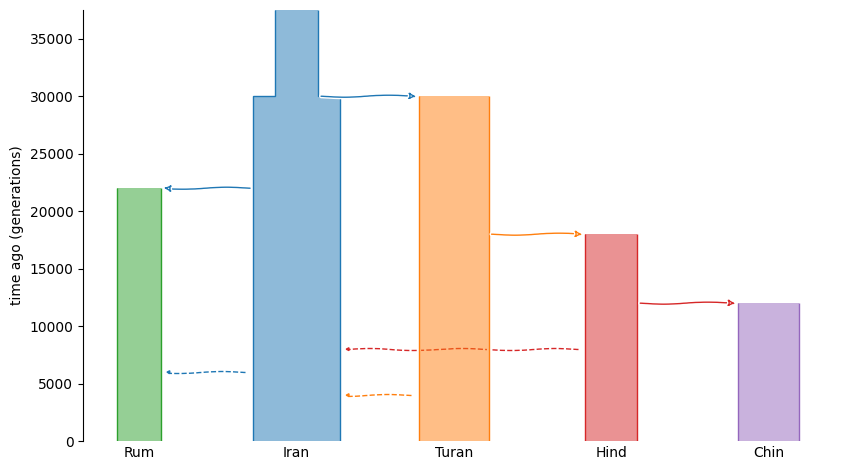
Populations: Iran, Turan, Rum, Hind, Chin
Five Shahnameh realms with pulse admixture events. Tests 5-pop graph inference.
SixPopExtRecolon_6F10
Six-population model with extinction and recolonization
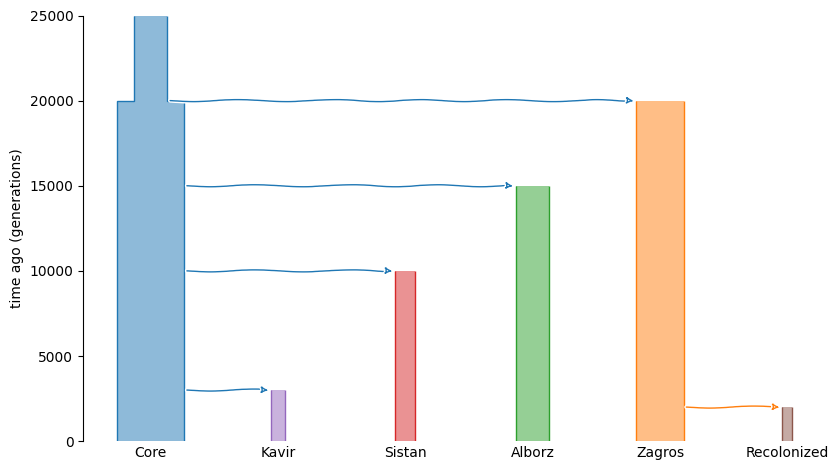
Populations: Core, Zagros, Alborz, Kavir, Sistan, Recolonized
Kavir goes extinct at 3000 gen, recolonized from Zagros at 2000 gen.
AsymReversal_2F10
Two-pop with migration direction reversal over time
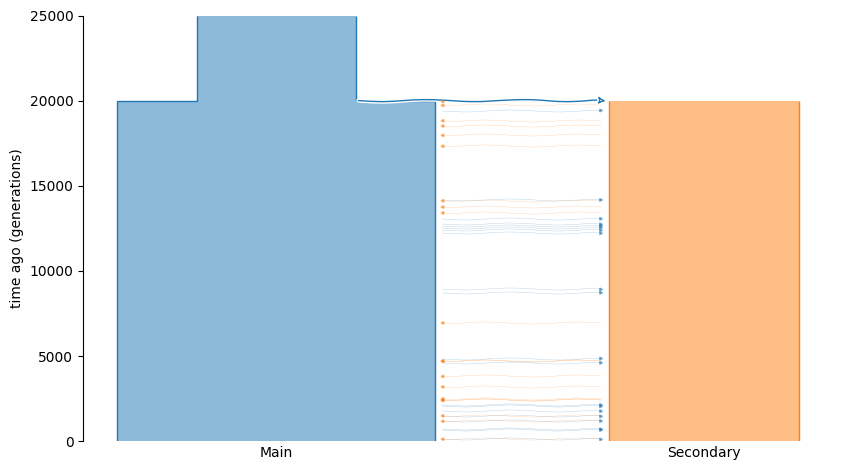
Populations: Main, Secondary
Migration reverses direction at 5000 gen ago. Tests temporal asymmetry.
SilkRoad_8F10
Eight-population Silk Road stepping-stone model
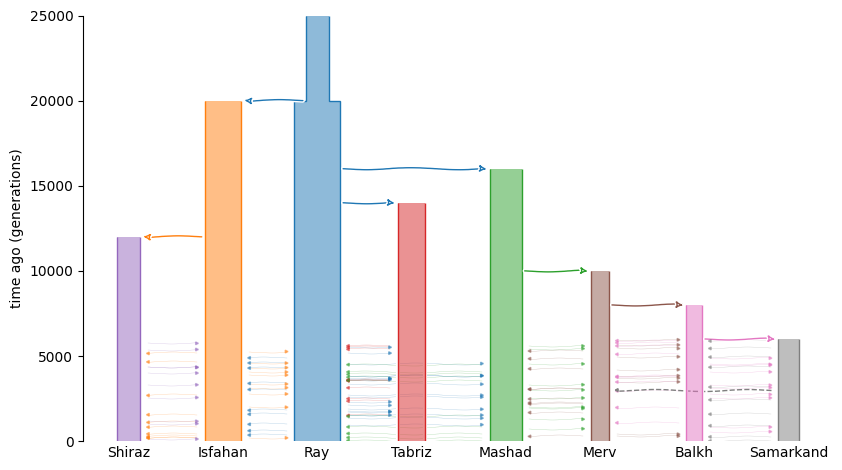
Populations: Ray, Isfahan, Shiraz, Tabriz, Mashad, Merv, Balkh, Samarkand
Eight cities along the Silk Road with stepping-stone migration and admixture.
Pahlavan (Pahlavan divanus) — Hero-monster hybrid lineages. Some pahlavans (champions) carry Div blood through ancient admixture.
Genome summary
- ID:
PahDiv- Species:
Pahlavan divanus
- Common name:
Pahlavan (hero-monster hybrid lineage)
- Assembly:
Pahlavan1.0(GCA_FERD_PahDiv)- Ploidy:
2
- Generation time:
35 years
- Population size:
28,000
Chromosomes
Name |
Length (bp) |
Mutation rate |
Recombination rate |
|---|---|---|---|
1 |
20,000,000 |
2.20e-08 |
3.00e-08 |
2 |
18,000,000 |
2.20e-08 |
3.00e-08 |
3 |
16,000,000 |
2.20e-08 |
3.00e-08 |
4 |
14,000,000 |
2.20e-08 |
3.00e-08 |
5 |
12,000,000 |
2.20e-08 |
3.00e-08 |
pahlavan_mitogenome |
17,000 |
6.16e-08 |
0.00e+00 |
Demographic models
Constant_1F10
Single population constant-size model
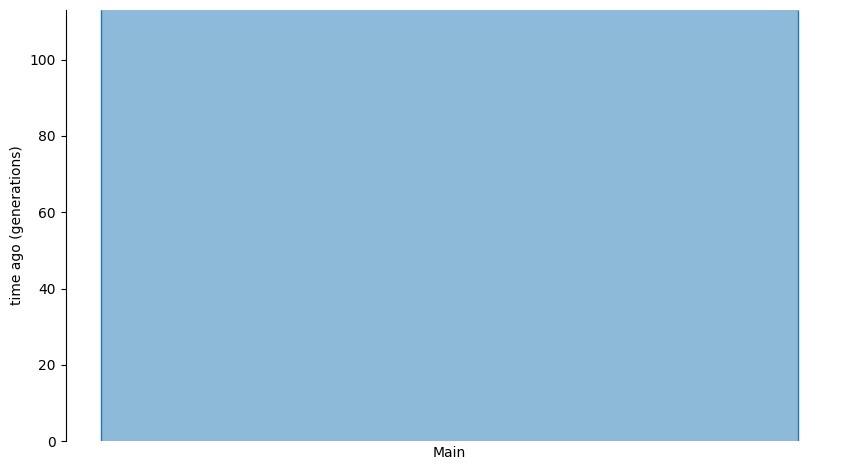
Populations: Main
Single population of Pahlavan (hero-monster hybrid lineage) at constant size N=28000.
ThreeEpoch_1F10
Single population three-epoch model with bottleneck
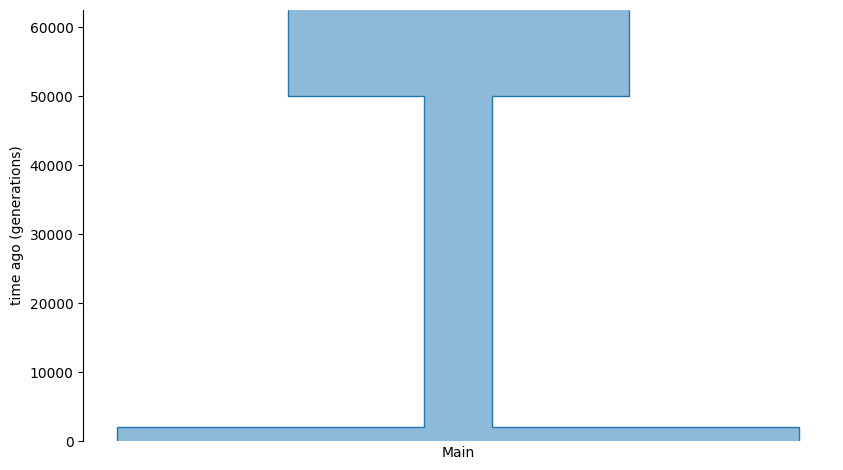
Populations: Main
Single pop of Pahlavan (hero-monster hybrid lineage). Modern N=28000, bottleneck 2800 at 2000 gen, ancestral 14000 at 50000 gen.
TwoPopSplit_2F10
Two population split with symmetric migration
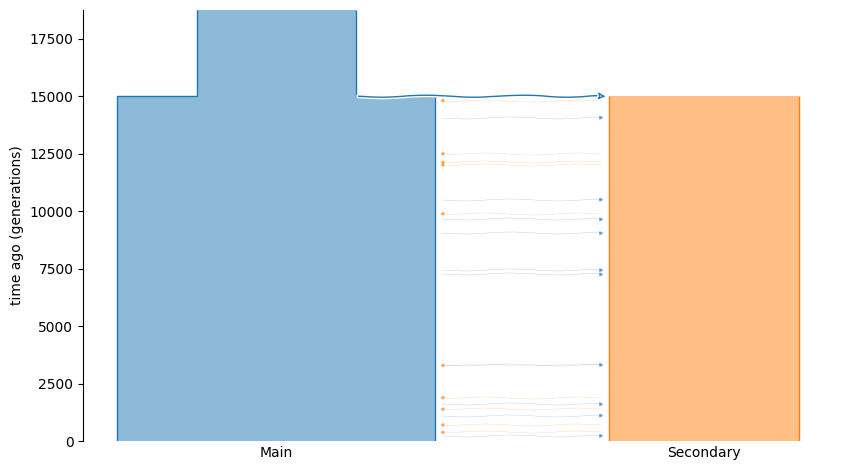
Populations: Main, Secondary
Two pops of Pahlavan (hero-monster hybrid lineage). Main N=28000, Secondary N=16800. Split 15000 gen ago.
GhostAdmixture_3F10
Two sampled pops + extinct ghost with pulse admixture
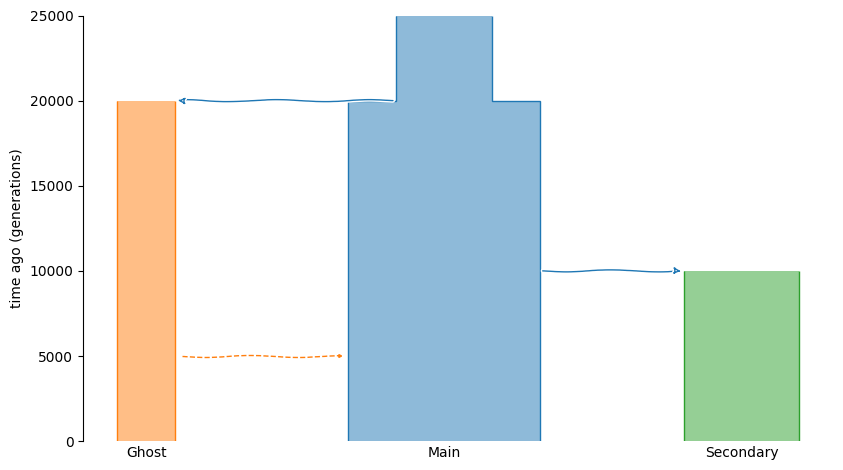
Populations: Main, Secondary, Ghost
Ghost contributes 15%% pulse admixture to Main at 5000 gen. Non-tree-like history.
ThreePopAdmix_3F10
Three populations with bidirectional pulse admixture
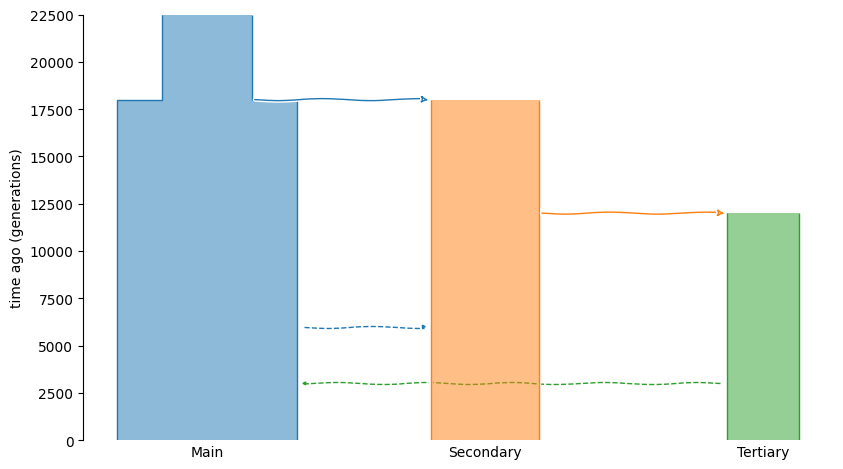
Populations: Main, Secondary, Tertiary
10%% Tertiary->Main at 3000 gen, 5%% Main->Secondary at 6000 gen. Admixture graph.
FourRegion_4F10
Four-population stepping-stone across Iranian plateau
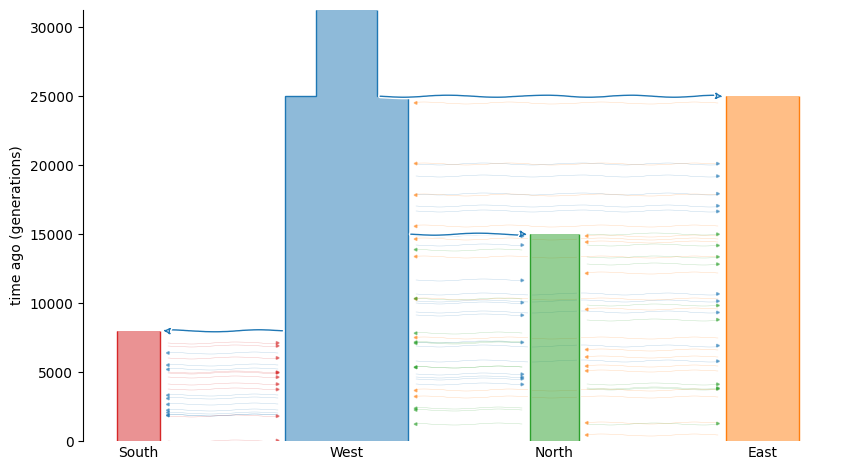
Populations: West, East, North, South
West, East, North, South populations with stepping-stone migration.
FiveRealm_5F10
Five-population admixture graph (Iran-Turan-Rum-Hind-Chin)
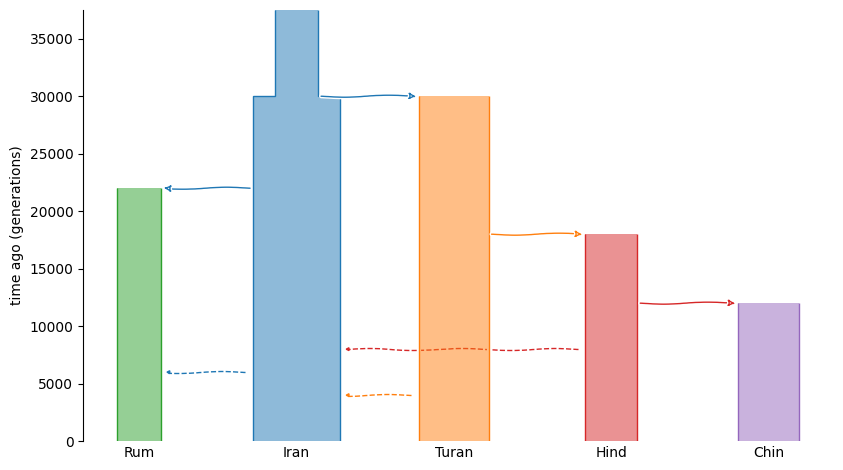
Populations: Iran, Turan, Rum, Hind, Chin
Five Shahnameh realms with pulse admixture events. Tests 5-pop graph inference.
SixPopExtRecolon_6F10
Six-population model with extinction and recolonization
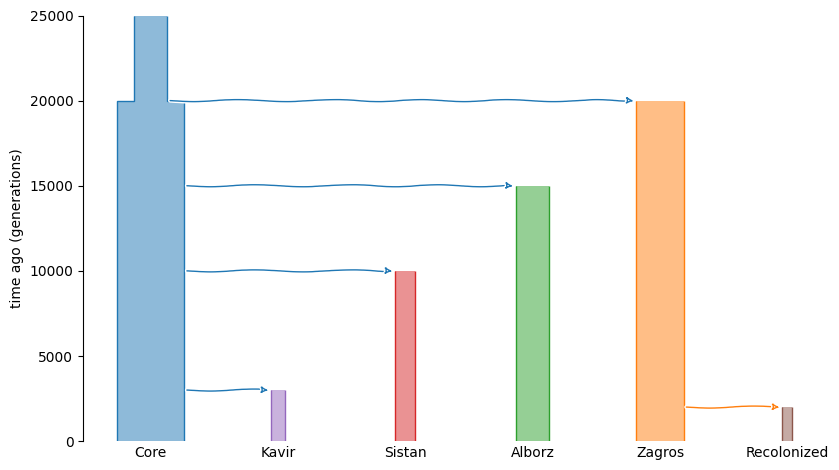
Populations: Core, Zagros, Alborz, Kavir, Sistan, Recolonized
Kavir goes extinct at 3000 gen, recolonized from Zagros at 2000 gen.
AsymReversal_2F10
Two-pop with migration direction reversal over time
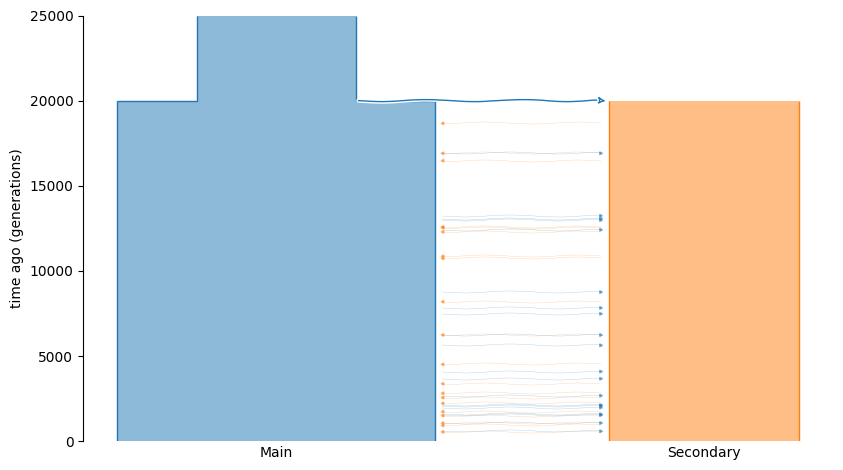
Populations: Main, Secondary
Migration reverses direction at 5000 gen ago. Tests temporal asymmetry.
SilkRoad_8F10
Eight-population Silk Road stepping-stone model
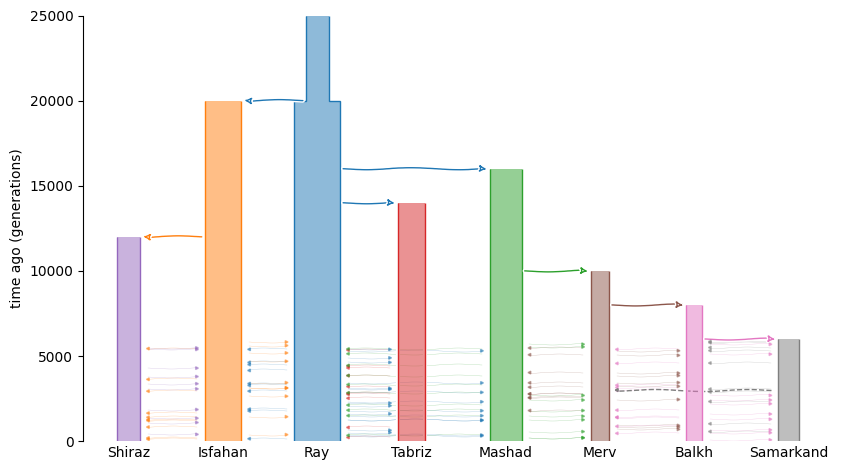
Populations: Ray, Isfahan, Shiraz, Tabriz, Mashad, Merv, Balkh, Samarkand
Eight cities along the Silk Road with stepping-stone migration and admixture.
Sorcerer (Sorcerer wizardus) — The jadugar (sorcerers) of the Shahnameh, practitioners of dark arts, often serving Turanian kings.
Genome summary
- ID:
SorWiz- Species:
Sorcerer wizardus
- Common name:
Sorcerer (jadugar)
- Assembly:
Jadoo1.0(GCA_FERD_SorWiz)- Ploidy:
2
- Generation time:
50 years
- Population size:
30,000
Chromosomes
Name |
Length (bp) |
Mutation rate |
Recombination rate |
|---|---|---|---|
1 |
20,000,000 |
3.50e-08 |
2.50e-08 |
2 |
18,000,000 |
3.50e-08 |
2.50e-08 |
3 |
16,000,000 |
3.50e-08 |
2.50e-08 |
4 |
14,000,000 |
3.50e-08 |
2.50e-08 |
5 |
12,000,000 |
3.50e-08 |
2.50e-08 |
jadoo_mitogenome |
17,000 |
9.80e-08 |
0.00e+00 |
Demographic models
Constant_1F10
Single population constant-size model
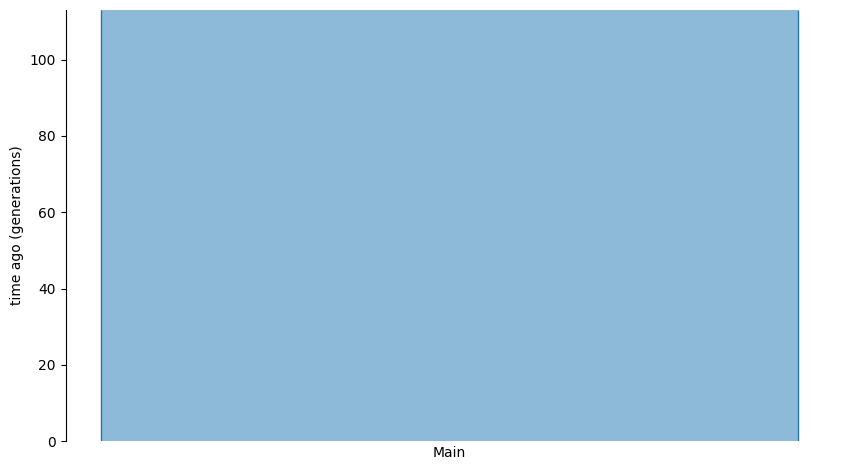
Populations: Main
Single population of Sorcerer (jadugar) at constant size N=30000.
ThreeEpoch_1F10
Single population three-epoch model with bottleneck
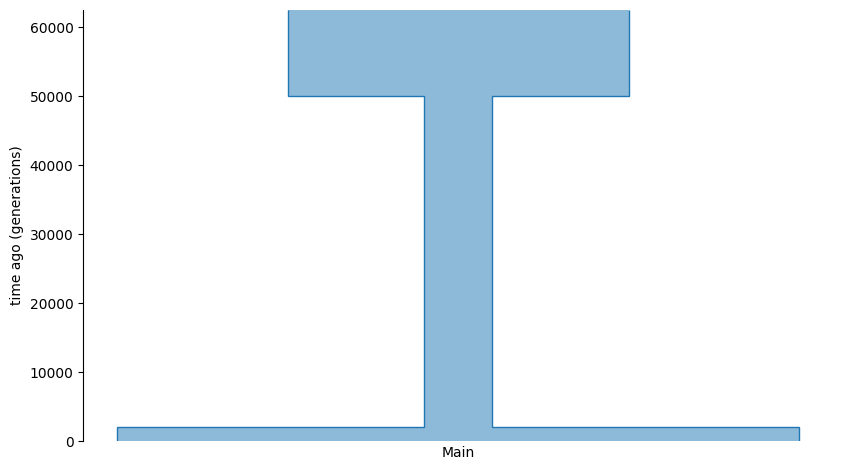
Populations: Main
Single pop of Sorcerer (jadugar). Modern N=30000, bottleneck 3000 at 2000 gen, ancestral 15000 at 50000 gen.
TwoPopSplit_2F10
Two population split with symmetric migration
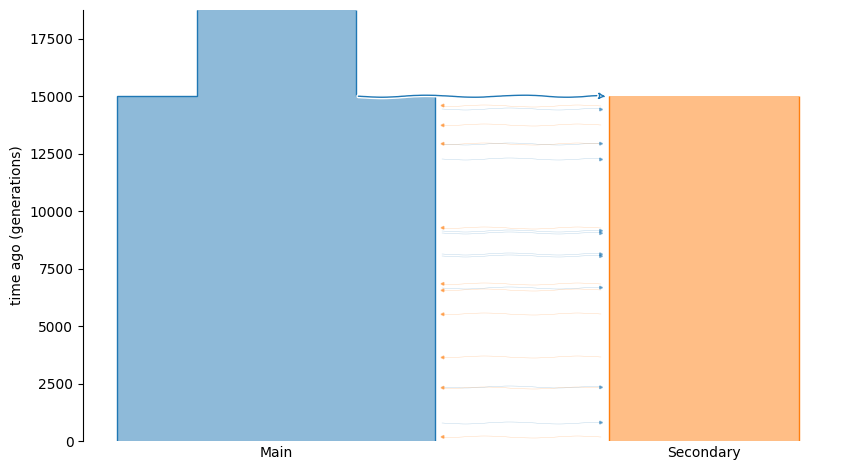
Populations: Main, Secondary
Two pops of Sorcerer (jadugar). Main N=30000, Secondary N=18000. Split 15000 gen ago.
GhostAdmixture_3F10
Two sampled pops + extinct ghost with pulse admixture
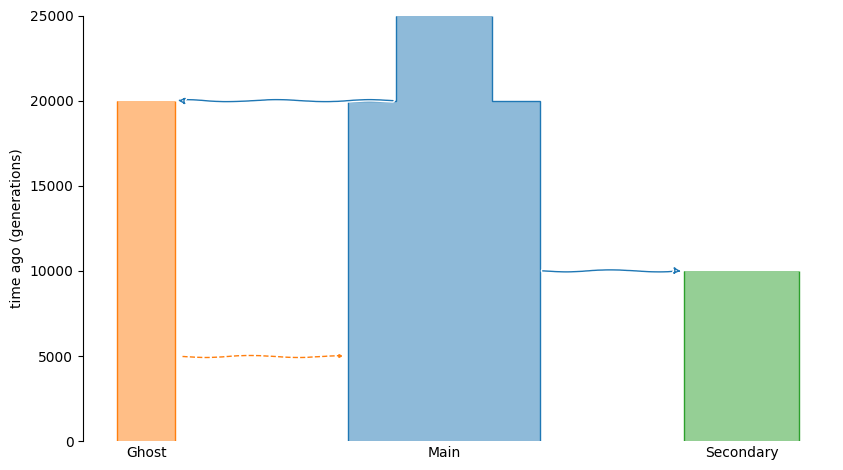
Populations: Main, Secondary, Ghost
Ghost contributes 15%% pulse admixture to Main at 5000 gen. Non-tree-like history.
ThreePopAdmix_3F10
Three populations with bidirectional pulse admixture
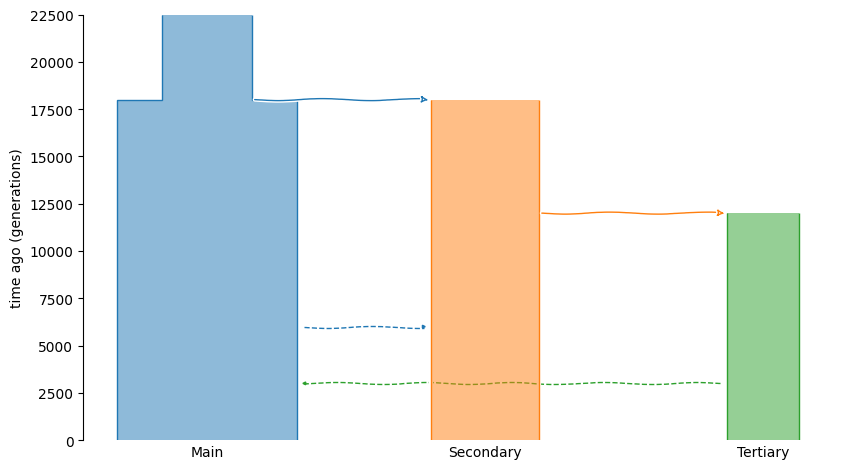
Populations: Main, Secondary, Tertiary
10%% Tertiary->Main at 3000 gen, 5%% Main->Secondary at 6000 gen. Admixture graph.
FourRegion_4F10
Four-population stepping-stone across Iranian plateau
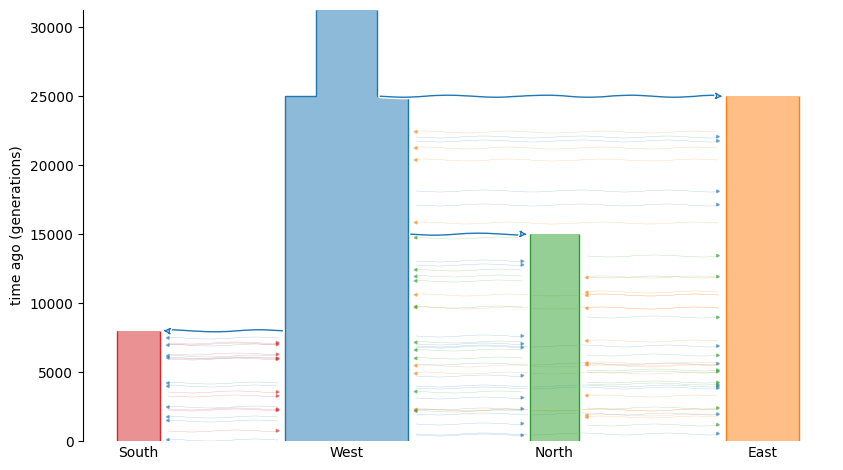
Populations: West, East, North, South
West, East, North, South populations with stepping-stone migration.
FiveRealm_5F10
Five-population admixture graph (Iran-Turan-Rum-Hind-Chin)
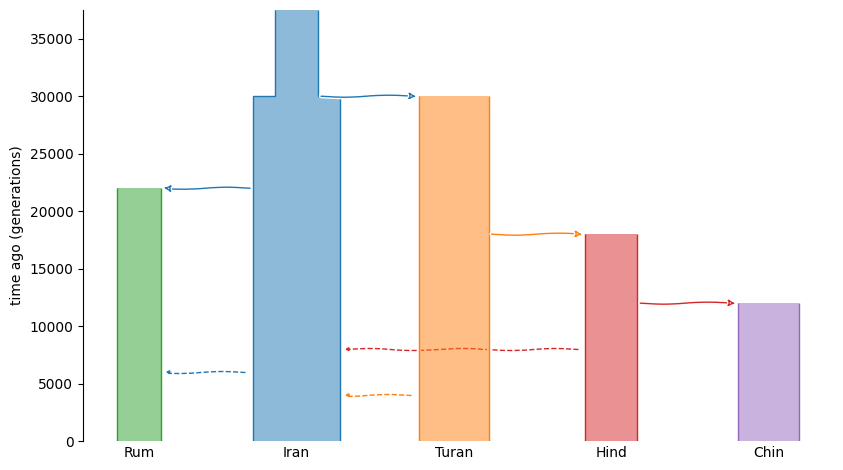
Populations: Iran, Turan, Rum, Hind, Chin
Five Shahnameh realms with pulse admixture events. Tests 5-pop graph inference.
SixPopExtRecolon_6F10
Six-population model with extinction and recolonization
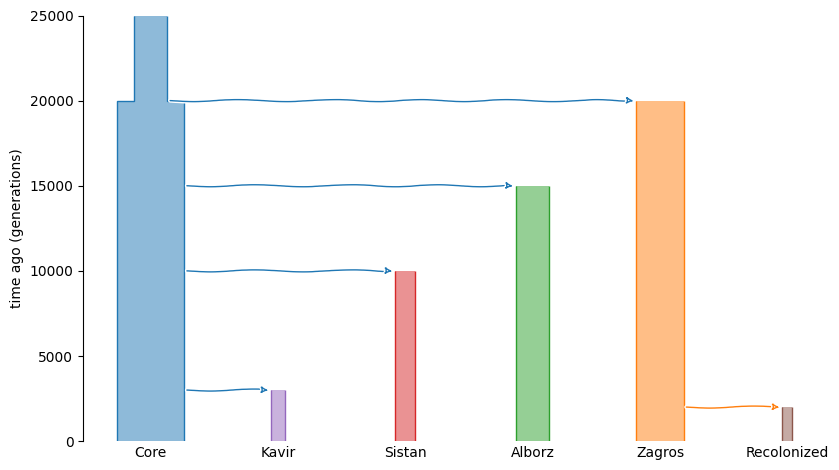
Populations: Core, Zagros, Alborz, Kavir, Sistan, Recolonized
Kavir goes extinct at 3000 gen, recolonized from Zagros at 2000 gen.
AsymReversal_2F10
Two-pop with migration direction reversal over time
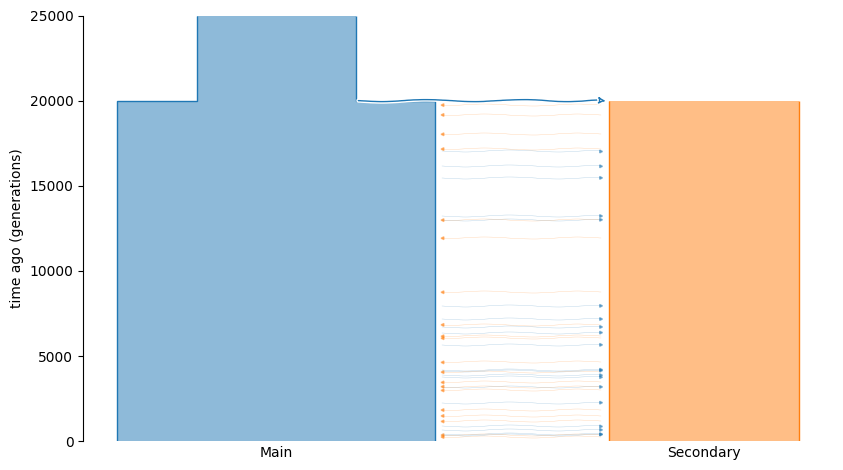
Populations: Main, Secondary
Migration reverses direction at 5000 gen ago. Tests temporal asymmetry.
SilkRoad_8F10
Eight-population Silk Road stepping-stone model
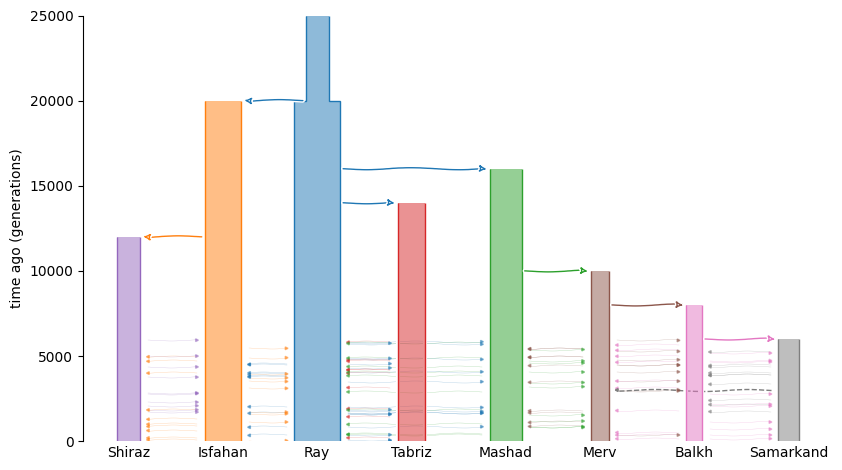
Populations: Ray, Isfahan, Shiraz, Tabriz, Mashad, Merv, Balkh, Samarkand
Eight cities along the Silk Road with stepping-stone migration and admixture.
Div-e Sepid (Dough giant) — The White Demon, greatest of the Mazandaran Divs, slain by Rostam in the Seven Labours.
Genome summary
- ID:
DouGia- Species:
Dough giant
- Common name:
Div-e Sepid (White Demon giant)
- Assembly:
DivSepid1.0(GCA_FERD_DouGia)- Ploidy:
2
- Generation time:
120 years
- Population size:
4,000
Chromosomes
Name |
Length (bp) |
Mutation rate |
Recombination rate |
|---|---|---|---|
1 |
20,000,000 |
8.00e-09 |
1.50e-08 |
2 |
18,000,000 |
8.00e-09 |
1.50e-08 |
3 |
16,000,000 |
8.00e-09 |
1.50e-08 |
4 |
14,000,000 |
8.00e-09 |
1.50e-08 |
5 |
12,000,000 |
8.00e-09 |
1.50e-08 |
sepid_mitogenome |
17,000 |
2.24e-08 |
0.00e+00 |
Demographic models
Constant_1F10
Single population constant-size model
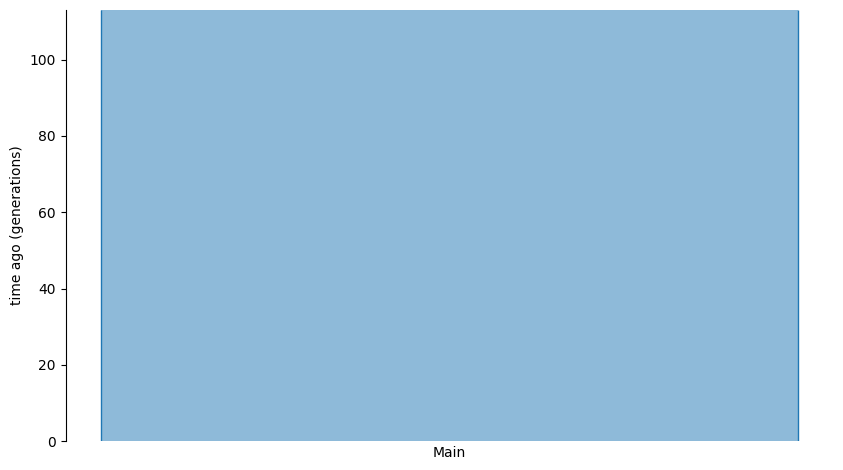
Populations: Main
Single population of Div-e Sepid (White Demon giant) at constant size N=4000.
ThreeEpoch_1F10
Single population three-epoch model with bottleneck
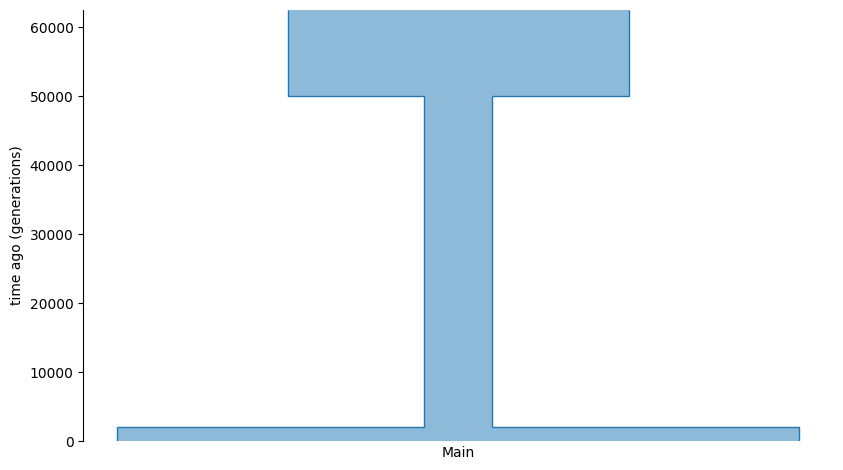
Populations: Main
Single pop of Div-e Sepid (White Demon giant). Modern N=4000, bottleneck 400 at 2000 gen, ancestral 2000 at 50000 gen.
TwoPopSplit_2F10
Two population split with symmetric migration
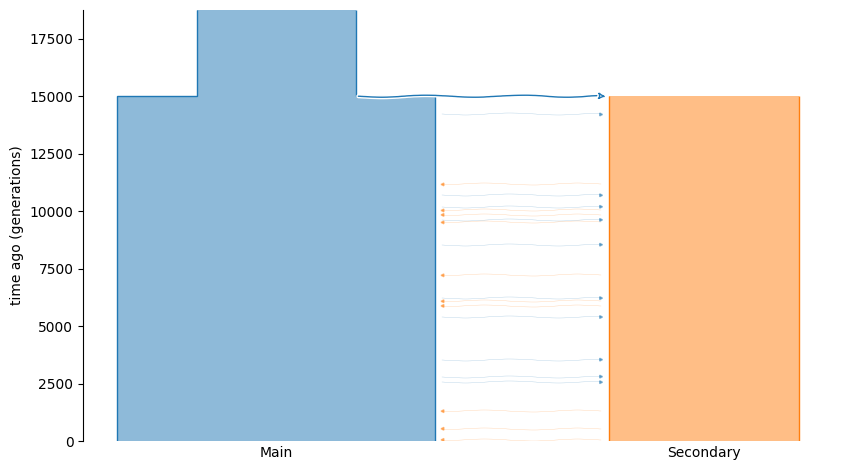
Populations: Main, Secondary
Two pops of Div-e Sepid (White Demon giant). Main N=4000, Secondary N=2400. Split 15000 gen ago.
GhostAdmixture_3F10
Two sampled pops + extinct ghost with pulse admixture
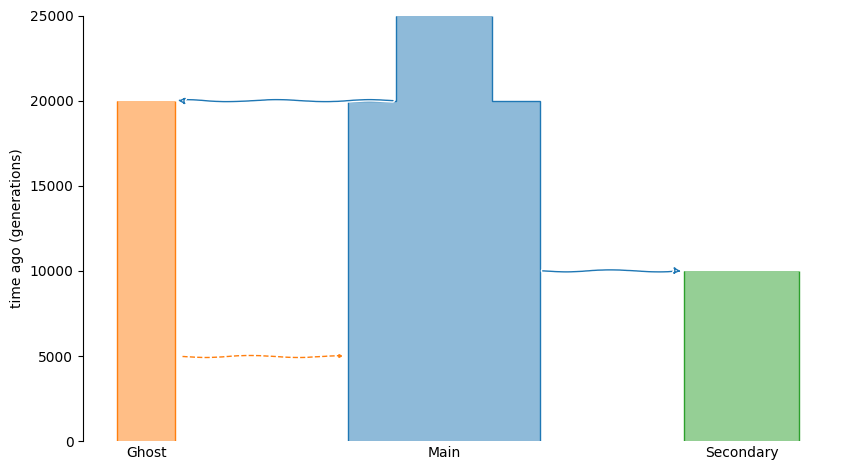
Populations: Main, Secondary, Ghost
Ghost contributes 15%% pulse admixture to Main at 5000 gen. Non-tree-like history.
ThreePopAdmix_3F10
Three populations with bidirectional pulse admixture
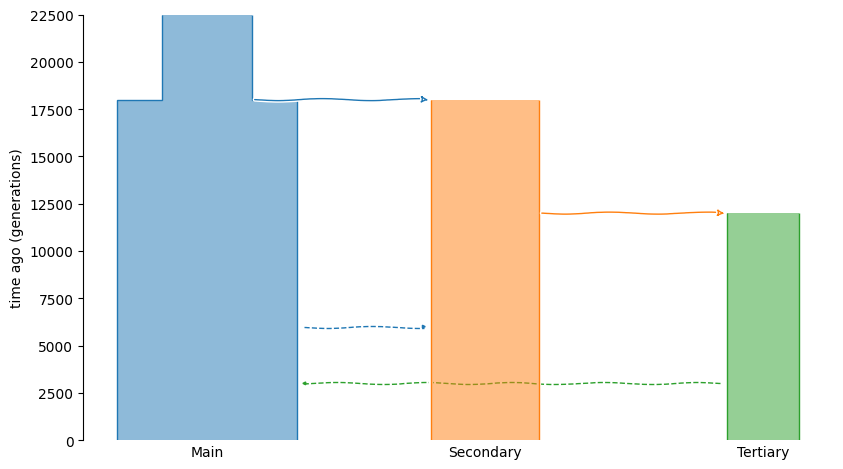
Populations: Main, Secondary, Tertiary
10%% Tertiary->Main at 3000 gen, 5%% Main->Secondary at 6000 gen. Admixture graph.
FourRegion_4F10
Four-population stepping-stone across Iranian plateau
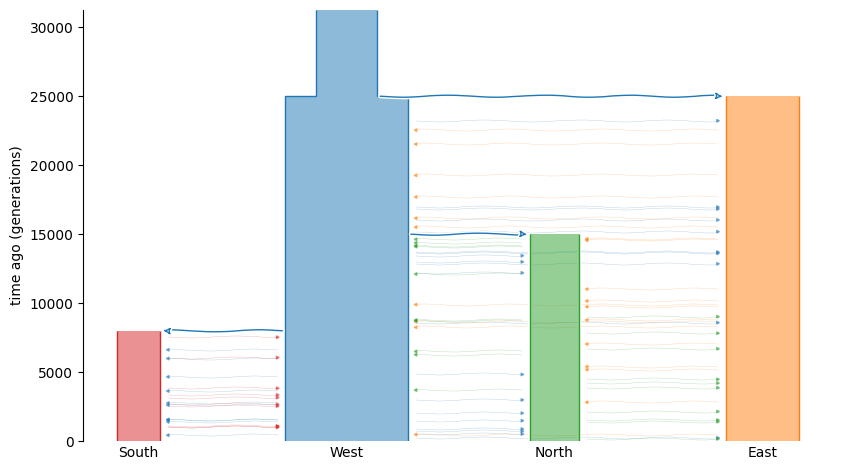
Populations: West, East, North, South
West, East, North, South populations with stepping-stone migration.
FiveRealm_5F10
Five-population admixture graph (Iran-Turan-Rum-Hind-Chin)
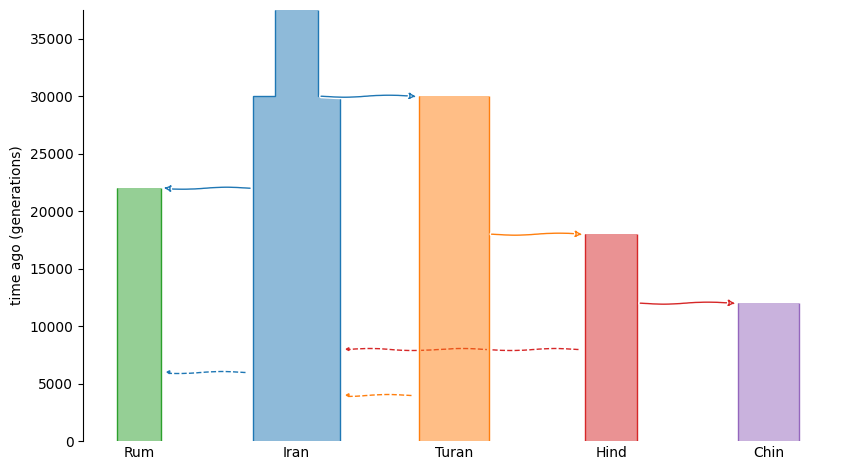
Populations: Iran, Turan, Rum, Hind, Chin
Five Shahnameh realms with pulse admixture events. Tests 5-pop graph inference.
SixPopExtRecolon_6F10
Six-population model with extinction and recolonization
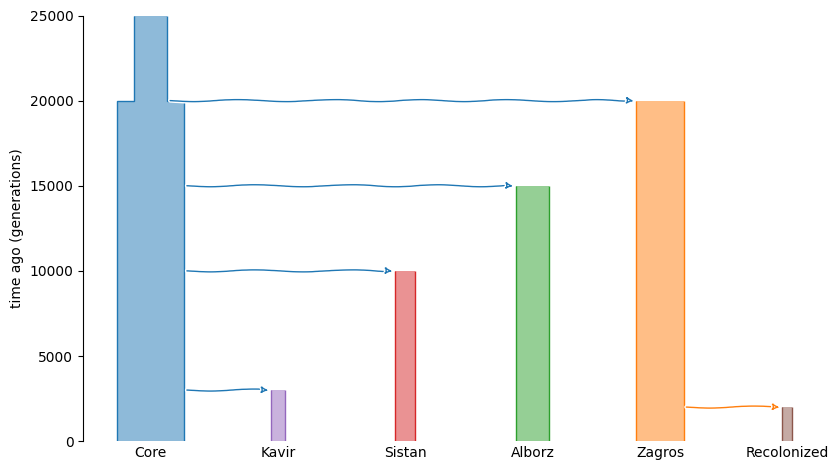
Populations: Core, Zagros, Alborz, Kavir, Sistan, Recolonized
Kavir goes extinct at 3000 gen, recolonized from Zagros at 2000 gen.
AsymReversal_2F10
Two-pop with migration direction reversal over time
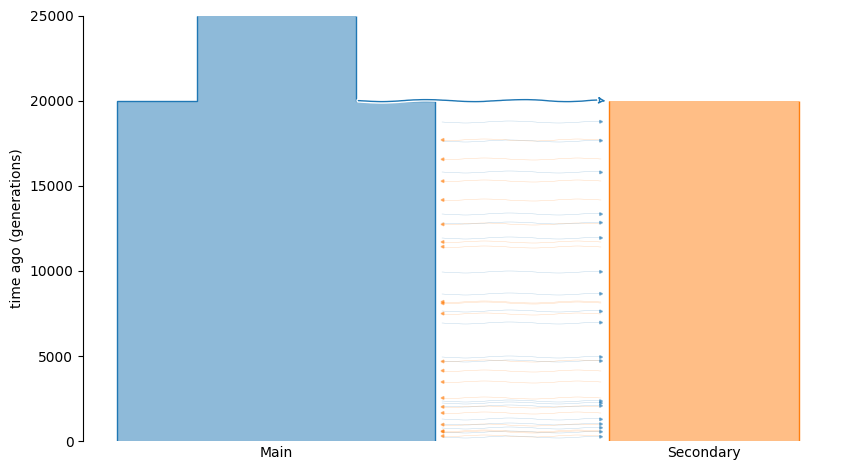
Populations: Main, Secondary
Migration reverses direction at 5000 gen ago. Tests temporal asymmetry.
SilkRoad_8F10
Eight-population Silk Road stepping-stone model
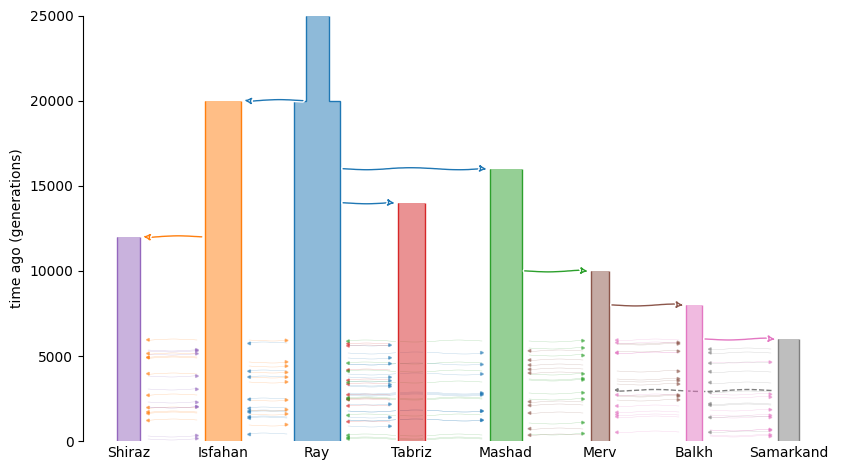
Populations: Ray, Isfahan, Shiraz, Tabriz, Mashad, Merv, Balkh, Samarkand
Eight cities along the Silk Road with stepping-stone migration and admixture.
Afrasiyab (Afrasiyab horrens) — The Turanian warlord, arch-enemy of Iran, grandson of Tur son of Feridun. His lineage represents Turanian-Iranian conflict and occasional admixture.
Genome summary
- ID:
AfrHor- Species:
Afrasiyab horrens
- Common name:
Afrasiyab-kind (Turanian warlord lineage)
- Assembly:
Afrasiyab1.0(GCA_FERD_AfrHor)- Ploidy:
2
- Generation time:
28 years
- Population size:
65,000
Chromosomes
Name |
Length (bp) |
Mutation rate |
Recombination rate |
|---|---|---|---|
1 |
20,000,000 |
2.80e-08 |
2.20e-08 |
2 |
18,000,000 |
2.80e-08 |
2.20e-08 |
3 |
16,000,000 |
2.80e-08 |
2.20e-08 |
4 |
14,000,000 |
2.80e-08 |
2.20e-08 |
5 |
12,000,000 |
2.80e-08 |
2.20e-08 |
afrasiyab_mitogenome |
17,000 |
7.84e-08 |
0.00e+00 |
Demographic models
Constant_1F10
Single population constant-size model
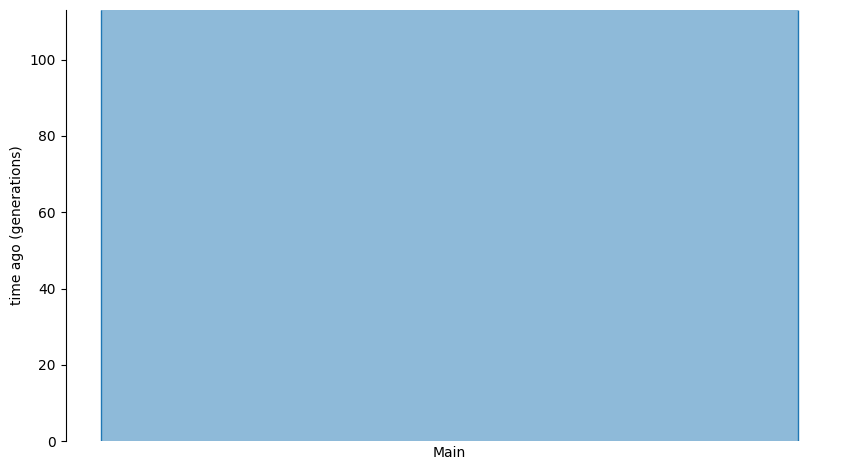
Populations: Main
Single population of Afrasiyab-kind (Turanian warlord lineage) at constant size N=65000.
ThreeEpoch_1F10
Single population three-epoch model with bottleneck
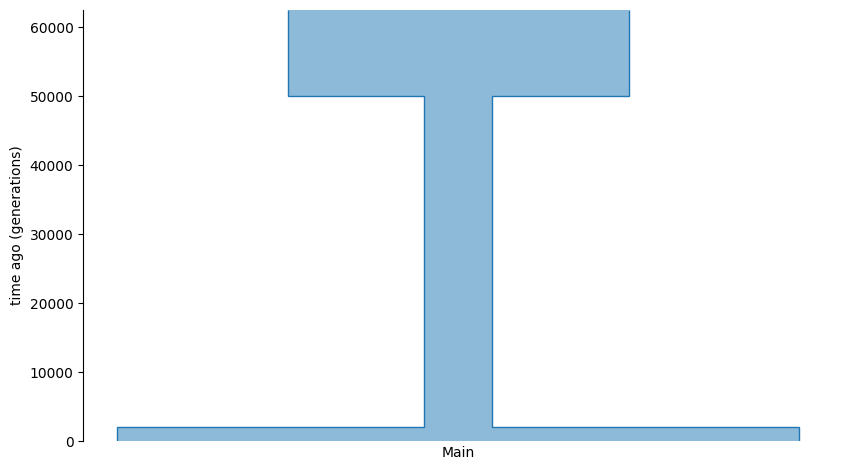
Populations: Main
Single pop of Afrasiyab-kind (Turanian warlord lineage). Modern N=65000, bottleneck 6500 at 2000 gen, ancestral 32500 at 50000 gen.
TwoPopSplit_2F10
Two population split with symmetric migration
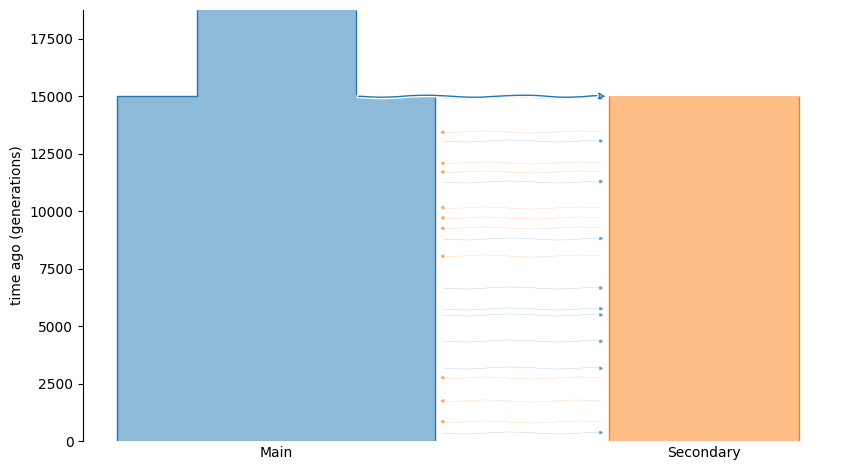
Populations: Main, Secondary
Two pops of Afrasiyab-kind (Turanian warlord lineage). Main N=65000, Secondary N=39000. Split 15000 gen ago.
GhostAdmixture_3F10
Two sampled pops + extinct ghost with pulse admixture
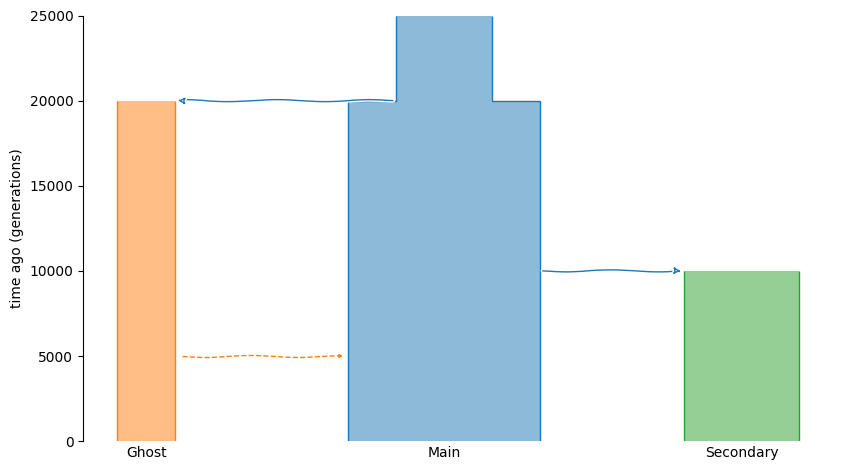
Populations: Main, Secondary, Ghost
Ghost contributes 15%% pulse admixture to Main at 5000 gen. Non-tree-like history.
ThreePopAdmix_3F10
Three populations with bidirectional pulse admixture
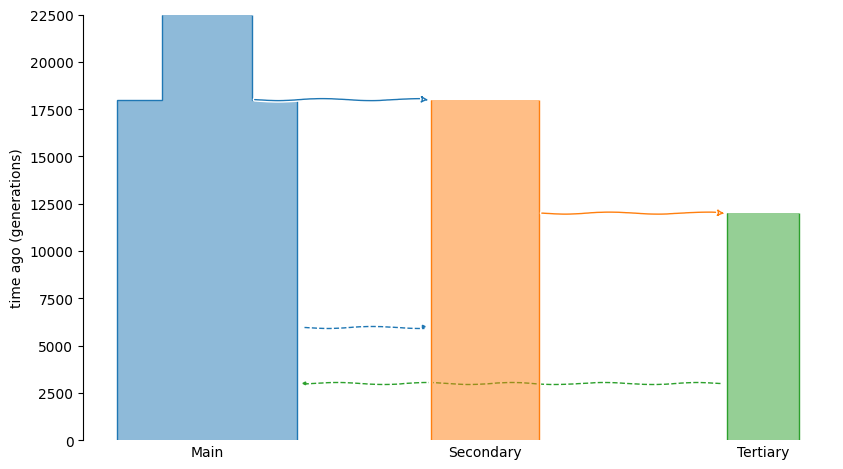
Populations: Main, Secondary, Tertiary
10%% Tertiary->Main at 3000 gen, 5%% Main->Secondary at 6000 gen. Admixture graph.
FourRegion_4F10
Four-population stepping-stone across Iranian plateau
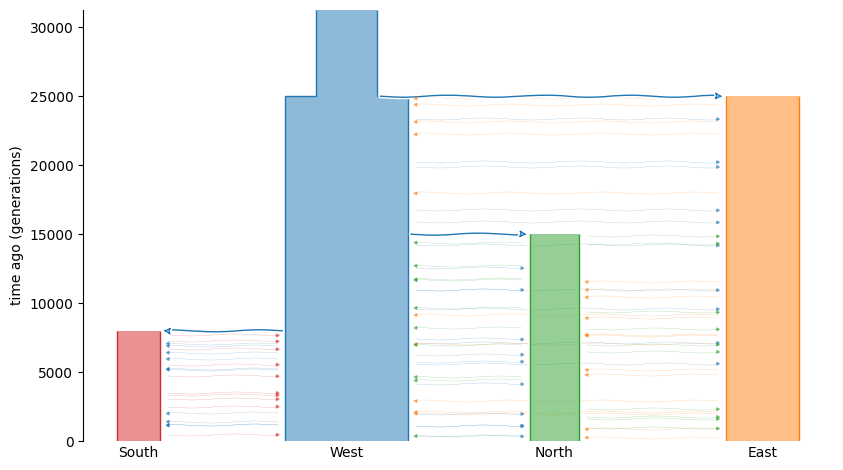
Populations: West, East, North, South
West, East, North, South populations with stepping-stone migration.
FiveRealm_5F10
Five-population admixture graph (Iran-Turan-Rum-Hind-Chin)
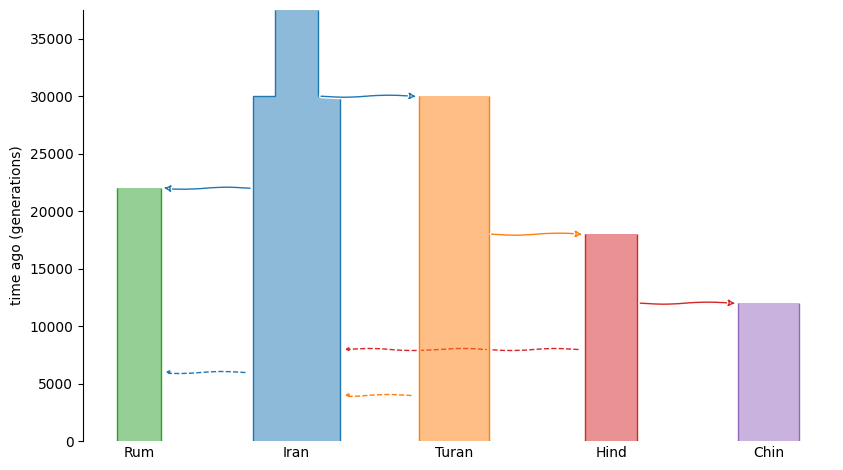
Populations: Iran, Turan, Rum, Hind, Chin
Five Shahnameh realms with pulse admixture events. Tests 5-pop graph inference.
SixPopExtRecolon_6F10
Six-population model with extinction and recolonization
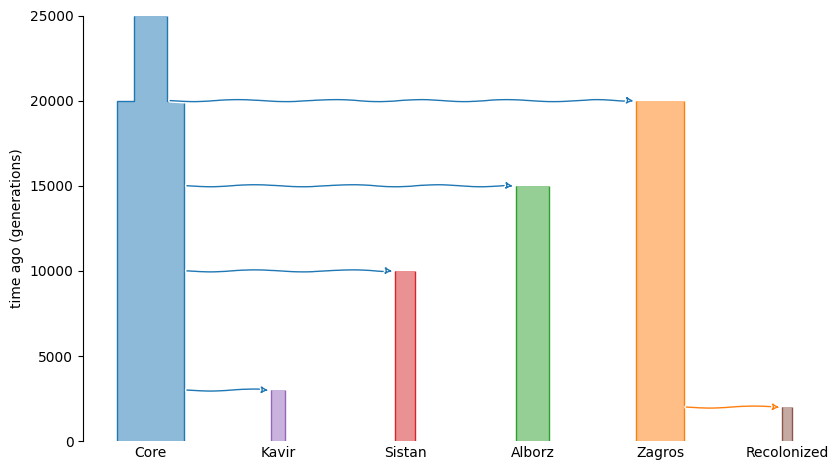
Populations: Core, Zagros, Alborz, Kavir, Sistan, Recolonized
Kavir goes extinct at 3000 gen, recolonized from Zagros at 2000 gen.
AsymReversal_2F10
Two-pop with migration direction reversal over time
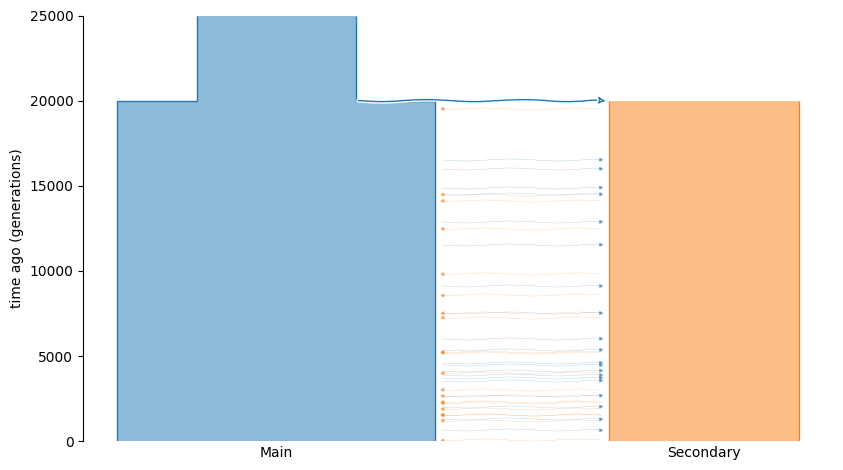
Populations: Main, Secondary
Migration reverses direction at 5000 gen ago. Tests temporal asymmetry.
SilkRoad_8F10
Eight-population Silk Road stepping-stone model
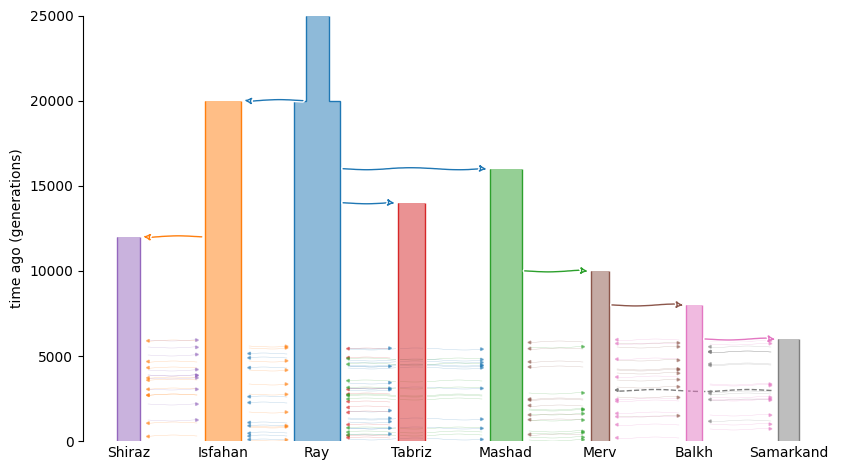
Populations: Ray, Isfahan, Shiraz, Tabriz, Mashad, Merv, Balkh, Samarkand
Eight cities along the Silk Road with stepping-stone migration and admixture.
Turanian (Turanian nomadicus) — The steppe nomad spirits of Turan, the great enemy civilization in the Shahnameh. Large populations, short generation times, representing the mobile steppe peoples.
Genome summary
- ID:
TurNom- Species:
Turanian nomadicus
- Common name:
Turanian (steppe nomad spirit)
- Assembly:
Turan1.0(GCA_FERD_TurNom)- Ploidy:
2
- Generation time:
22 years
- Population size:
120,000
Chromosomes
Name |
Length (bp) |
Mutation rate |
Recombination rate |
|---|---|---|---|
1 |
20,000,000 |
3.00e-08 |
2.00e-08 |
2 |
18,000,000 |
3.00e-08 |
2.00e-08 |
3 |
16,000,000 |
3.00e-08 |
2.00e-08 |
4 |
14,000,000 |
3.00e-08 |
2.00e-08 |
5 |
12,000,000 |
3.00e-08 |
2.00e-08 |
turan_mitogenome |
17,000 |
8.40e-08 |
0.00e+00 |
Demographic models
Constant_1F10
Single population constant-size model
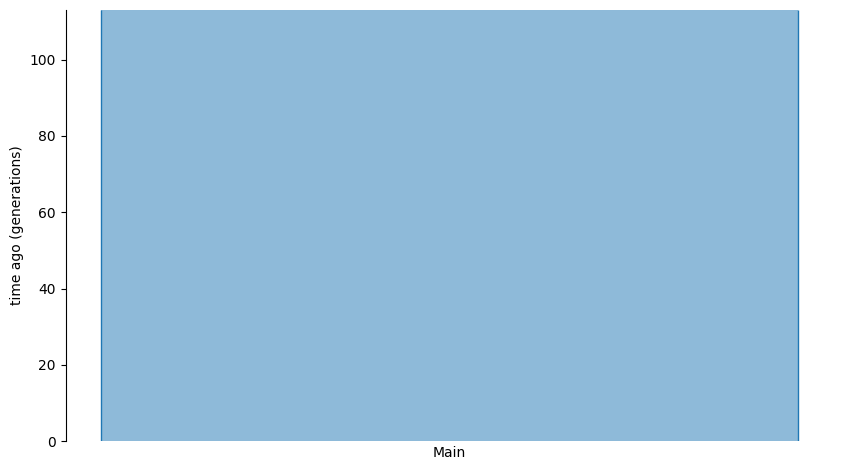
Populations: Main
Single population of Turanian (steppe nomad spirit) at constant size N=120000.
ThreeEpoch_1F10
Single population three-epoch model with bottleneck
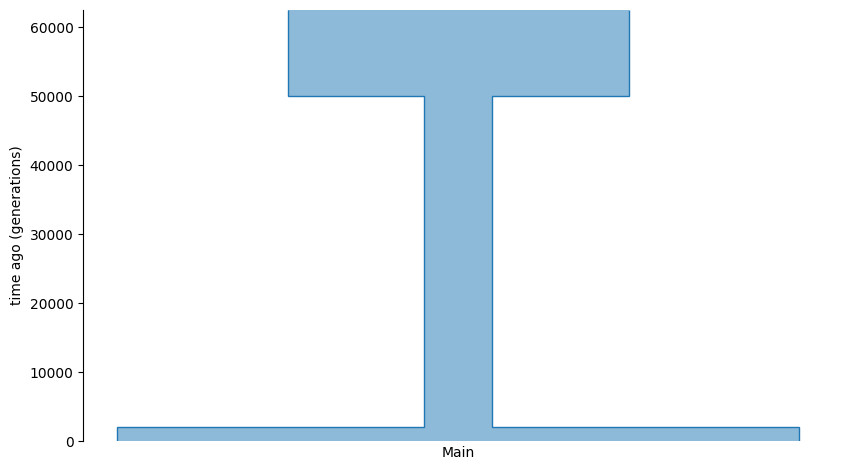
Populations: Main
Single pop of Turanian (steppe nomad spirit). Modern N=120000, bottleneck 12000 at 2000 gen, ancestral 60000 at 50000 gen.
TwoPopSplit_2F10
Two population split with symmetric migration
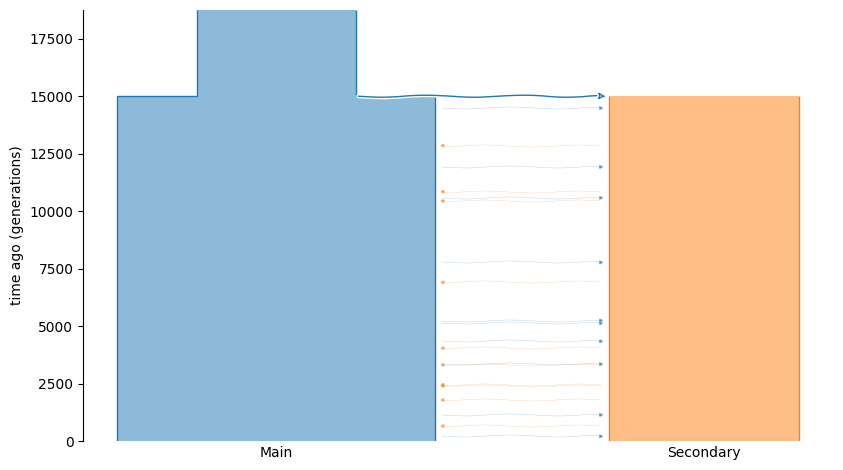
Populations: Main, Secondary
Two pops of Turanian (steppe nomad spirit). Main N=120000, Secondary N=72000. Split 15000 gen ago.
GhostAdmixture_3F10
Two sampled pops + extinct ghost with pulse admixture
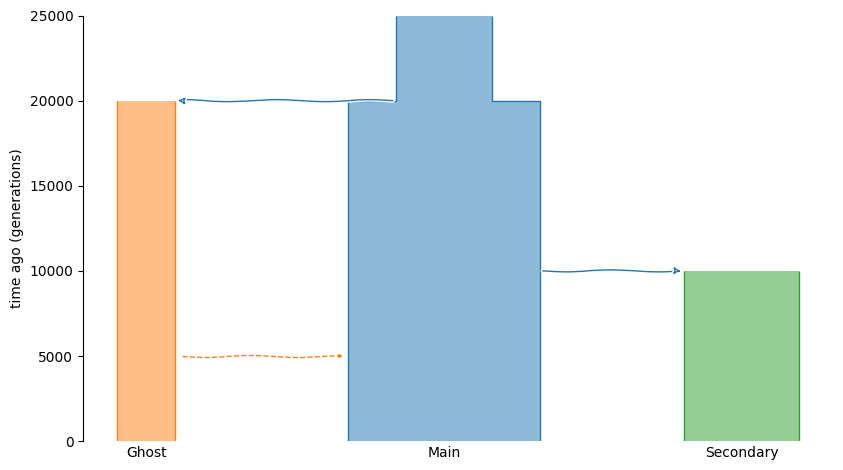
Populations: Main, Secondary, Ghost
Ghost contributes 15%% pulse admixture to Main at 5000 gen. Non-tree-like history.
ThreePopAdmix_3F10
Three populations with bidirectional pulse admixture
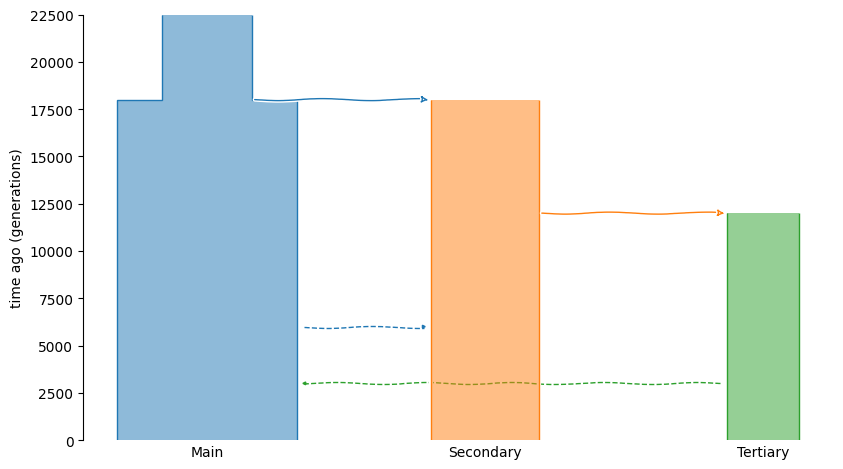
Populations: Main, Secondary, Tertiary
10%% Tertiary->Main at 3000 gen, 5%% Main->Secondary at 6000 gen. Admixture graph.
FourRegion_4F10
Four-population stepping-stone across Iranian plateau
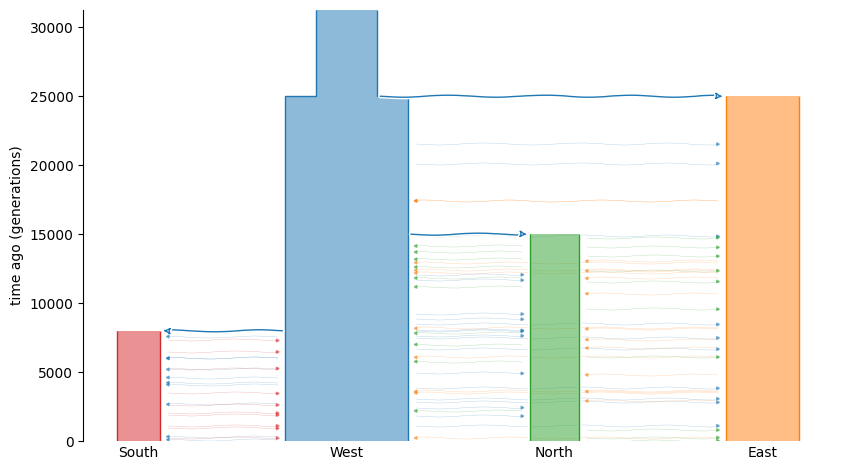
Populations: West, East, North, South
West, East, North, South populations with stepping-stone migration.
FiveRealm_5F10
Five-population admixture graph (Iran-Turan-Rum-Hind-Chin)
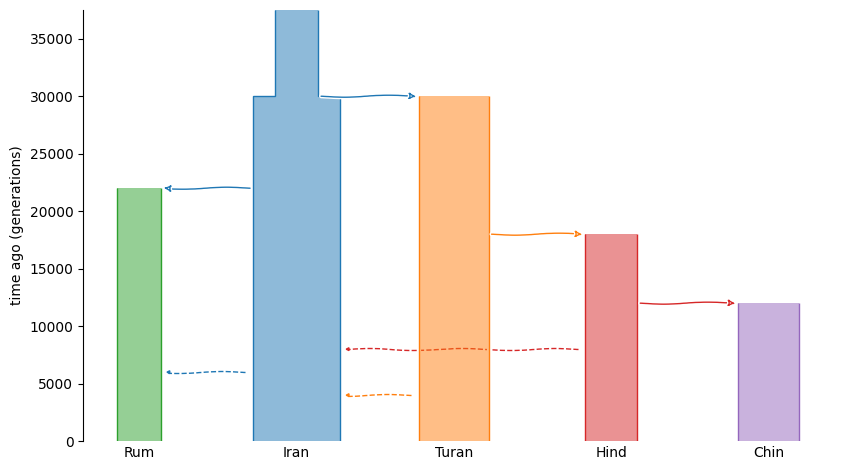
Populations: Iran, Turan, Rum, Hind, Chin
Five Shahnameh realms with pulse admixture events. Tests 5-pop graph inference.
SixPopExtRecolon_6F10
Six-population model with extinction and recolonization
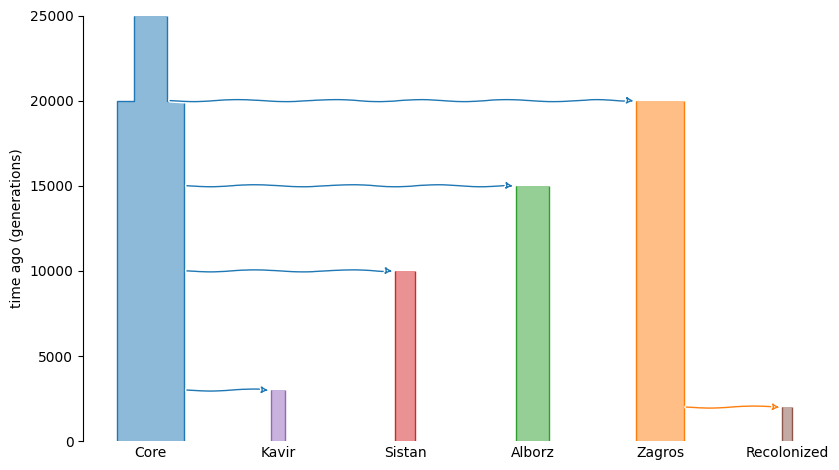
Populations: Core, Zagros, Alborz, Kavir, Sistan, Recolonized
Kavir goes extinct at 3000 gen, recolonized from Zagros at 2000 gen.
AsymReversal_2F10
Two-pop with migration direction reversal over time
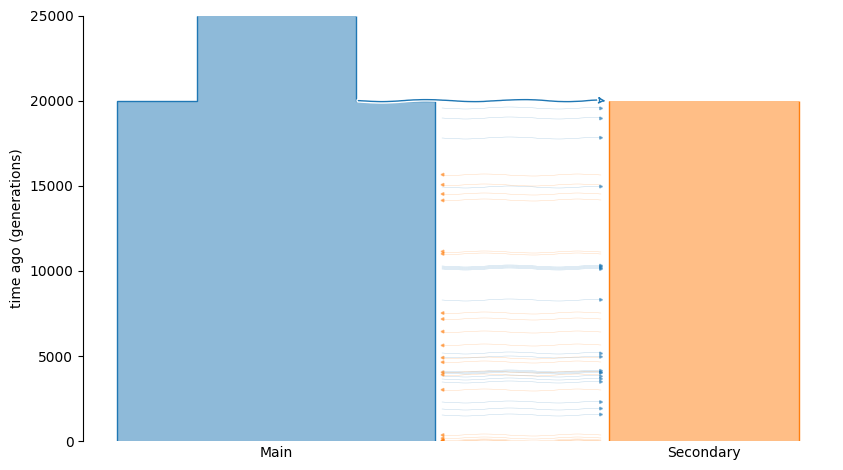
Populations: Main, Secondary
Migration reverses direction at 5000 gen ago. Tests temporal asymmetry.
SilkRoad_8F10
Eight-population Silk Road stepping-stone model
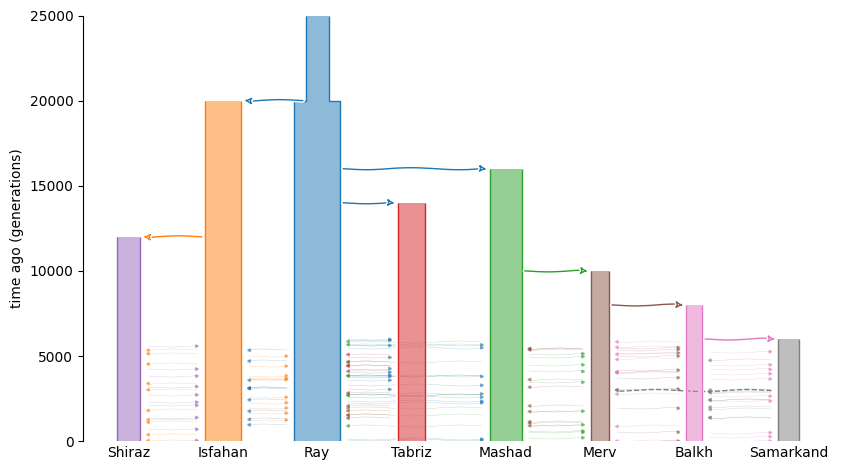
Populations: Ray, Isfahan, Shiraz, Tabriz, Mashad, Merv, Balkh, Samarkand
Eight cities along the Silk Road with stepping-stone migration and admixture.
Spirits, Jinn & Peris
Jinn (Jinnus persicus) — Elemental spirits of pre-Islamic and Islamic Persian tradition. Made of smokeless fire, they exist in a parallel world (Jinnestan). Very large populations, widespread.
Genome summary
- ID:
PriJin- Species:
Jinnus persicus
- Common name:
Jinn (elemental spirit)
- Assembly:
Jinnestan1.0(GCA_FERD_PriJin)- Ploidy:
2
- Generation time:
30 years
- Population size:
200,000
Chromosomes
Name |
Length (bp) |
Mutation rate |
Recombination rate |
|---|---|---|---|
1 |
20,000,000 |
5.00e-08 |
3.00e-08 |
2 |
18,000,000 |
5.00e-08 |
3.00e-08 |
3 |
16,000,000 |
5.00e-08 |
3.00e-08 |
4 |
14,000,000 |
5.00e-08 |
3.00e-08 |
5 |
12,000,000 |
5.00e-08 |
3.00e-08 |
jinn_mitogenome |
17,000 |
1.40e-07 |
0.00e+00 |
Demographic models
Constant_1F10
Single population constant-size model
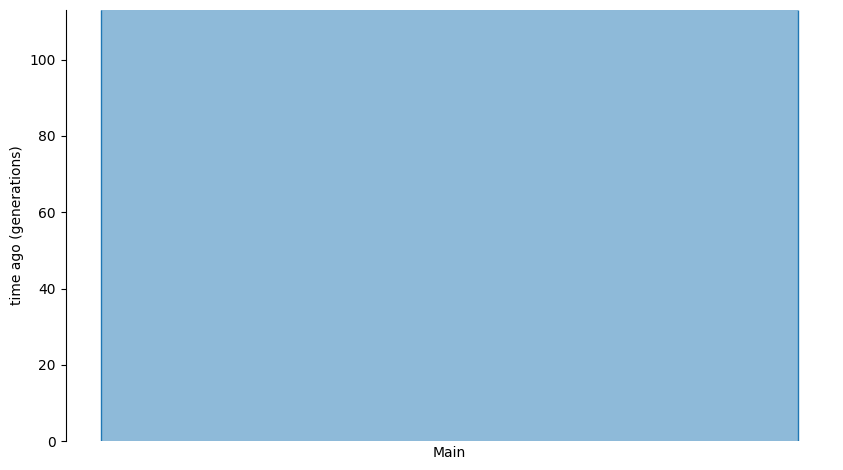
Populations: Main
Single population of Jinn (elemental spirit) at constant size N=200000.
ThreeEpoch_1F10
Single population three-epoch model with bottleneck
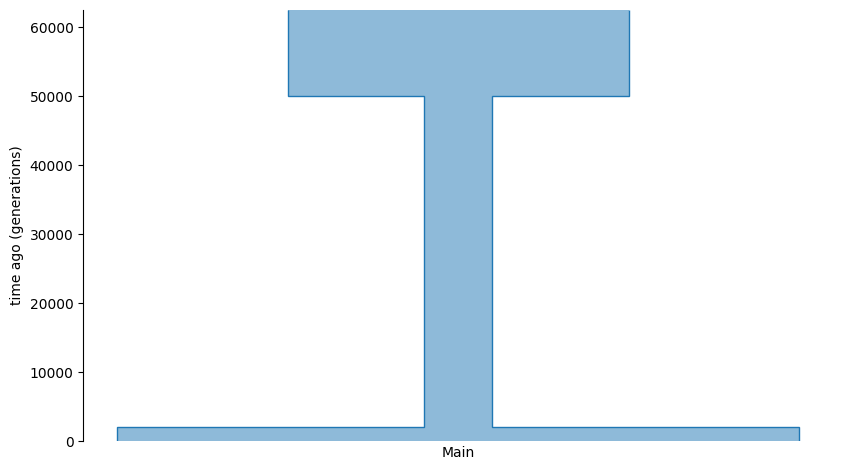
Populations: Main
Single pop of Jinn (elemental spirit). Modern N=200000, bottleneck 20000 at 2000 gen, ancestral 100000 at 50000 gen.
TwoPopSplit_2F10
Two population split with symmetric migration
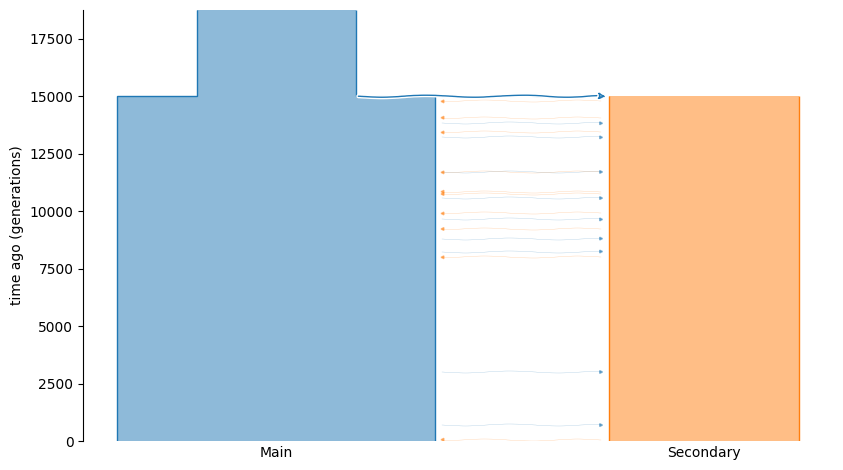
Populations: Main, Secondary
Two pops of Jinn (elemental spirit). Main N=200000, Secondary N=120000. Split 15000 gen ago.
GhostAdmixture_3F10
Two sampled pops + extinct ghost with pulse admixture
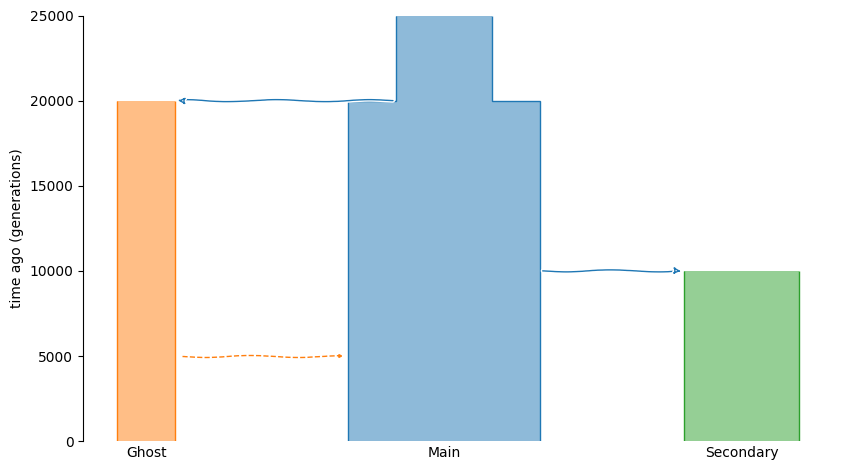
Populations: Main, Secondary, Ghost
Ghost contributes 15%% pulse admixture to Main at 5000 gen. Non-tree-like history.
ThreePopAdmix_3F10
Three populations with bidirectional pulse admixture
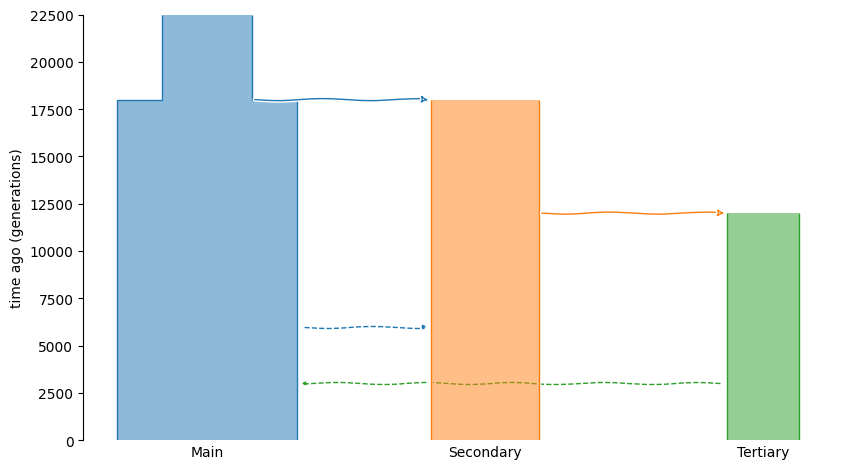
Populations: Main, Secondary, Tertiary
10%% Tertiary->Main at 3000 gen, 5%% Main->Secondary at 6000 gen. Admixture graph.
FourRegion_4F10
Four-population stepping-stone across Iranian plateau
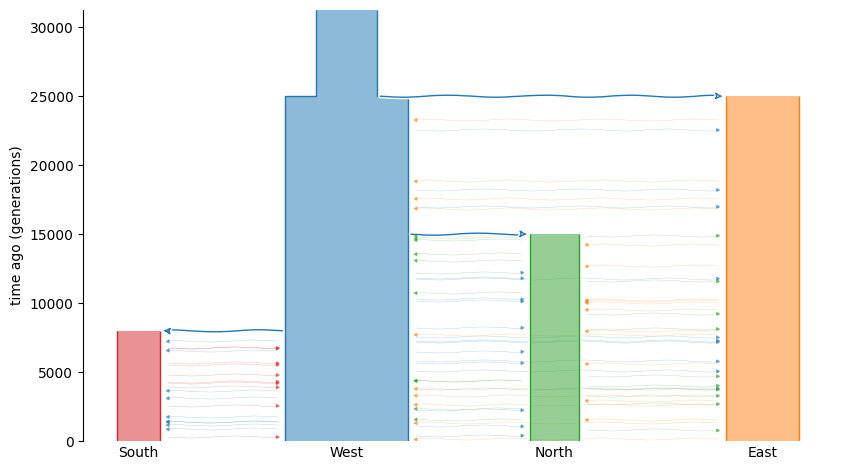
Populations: West, East, North, South
West, East, North, South populations with stepping-stone migration.
FiveRealm_5F10
Five-population admixture graph (Iran-Turan-Rum-Hind-Chin)
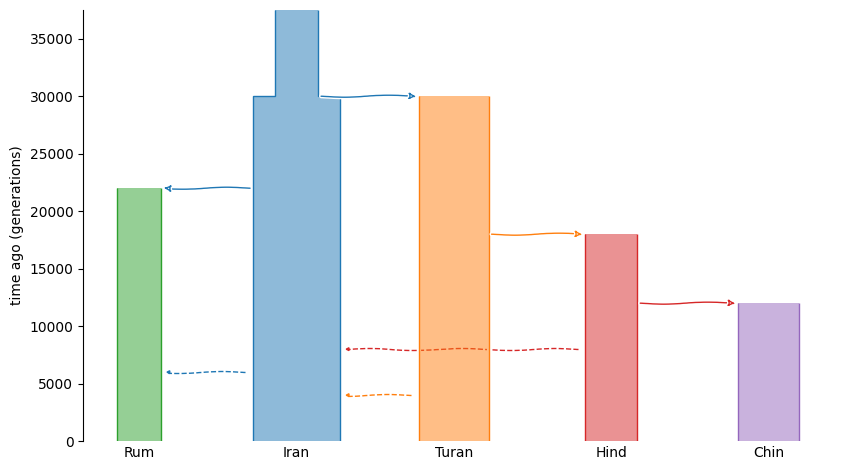
Populations: Iran, Turan, Rum, Hind, Chin
Five Shahnameh realms with pulse admixture events. Tests 5-pop graph inference.
SixPopExtRecolon_6F10
Six-population model with extinction and recolonization
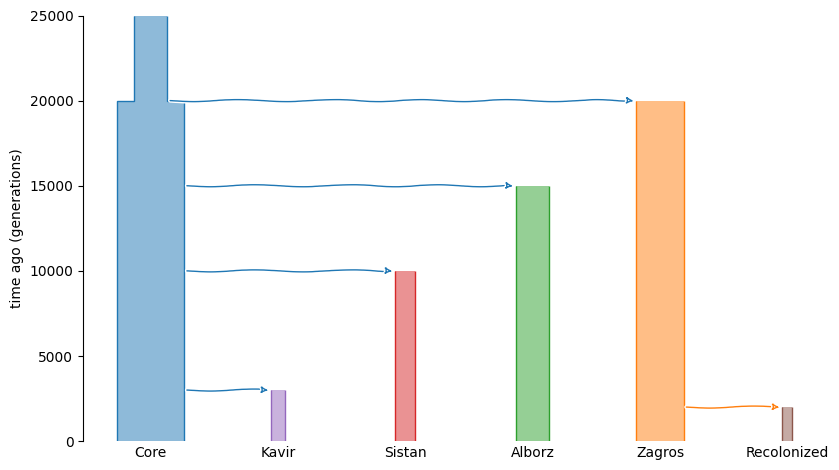
Populations: Core, Zagros, Alborz, Kavir, Sistan, Recolonized
Kavir goes extinct at 3000 gen, recolonized from Zagros at 2000 gen.
AsymReversal_2F10
Two-pop with migration direction reversal over time
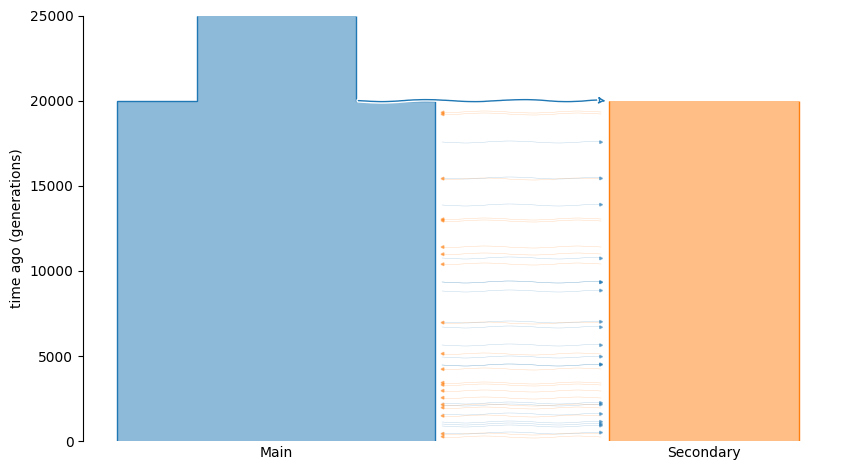
Populations: Main, Secondary
Migration reverses direction at 5000 gen ago. Tests temporal asymmetry.
SilkRoad_8F10
Eight-population Silk Road stepping-stone model
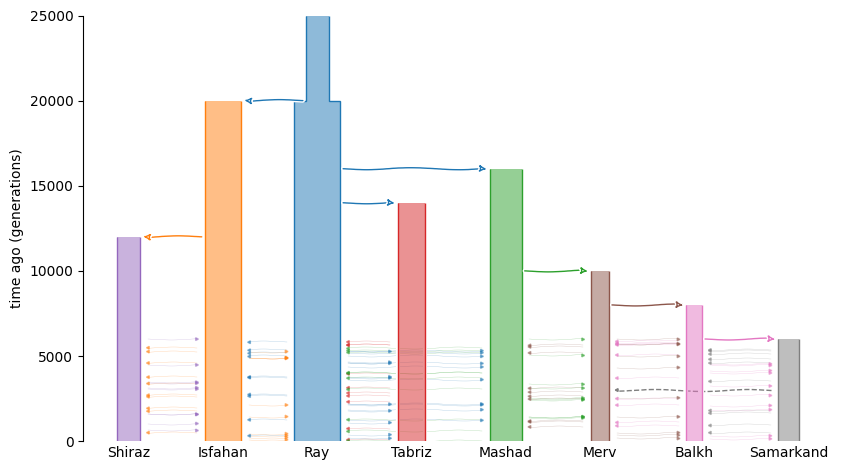
Populations: Ray, Isfahan, Shiraz, Tabriz, Mashad, Merv, Balkh, Samarkand
Eight cities along the Silk Road with stepping-stone migration and admixture.
Peri (Peri paradisi) — Beautiful fairy-like spirits, intermediate between the divine and mortal realms. In the Shahnameh, Peris sometimes interbreed with human lineages — natural admixture events.
Genome summary
- ID:
PerPar- Species:
Peri paradisi
- Common name:
Peri (fairy/angel-like spirit)
- Assembly:
Peristan1.0(GCA_FERD_PerPar)- Ploidy:
2
- Generation time:
40 years
- Population size:
100,000
Chromosomes
Name |
Length (bp) |
Mutation rate |
Recombination rate |
|---|---|---|---|
1 |
20,000,000 |
4.00e-08 |
3.50e-08 |
2 |
18,000,000 |
4.00e-08 |
3.50e-08 |
3 |
16,000,000 |
4.00e-08 |
3.50e-08 |
4 |
14,000,000 |
4.00e-08 |
3.50e-08 |
5 |
12,000,000 |
4.00e-08 |
3.50e-08 |
peri_mitogenome |
17,000 |
1.12e-07 |
0.00e+00 |
Demographic models
Constant_1F10
Single population constant-size model
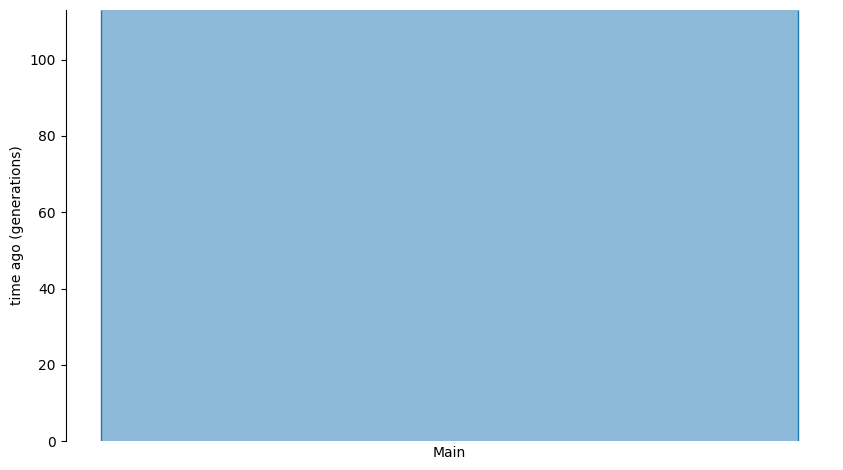
Populations: Main
Single population of Peri (fairy/angel-like spirit) at constant size N=100000.
ThreeEpoch_1F10
Single population three-epoch model with bottleneck
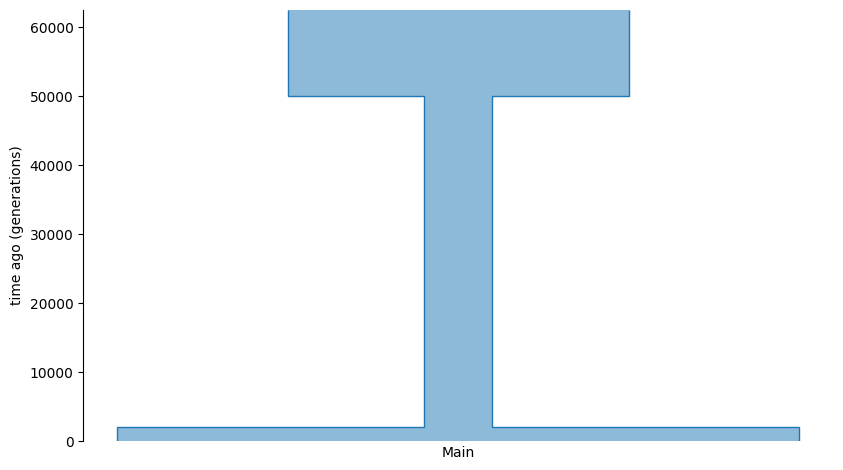
Populations: Main
Single pop of Peri (fairy/angel-like spirit). Modern N=100000, bottleneck 10000 at 2000 gen, ancestral 50000 at 50000 gen.
TwoPopSplit_2F10
Two population split with symmetric migration
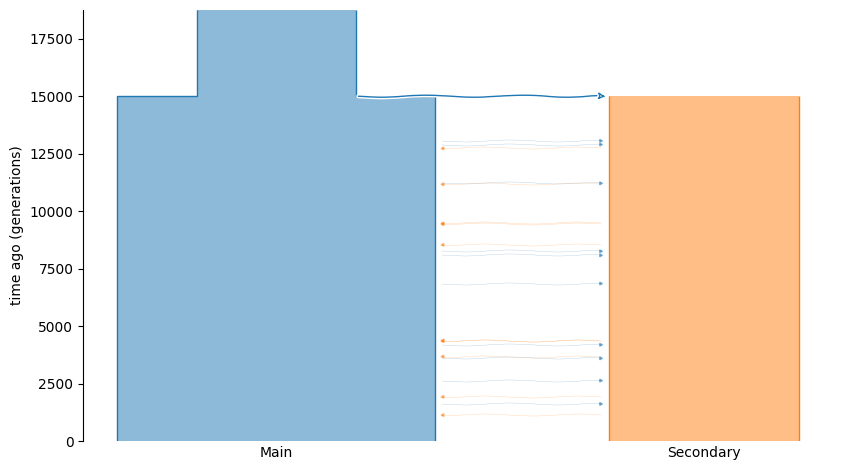
Populations: Main, Secondary
Two pops of Peri (fairy/angel-like spirit). Main N=100000, Secondary N=60000. Split 15000 gen ago.
GhostAdmixture_3F10
Two sampled pops + extinct ghost with pulse admixture
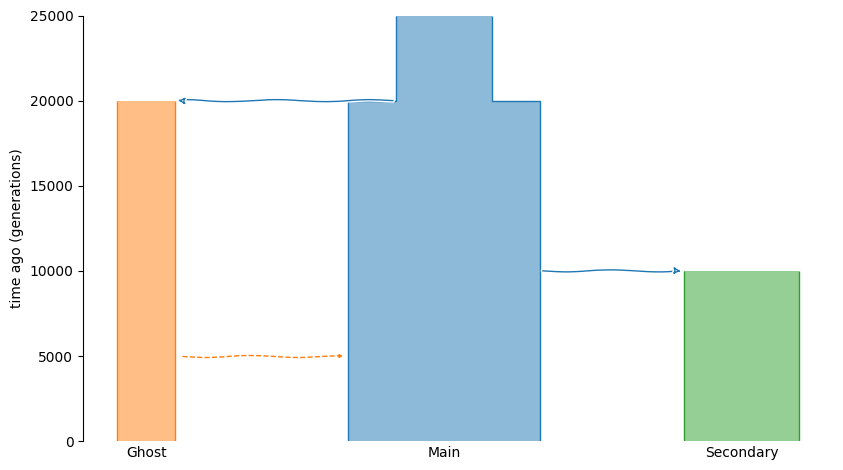
Populations: Main, Secondary, Ghost
Ghost contributes 15%% pulse admixture to Main at 5000 gen. Non-tree-like history.
ThreePopAdmix_3F10
Three populations with bidirectional pulse admixture
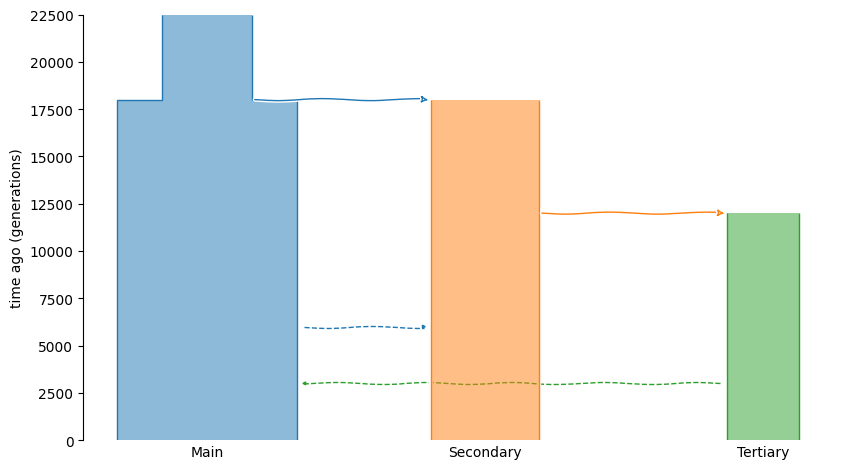
Populations: Main, Secondary, Tertiary
10%% Tertiary->Main at 3000 gen, 5%% Main->Secondary at 6000 gen. Admixture graph.
FourRegion_4F10
Four-population stepping-stone across Iranian plateau
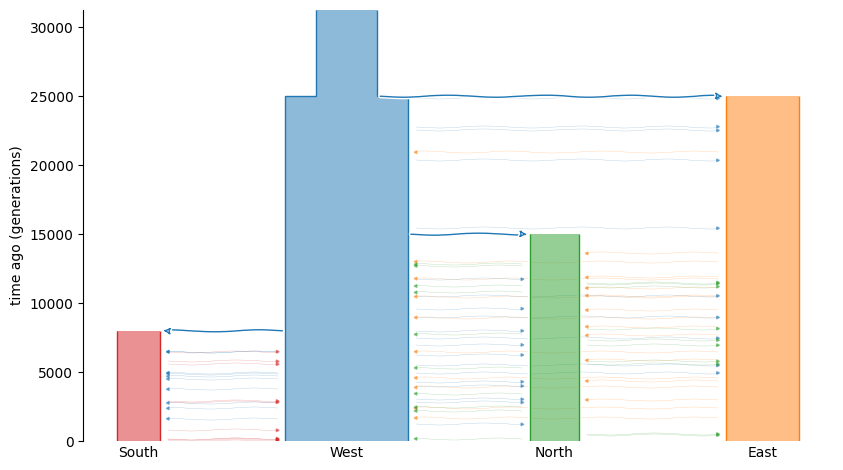
Populations: West, East, North, South
West, East, North, South populations with stepping-stone migration.
FiveRealm_5F10
Five-population admixture graph (Iran-Turan-Rum-Hind-Chin)
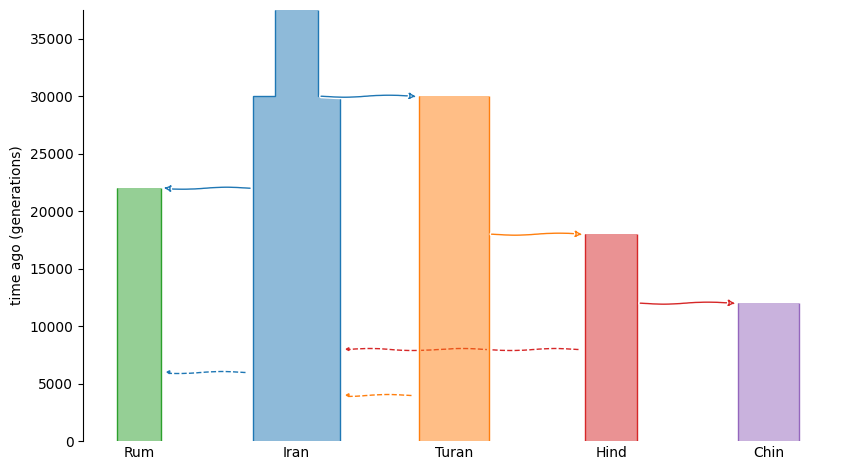
Populations: Iran, Turan, Rum, Hind, Chin
Five Shahnameh realms with pulse admixture events. Tests 5-pop graph inference.
SixPopExtRecolon_6F10
Six-population model with extinction and recolonization
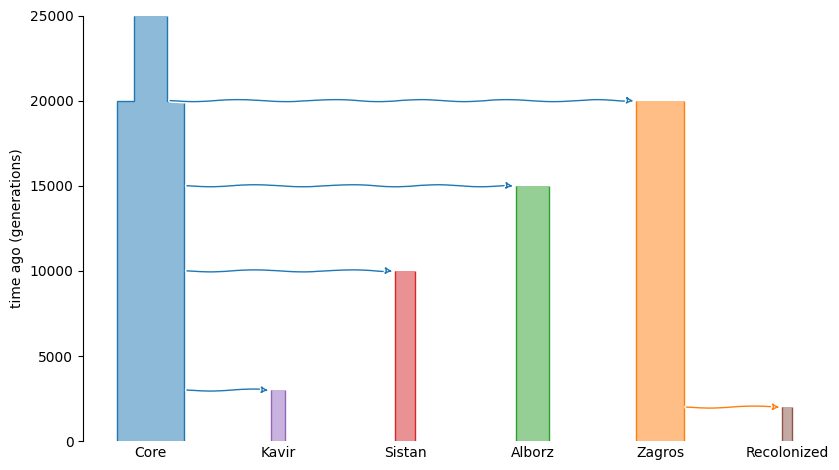
Populations: Core, Zagros, Alborz, Kavir, Sistan, Recolonized
Kavir goes extinct at 3000 gen, recolonized from Zagros at 2000 gen.
AsymReversal_2F10
Two-pop with migration direction reversal over time
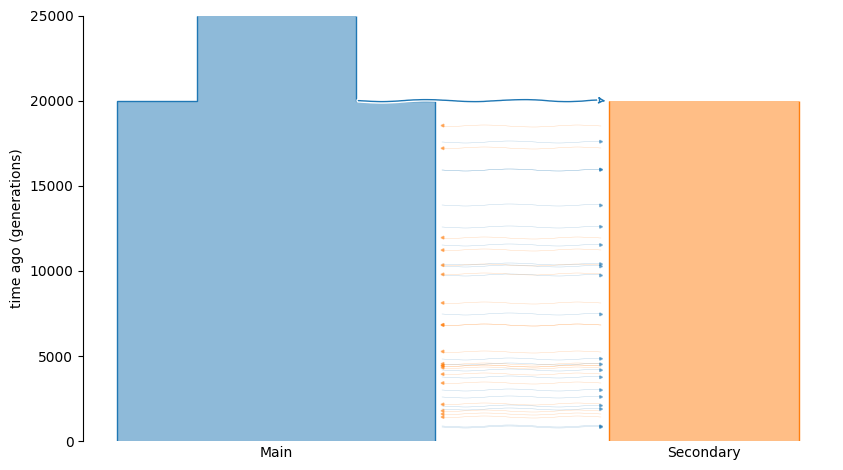
Populations: Main, Secondary
Migration reverses direction at 5000 gen ago. Tests temporal asymmetry.
SilkRoad_8F10
Eight-population Silk Road stepping-stone model
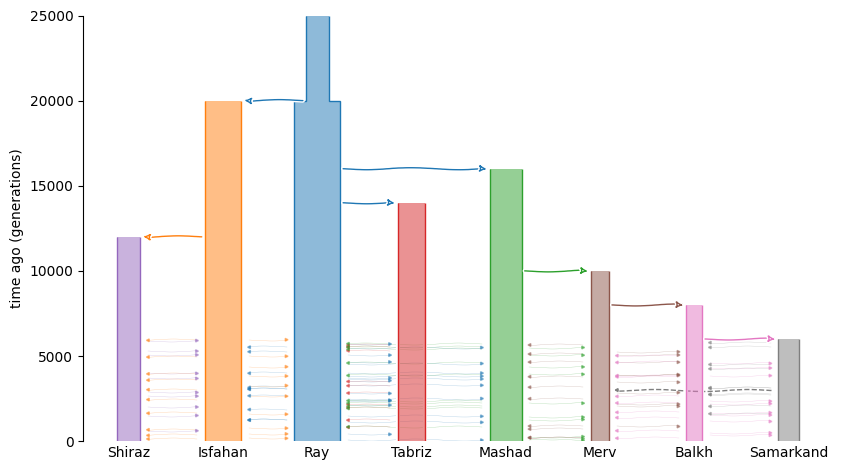
Populations: Ray, Isfahan, Shiraz, Tabriz, Mashad, Merv, Balkh, Samarkand
Eight cities along the Silk Road with stepping-stone migration and admixture.
Al (Al daemonius) — Nocturnal demons from Iranian folklore, associated with sleep paralysis and childhood illness.
Genome summary
- ID:
AlDem- Species:
Al daemonius
- Common name:
Al (nocturnal demon)
- Assembly:
AlNight1.0(GCA_FERD_AlDem)- Ploidy:
2
- Generation time:
20 years
- Population size:
70,000
Chromosomes
Name |
Length (bp) |
Mutation rate |
Recombination rate |
|---|---|---|---|
1 |
20,000,000 |
6.00e-08 |
2.00e-08 |
2 |
18,000,000 |
6.00e-08 |
2.00e-08 |
3 |
16,000,000 |
6.00e-08 |
2.00e-08 |
4 |
14,000,000 |
6.00e-08 |
2.00e-08 |
al_mitogenome |
17,000 |
1.68e-07 |
0.00e+00 |
Demographic models
Constant_1F10
Single population constant-size model
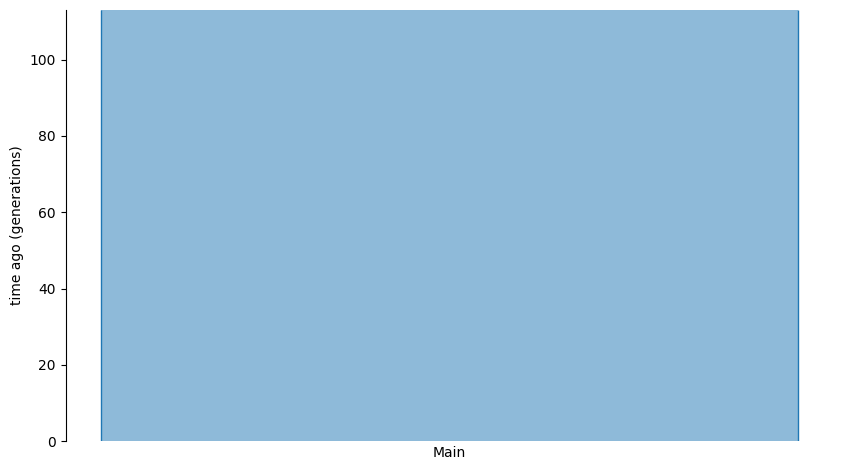
Populations: Main
Single population of Al (nocturnal demon) at constant size N=70000.
ThreeEpoch_1F10
Single population three-epoch model with bottleneck
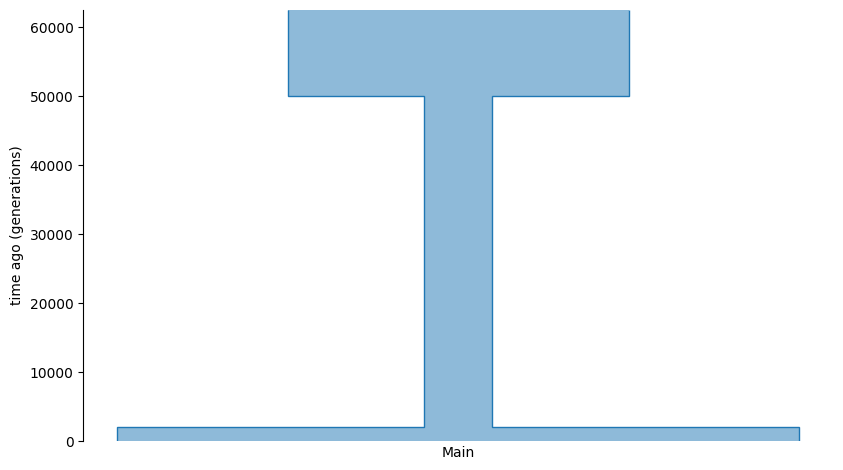
Populations: Main
Single pop of Al (nocturnal demon). Modern N=70000, bottleneck 7000 at 2000 gen, ancestral 35000 at 50000 gen.
TwoPopSplit_2F10
Two population split with symmetric migration
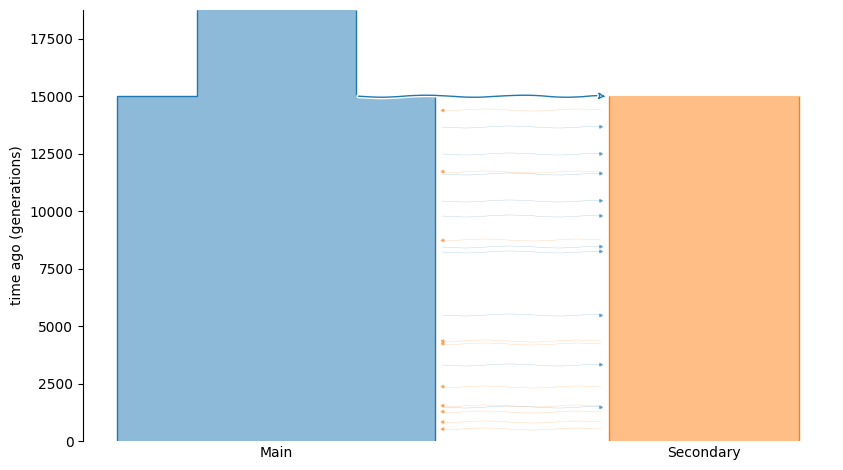
Populations: Main, Secondary
Two pops of Al (nocturnal demon). Main N=70000, Secondary N=42000. Split 15000 gen ago.
GhostAdmixture_3F10
Two sampled pops + extinct ghost with pulse admixture
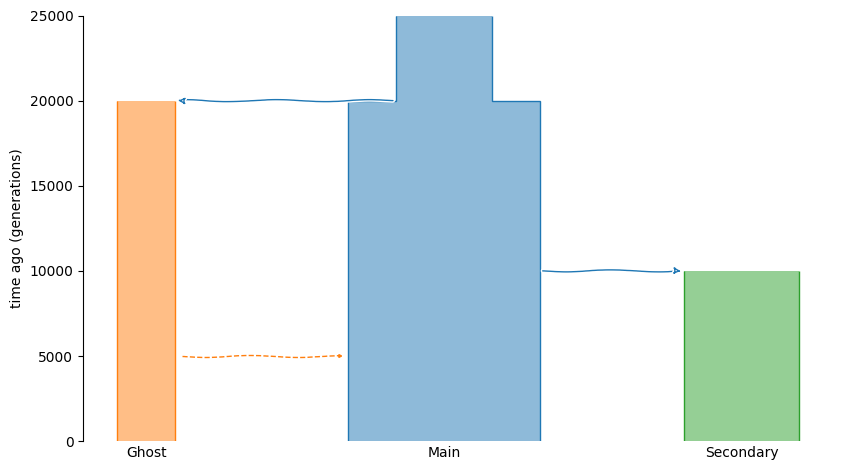
Populations: Main, Secondary, Ghost
Ghost contributes 15%% pulse admixture to Main at 5000 gen. Non-tree-like history.
ThreePopAdmix_3F10
Three populations with bidirectional pulse admixture
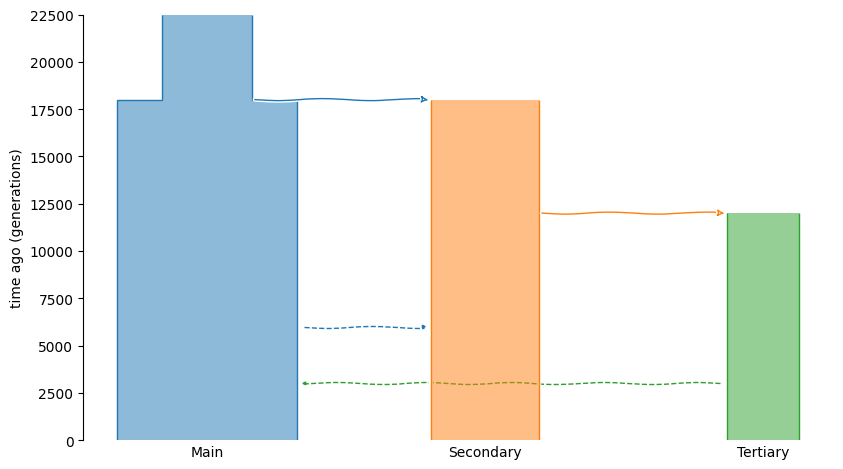
Populations: Main, Secondary, Tertiary
10%% Tertiary->Main at 3000 gen, 5%% Main->Secondary at 6000 gen. Admixture graph.
FourRegion_4F10
Four-population stepping-stone across Iranian plateau
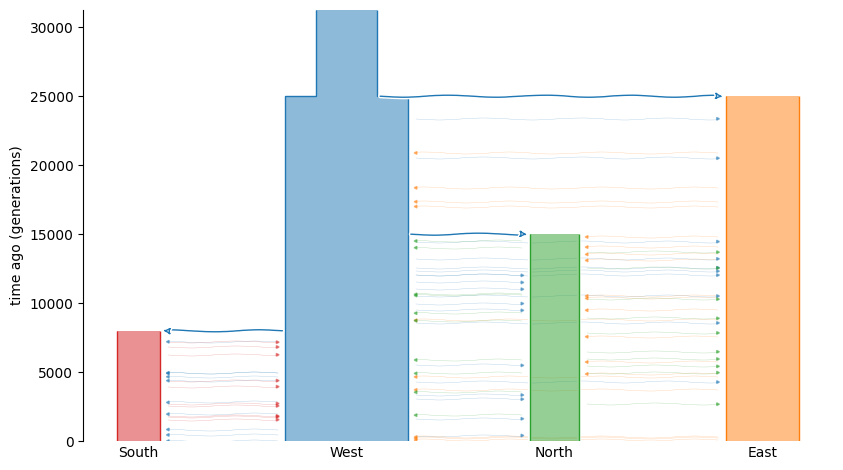
Populations: West, East, North, South
West, East, North, South populations with stepping-stone migration.
FiveRealm_5F10
Five-population admixture graph (Iran-Turan-Rum-Hind-Chin)
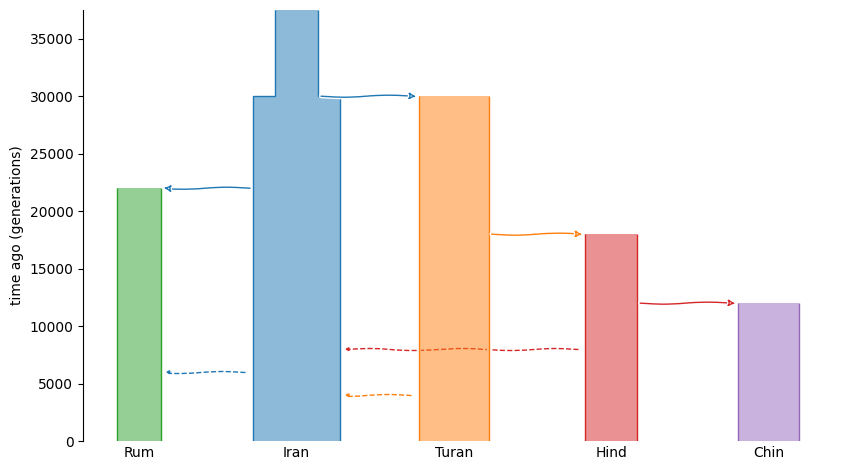
Populations: Iran, Turan, Rum, Hind, Chin
Five Shahnameh realms with pulse admixture events. Tests 5-pop graph inference.
SixPopExtRecolon_6F10
Six-population model with extinction and recolonization
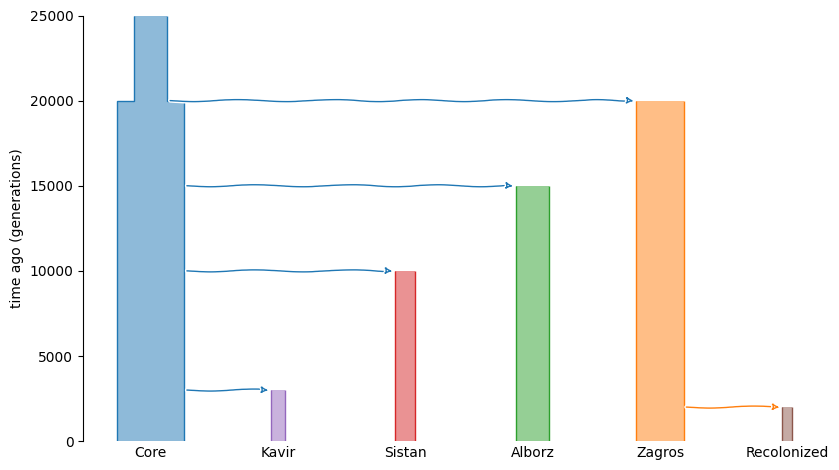
Populations: Core, Zagros, Alborz, Kavir, Sistan, Recolonized
Kavir goes extinct at 3000 gen, recolonized from Zagros at 2000 gen.
AsymReversal_2F10
Two-pop with migration direction reversal over time
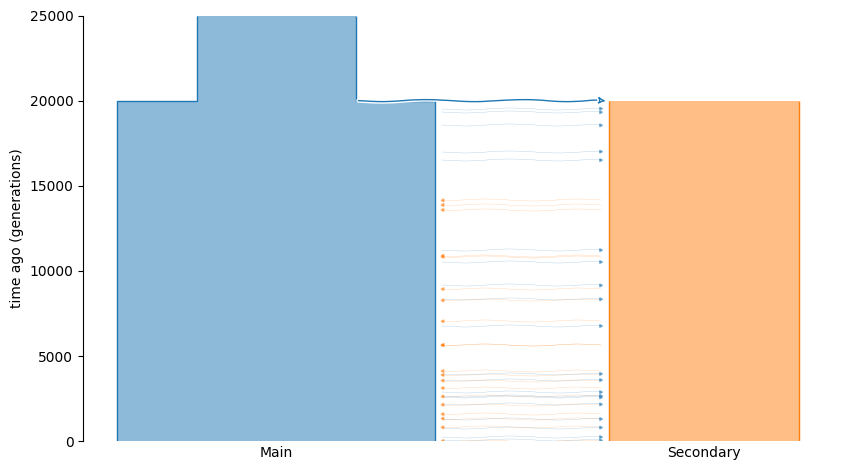
Populations: Main, Secondary
Migration reverses direction at 5000 gen ago. Tests temporal asymmetry.
SilkRoad_8F10
Eight-population Silk Road stepping-stone model
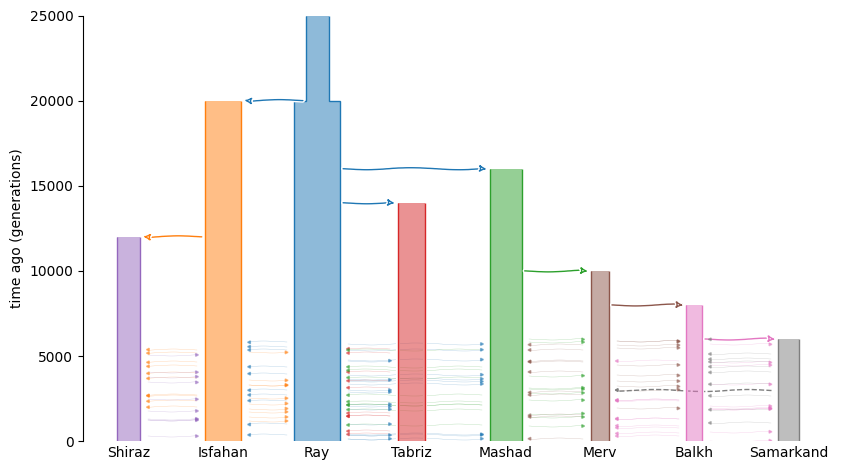
Populations: Ray, Isfahan, Shiraz, Tabriz, Mashad, Merv, Balkh, Samarkand
Eight cities along the Silk Road with stepping-stone migration and admixture.
Ghoul (Ghoul underworld) — Desert-dwelling undead (ghul), shape-shifters that prey on travellers. Originated in Persian folklore before spreading to Arabic tradition.
Genome summary
- ID:
GhoUnd- Species:
Ghoul underworld
- Common name:
Ghoul (ghul, desert undead)
- Assembly:
Ghul1.0(GCA_FERD_GhoUnd)- Ploidy:
2
- Generation time:
25 years
- Population size:
40,000
Chromosomes
Name |
Length (bp) |
Mutation rate |
Recombination rate |
|---|---|---|---|
1 |
20,000,000 |
4.50e-08 |
1.80e-08 |
2 |
18,000,000 |
4.50e-08 |
1.80e-08 |
3 |
16,000,000 |
4.50e-08 |
1.80e-08 |
4 |
14,000,000 |
4.50e-08 |
1.80e-08 |
ghul_mitogenome |
17,000 |
1.26e-07 |
0.00e+00 |
Demographic models
Constant_1F10
Single population constant-size model
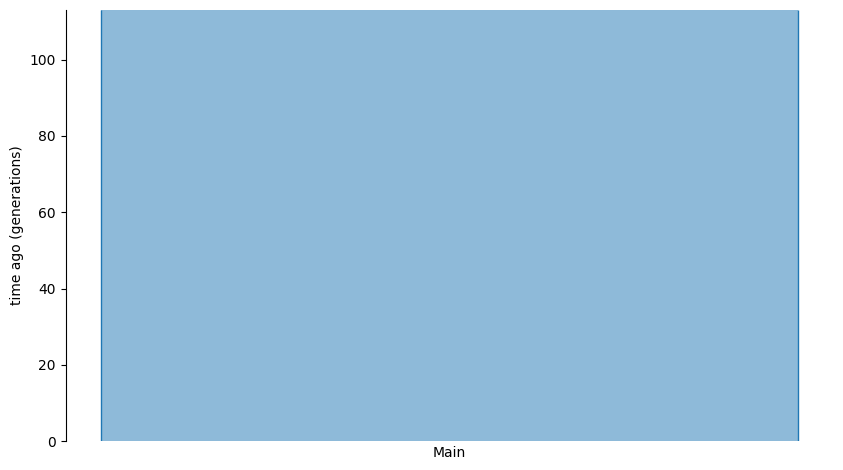
Populations: Main
Single population of Ghoul (ghul, desert undead) at constant size N=40000.
ThreeEpoch_1F10
Single population three-epoch model with bottleneck
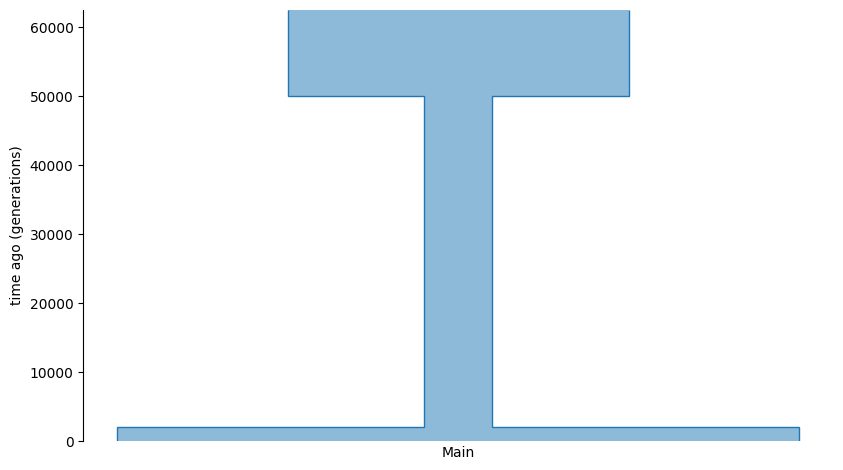
Populations: Main
Single pop of Ghoul (ghul, desert undead). Modern N=40000, bottleneck 4000 at 2000 gen, ancestral 20000 at 50000 gen.
TwoPopSplit_2F10
Two population split with symmetric migration
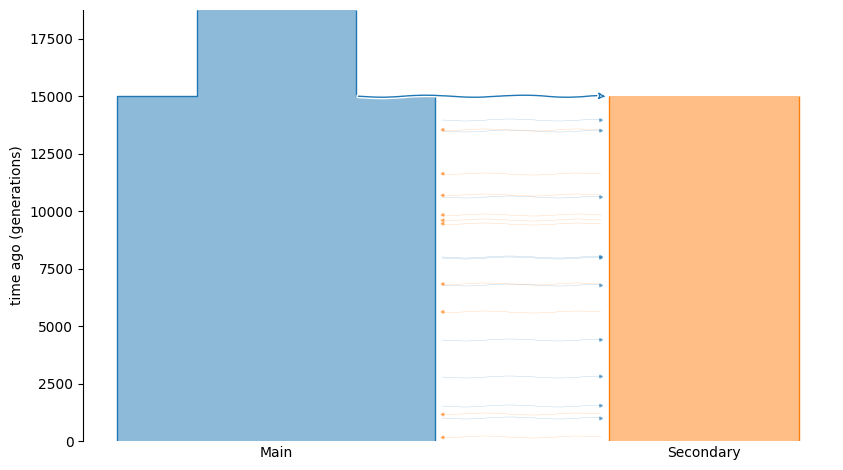
Populations: Main, Secondary
Two pops of Ghoul (ghul, desert undead). Main N=40000, Secondary N=24000. Split 15000 gen ago.
GhostAdmixture_3F10
Two sampled pops + extinct ghost with pulse admixture
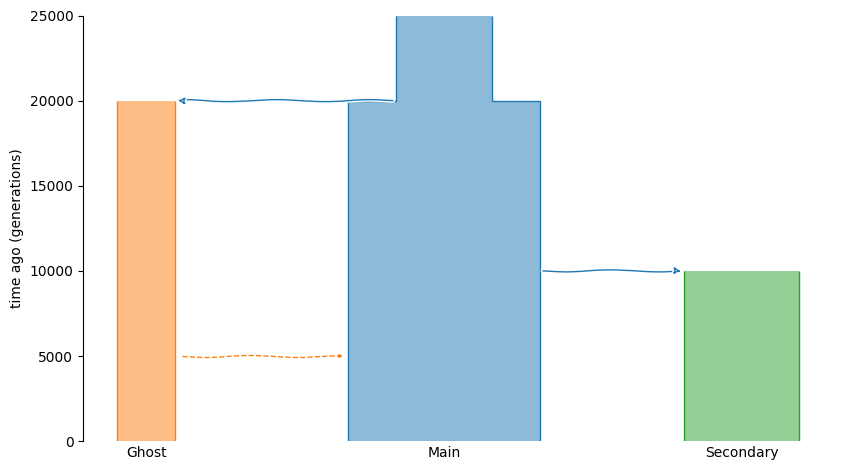
Populations: Main, Secondary, Ghost
Ghost contributes 15%% pulse admixture to Main at 5000 gen. Non-tree-like history.
ThreePopAdmix_3F10
Three populations with bidirectional pulse admixture
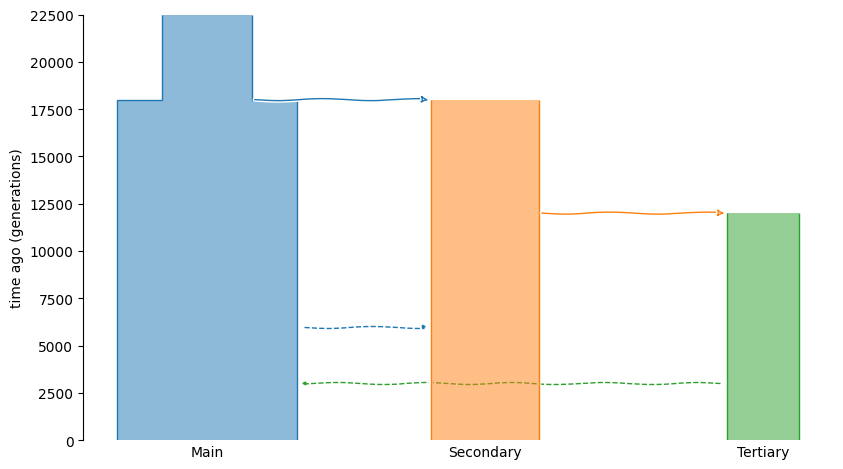
Populations: Main, Secondary, Tertiary
10%% Tertiary->Main at 3000 gen, 5%% Main->Secondary at 6000 gen. Admixture graph.
FourRegion_4F10
Four-population stepping-stone across Iranian plateau
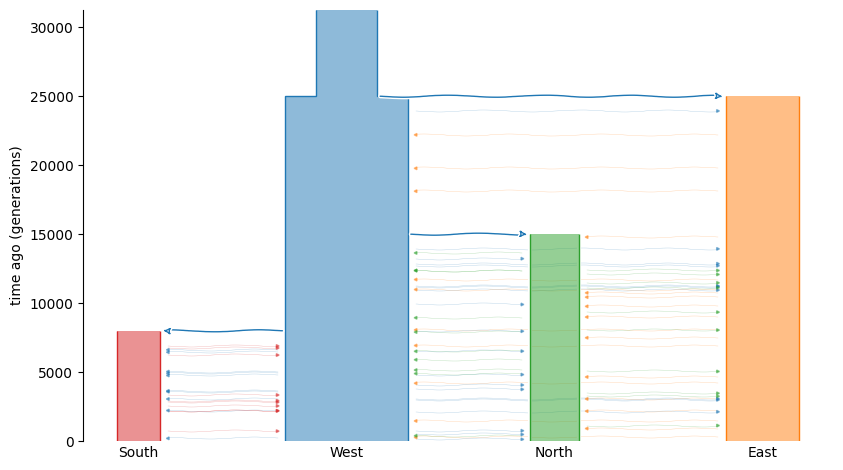
Populations: West, East, North, South
West, East, North, South populations with stepping-stone migration.
FiveRealm_5F10
Five-population admixture graph (Iran-Turan-Rum-Hind-Chin)
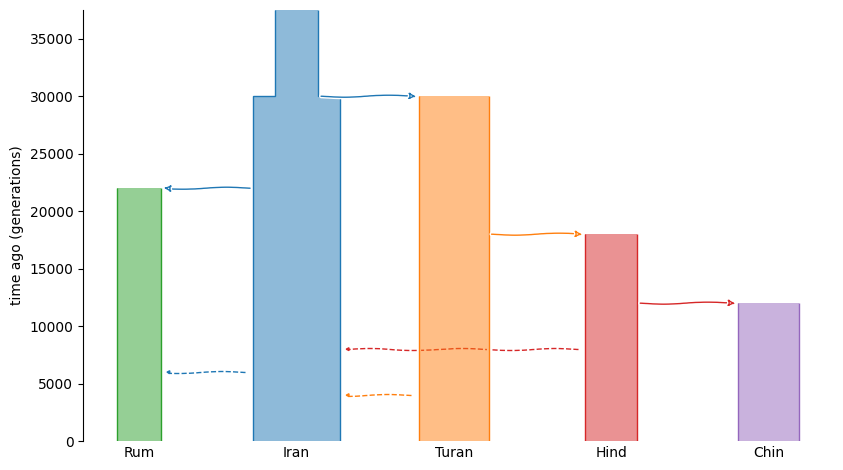
Populations: Iran, Turan, Rum, Hind, Chin
Five Shahnameh realms with pulse admixture events. Tests 5-pop graph inference.
SixPopExtRecolon_6F10
Six-population model with extinction and recolonization
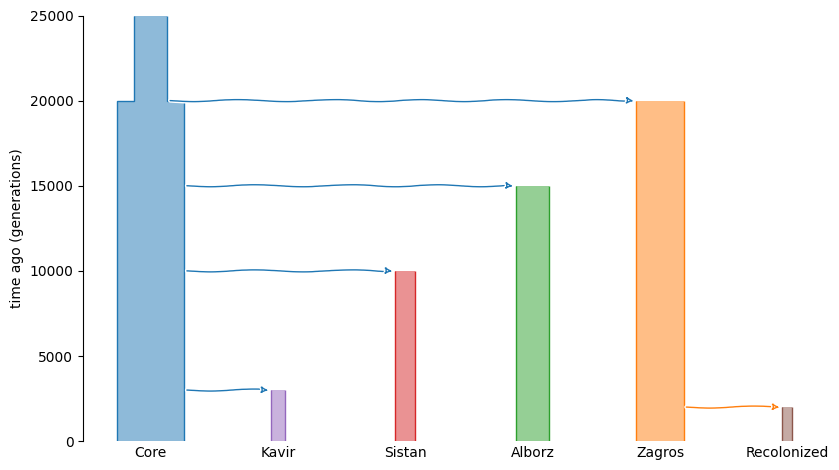
Populations: Core, Zagros, Alborz, Kavir, Sistan, Recolonized
Kavir goes extinct at 3000 gen, recolonized from Zagros at 2000 gen.
AsymReversal_2F10
Two-pop with migration direction reversal over time
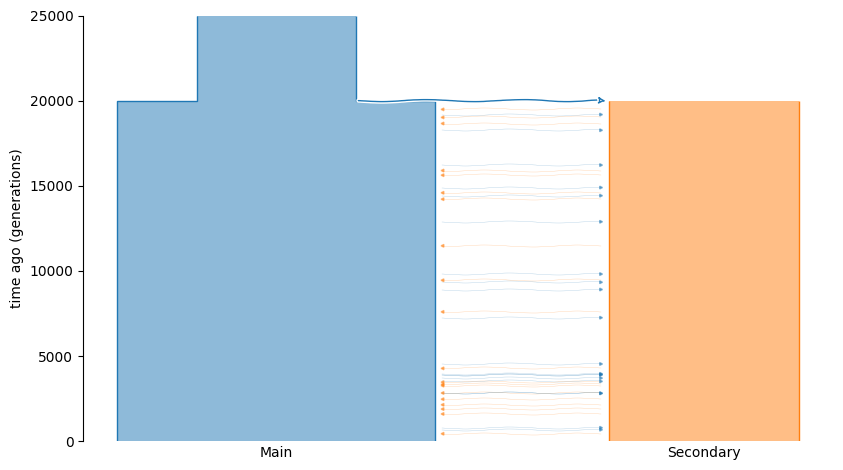
Populations: Main, Secondary
Migration reverses direction at 5000 gen ago. Tests temporal asymmetry.
SilkRoad_8F10
Eight-population Silk Road stepping-stone model
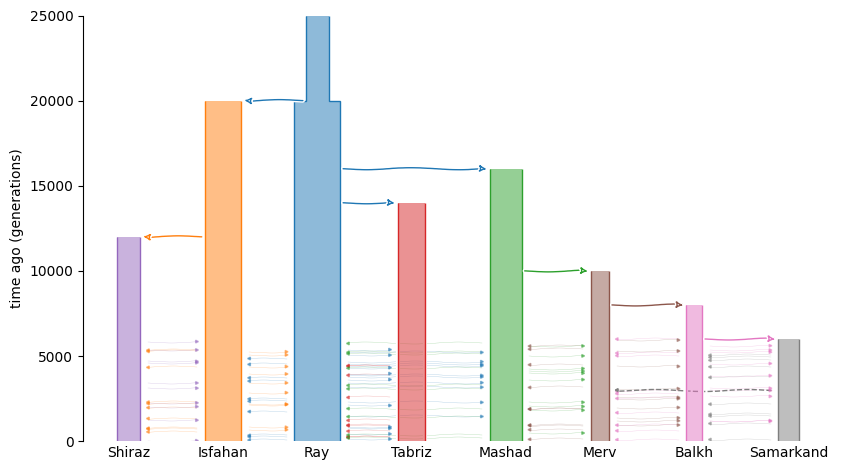
Populations: Ray, Isfahan, Shiraz, Tabriz, Mashad, Merv, Balkh, Samarkand
Eight cities along the Silk Road with stepping-stone migration and admixture.
Daeva (Daeva warrior) — False gods and war demons in Zoroastrian cosmology, the opposite of the Yazata. Large populations in the armies of Ahriman.
Genome summary
- ID:
DaeWar- Species:
Daeva warrior
- Common name:
Daeva (false god / war demon)
- Assembly:
Daeva1.0(GCA_FERD_DaeWar)- Ploidy:
2
- Generation time:
50 years
- Population size:
90,000
Chromosomes
Name |
Length (bp) |
Mutation rate |
Recombination rate |
|---|---|---|---|
1 |
20,000,000 |
3.50e-08 |
2.00e-08 |
2 |
18,000,000 |
3.50e-08 |
2.00e-08 |
3 |
16,000,000 |
3.50e-08 |
2.00e-08 |
4 |
14,000,000 |
3.50e-08 |
2.00e-08 |
5 |
12,000,000 |
3.50e-08 |
2.00e-08 |
daeva_mitogenome |
17,000 |
9.80e-08 |
0.00e+00 |
Demographic models
Constant_1F10
Single population constant-size model
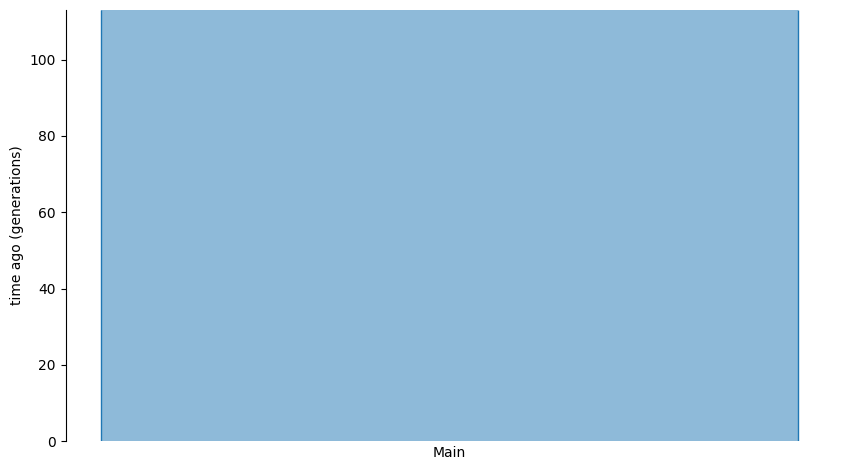
Populations: Main
Single population of Daeva (false god / war demon) at constant size N=90000.
ThreeEpoch_1F10
Single population three-epoch model with bottleneck
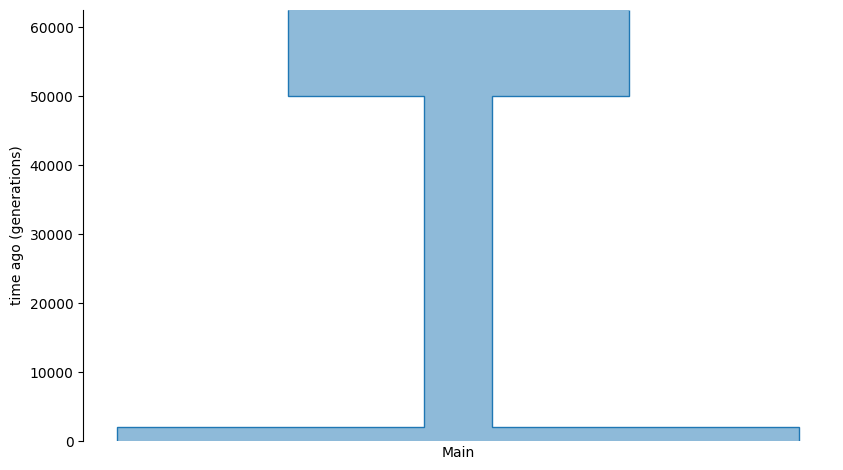
Populations: Main
Single pop of Daeva (false god / war demon). Modern N=90000, bottleneck 9000 at 2000 gen, ancestral 45000 at 50000 gen.
TwoPopSplit_2F10
Two population split with symmetric migration
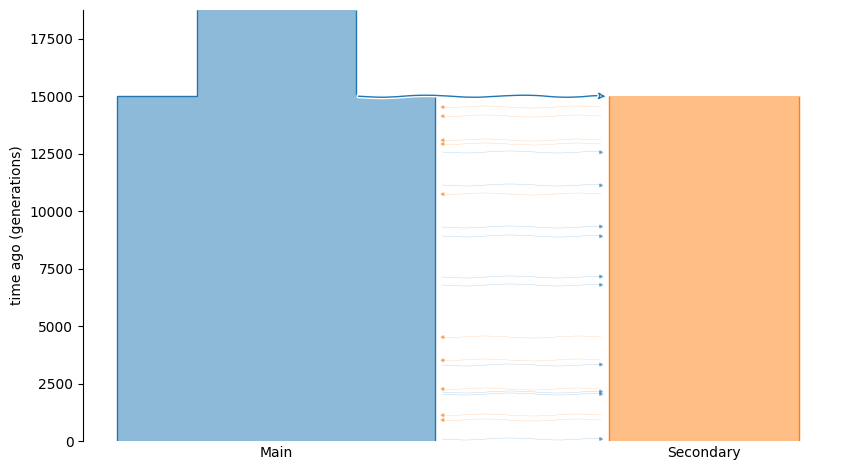
Populations: Main, Secondary
Two pops of Daeva (false god / war demon). Main N=90000, Secondary N=54000. Split 15000 gen ago.
GhostAdmixture_3F10
Two sampled pops + extinct ghost with pulse admixture
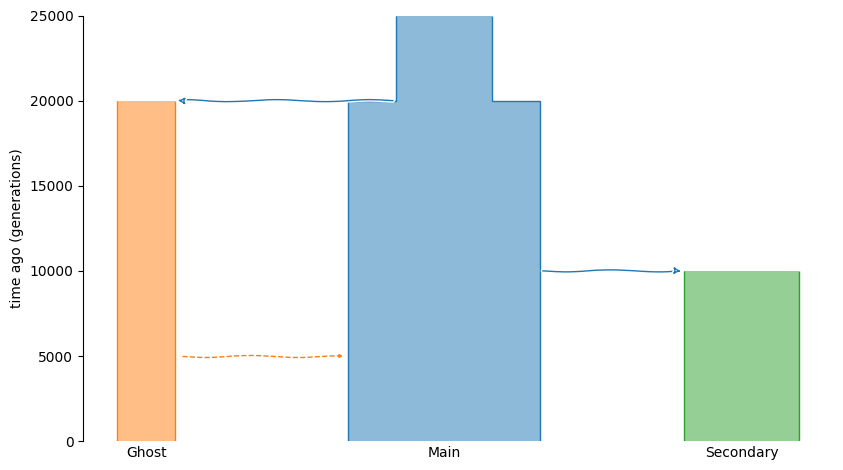
Populations: Main, Secondary, Ghost
Ghost contributes 15%% pulse admixture to Main at 5000 gen. Non-tree-like history.
ThreePopAdmix_3F10
Three populations with bidirectional pulse admixture
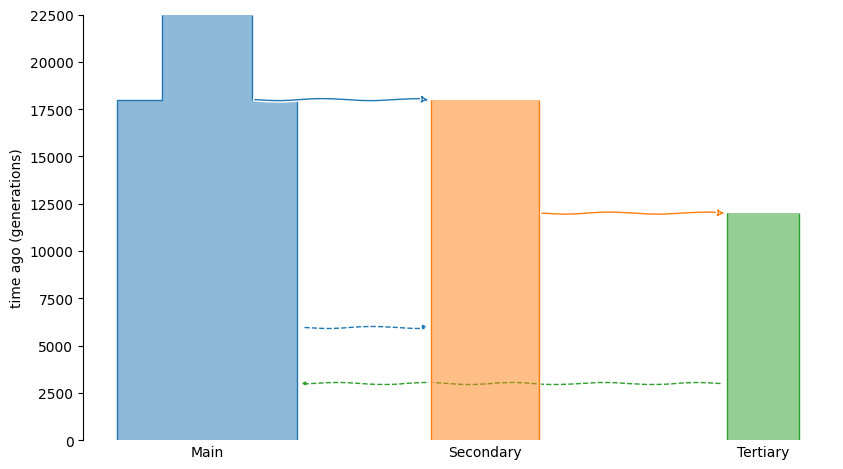
Populations: Main, Secondary, Tertiary
10%% Tertiary->Main at 3000 gen, 5%% Main->Secondary at 6000 gen. Admixture graph.
FourRegion_4F10
Four-population stepping-stone across Iranian plateau
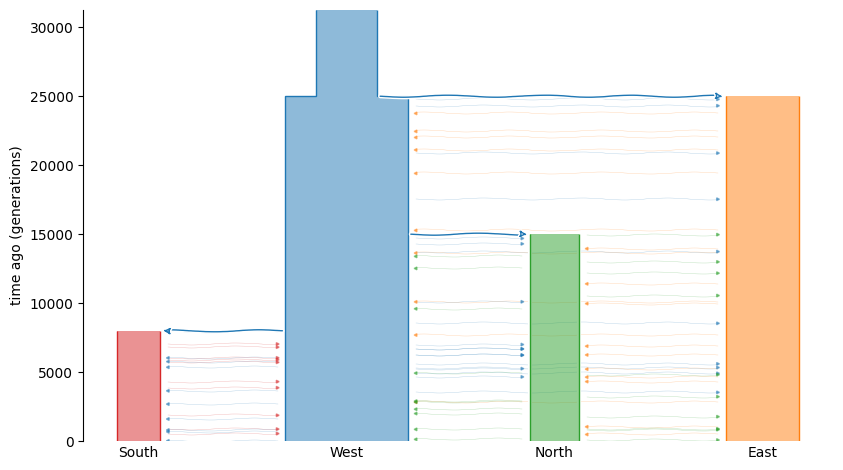
Populations: West, East, North, South
West, East, North, South populations with stepping-stone migration.
FiveRealm_5F10
Five-population admixture graph (Iran-Turan-Rum-Hind-Chin)
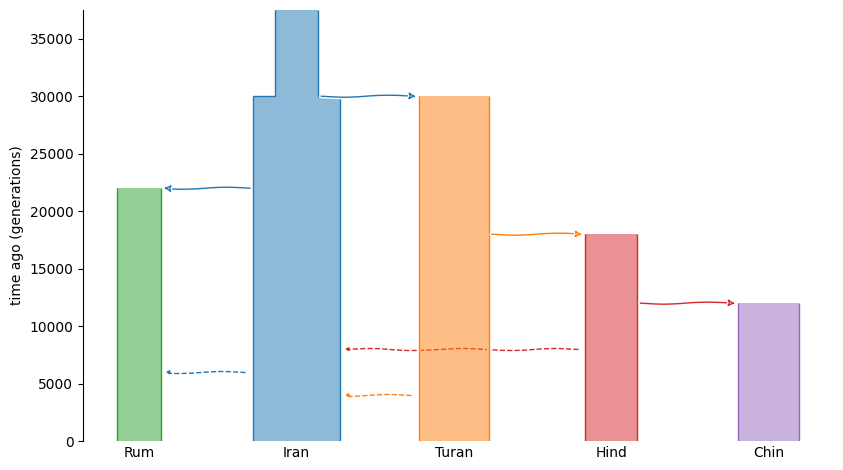
Populations: Iran, Turan, Rum, Hind, Chin
Five Shahnameh realms with pulse admixture events. Tests 5-pop graph inference.
SixPopExtRecolon_6F10
Six-population model with extinction and recolonization
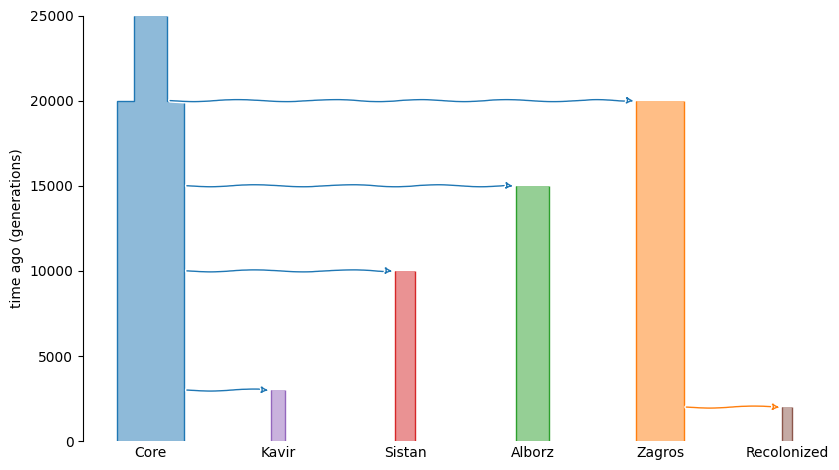
Populations: Core, Zagros, Alborz, Kavir, Sistan, Recolonized
Kavir goes extinct at 3000 gen, recolonized from Zagros at 2000 gen.
AsymReversal_2F10
Two-pop with migration direction reversal over time
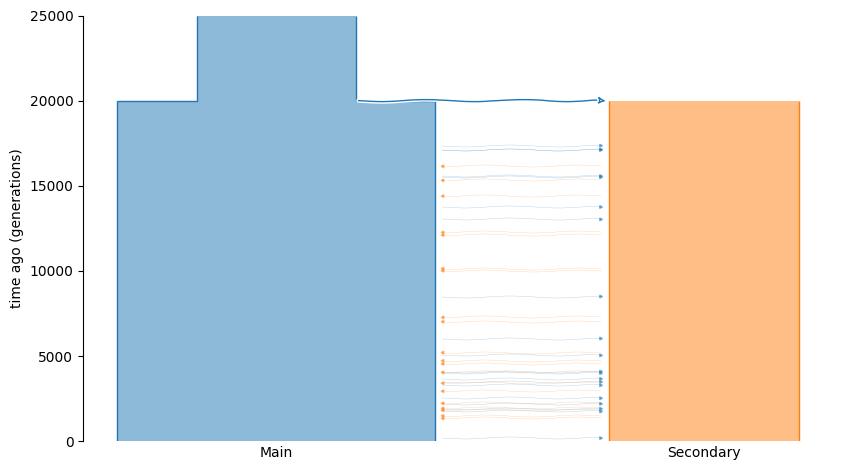
Populations: Main, Secondary
Migration reverses direction at 5000 gen ago. Tests temporal asymmetry.
SilkRoad_8F10
Eight-population Silk Road stepping-stone model
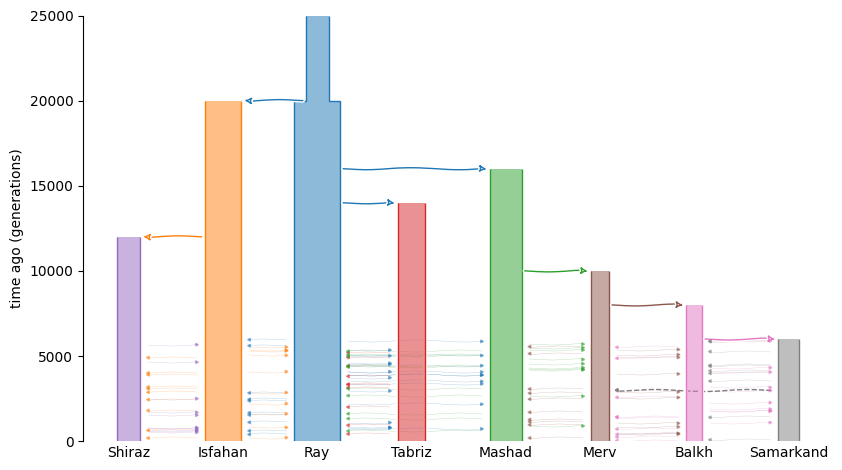
Populations: Ray, Isfahan, Shiraz, Tabriz, Mashad, Merv, Balkh, Samarkand
Eight cities along the Silk Road with stepping-stone migration and admixture.
Druj (Druj angra) — Demons of deceit and chaos in Zoroastrian theology, the fundamental force of evil (Angra Mainyu).
Genome summary
- ID:
DraAng- Species:
Druj angra
- Common name:
Druj (demon of deceit/chaos)
- Assembly:
Druj1.0(GCA_FERD_DraAng)- Ploidy:
2
- Generation time:
25 years
- Population size:
150,000
Chromosomes
Name |
Length (bp) |
Mutation rate |
Recombination rate |
|---|---|---|---|
1 |
20,000,000 |
5.00e-08 |
1.50e-08 |
2 |
18,000,000 |
5.00e-08 |
1.50e-08 |
3 |
16,000,000 |
5.00e-08 |
1.50e-08 |
4 |
14,000,000 |
5.00e-08 |
1.50e-08 |
5 |
12,000,000 |
5.00e-08 |
1.50e-08 |
druj_mitogenome |
17,000 |
1.40e-07 |
0.00e+00 |
Demographic models
Constant_1F10
Single population constant-size model
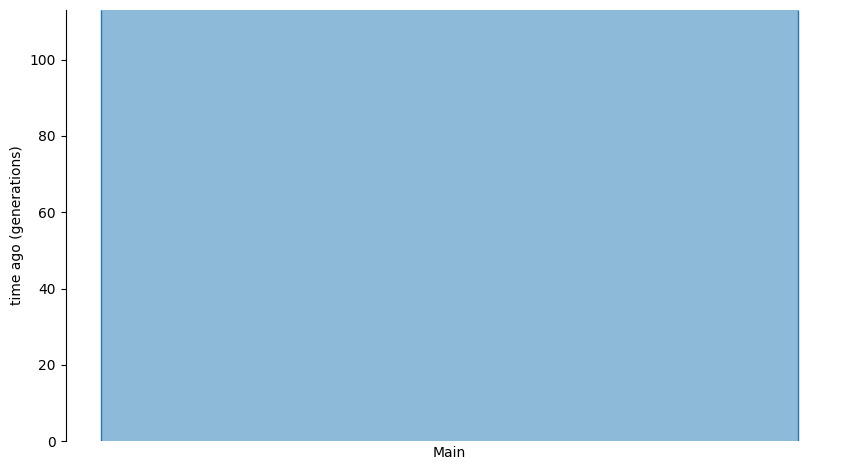
Populations: Main
Single population of Druj (demon of deceit/chaos) at constant size N=150000.
ThreeEpoch_1F10
Single population three-epoch model with bottleneck
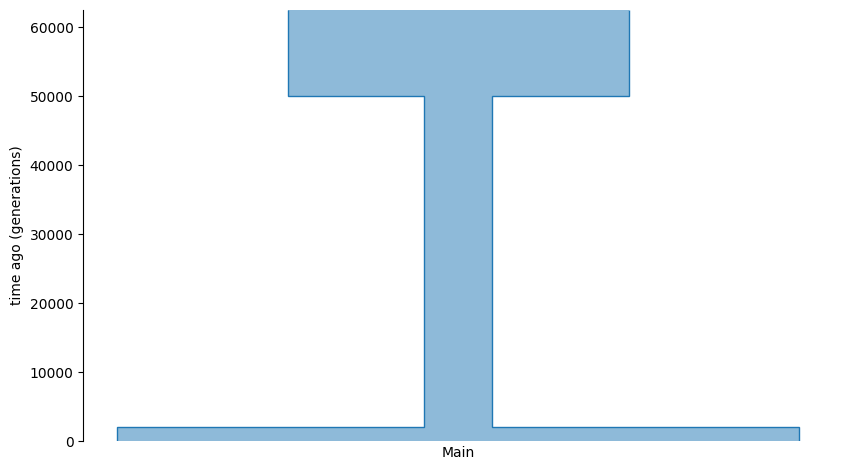
Populations: Main
Single pop of Druj (demon of deceit/chaos). Modern N=150000, bottleneck 15000 at 2000 gen, ancestral 75000 at 50000 gen.
TwoPopSplit_2F10
Two population split with symmetric migration
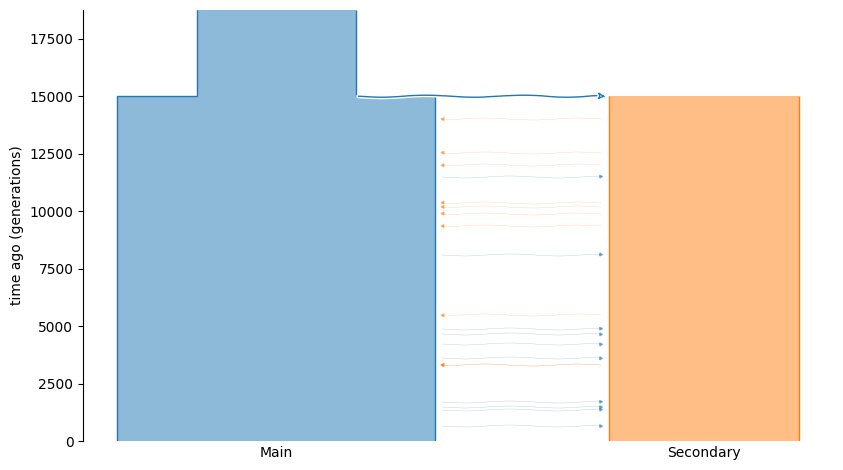
Populations: Main, Secondary
Two pops of Druj (demon of deceit/chaos). Main N=150000, Secondary N=90000. Split 15000 gen ago.
GhostAdmixture_3F10
Two sampled pops + extinct ghost with pulse admixture
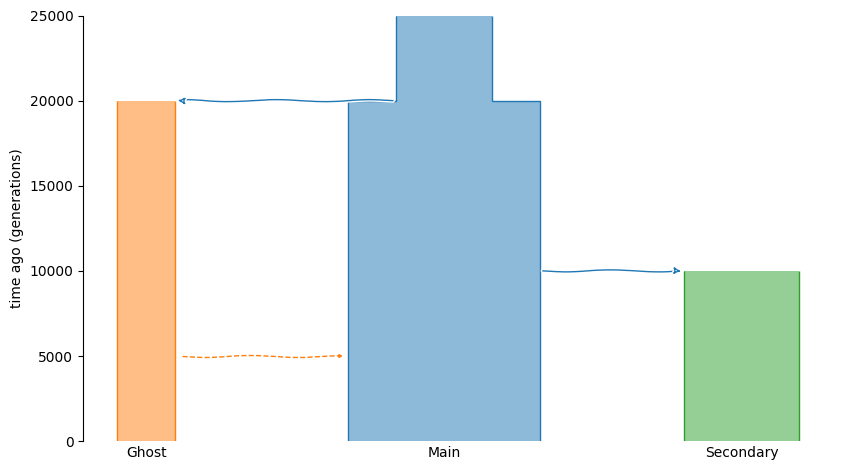
Populations: Main, Secondary, Ghost
Ghost contributes 15%% pulse admixture to Main at 5000 gen. Non-tree-like history.
ThreePopAdmix_3F10
Three populations with bidirectional pulse admixture
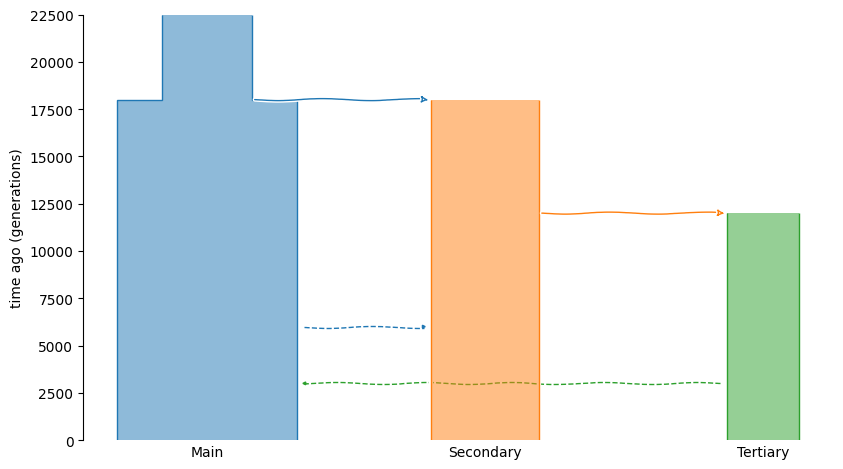
Populations: Main, Secondary, Tertiary
10%% Tertiary->Main at 3000 gen, 5%% Main->Secondary at 6000 gen. Admixture graph.
FourRegion_4F10
Four-population stepping-stone across Iranian plateau
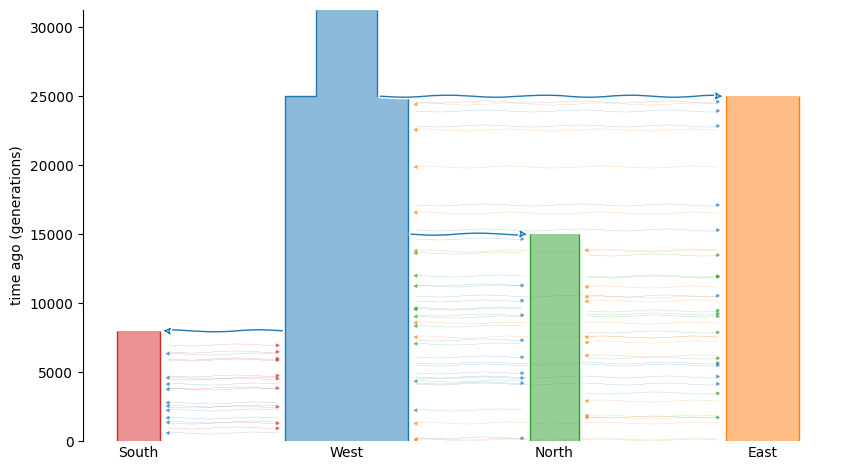
Populations: West, East, North, South
West, East, North, South populations with stepping-stone migration.
FiveRealm_5F10
Five-population admixture graph (Iran-Turan-Rum-Hind-Chin)
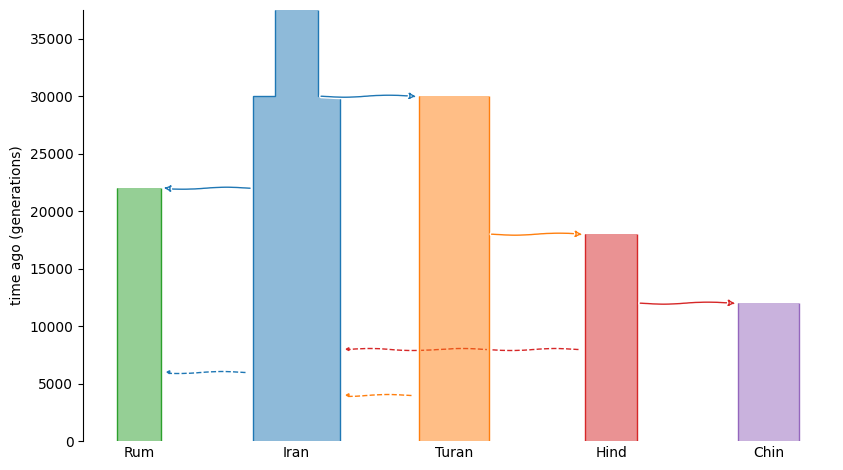
Populations: Iran, Turan, Rum, Hind, Chin
Five Shahnameh realms with pulse admixture events. Tests 5-pop graph inference.
SixPopExtRecolon_6F10
Six-population model with extinction and recolonization
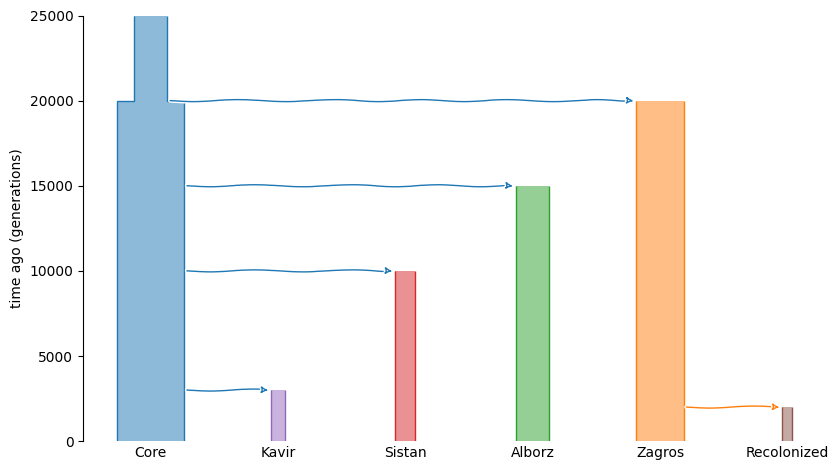
Populations: Core, Zagros, Alborz, Kavir, Sistan, Recolonized
Kavir goes extinct at 3000 gen, recolonized from Zagros at 2000 gen.
AsymReversal_2F10
Two-pop with migration direction reversal over time
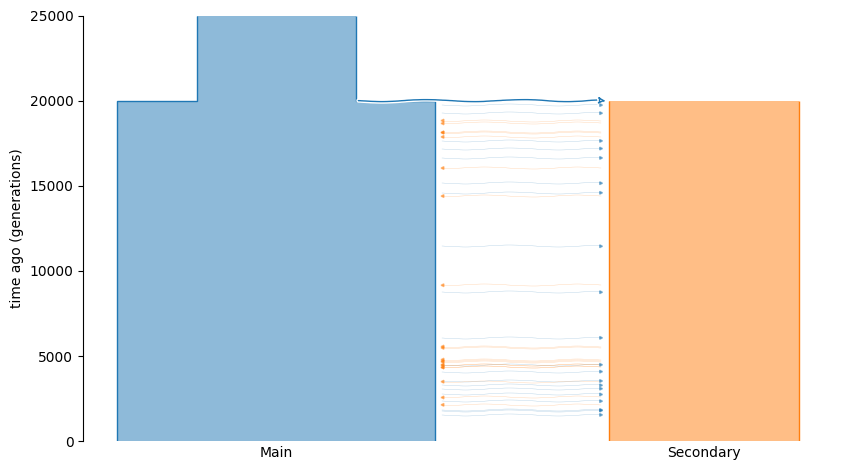
Populations: Main, Secondary
Migration reverses direction at 5000 gen ago. Tests temporal asymmetry.
SilkRoad_8F10
Eight-population Silk Road stepping-stone model
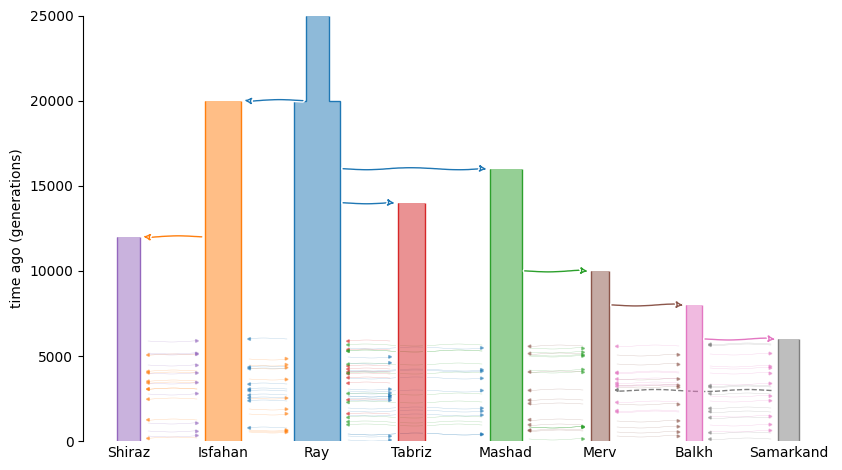
Populations: Ray, Isfahan, Shiraz, Tabriz, Mashad, Merv, Balkh, Samarkand
Eight cities along the Silk Road with stepping-stone migration and admixture.
Gul-spirit (Gulistan rosagarden) — Guardians of the rose garden (Gulistan), from Saadi’s literary tradition. Representing the gentler spirits of Persian literary mythology.
Genome summary
- ID:
GulRos- Species:
Gulistan rosagarden
- Common name:
Gul-spirit (rose garden guardian)
- Assembly:
Gulistan1.0(GCA_FERD_GulRos)- Ploidy:
2
- Generation time:
20 years
- Population size:
55,000
Chromosomes
Name |
Length (bp) |
Mutation rate |
Recombination rate |
|---|---|---|---|
1 |
20,000,000 |
4.00e-08 |
3.00e-08 |
2 |
18,000,000 |
4.00e-08 |
3.00e-08 |
3 |
16,000,000 |
4.00e-08 |
3.00e-08 |
4 |
14,000,000 |
4.00e-08 |
3.00e-08 |
5 |
12,000,000 |
4.00e-08 |
3.00e-08 |
gulistan_mitogenome |
17,000 |
1.12e-07 |
0.00e+00 |
Demographic models
Constant_1F10
Single population constant-size model
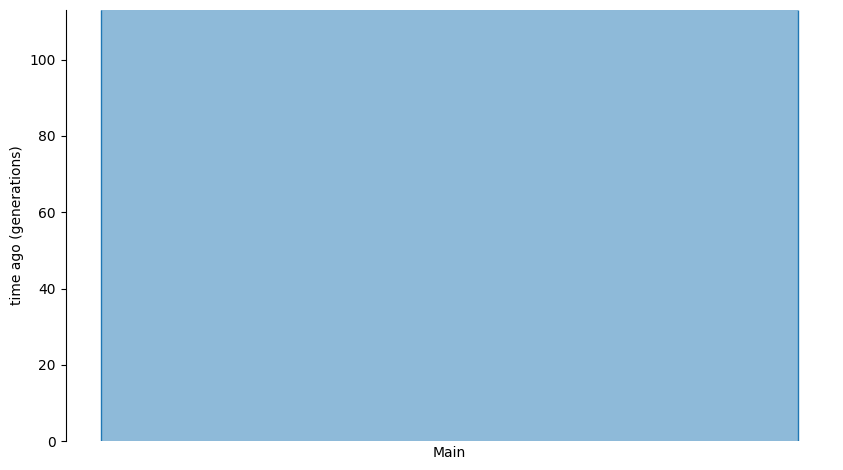
Populations: Main
Single population of Gul-spirit (rose garden guardian) at constant size N=55000.
ThreeEpoch_1F10
Single population three-epoch model with bottleneck
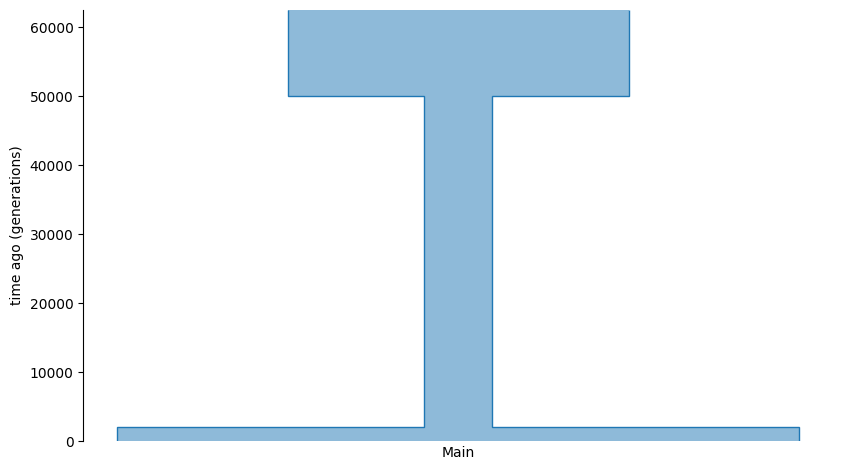
Populations: Main
Single pop of Gul-spirit (rose garden guardian). Modern N=55000, bottleneck 5500 at 2000 gen, ancestral 27500 at 50000 gen.
TwoPopSplit_2F10
Two population split with symmetric migration
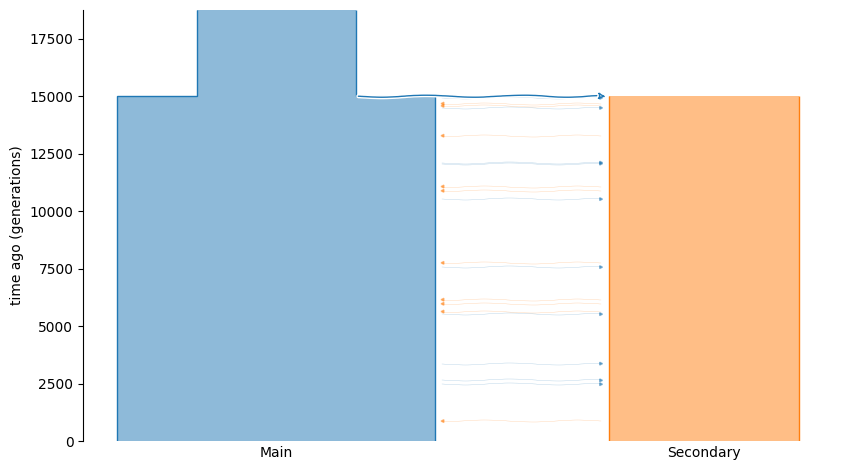
Populations: Main, Secondary
Two pops of Gul-spirit (rose garden guardian). Main N=55000, Secondary N=33000. Split 15000 gen ago.
GhostAdmixture_3F10
Two sampled pops + extinct ghost with pulse admixture
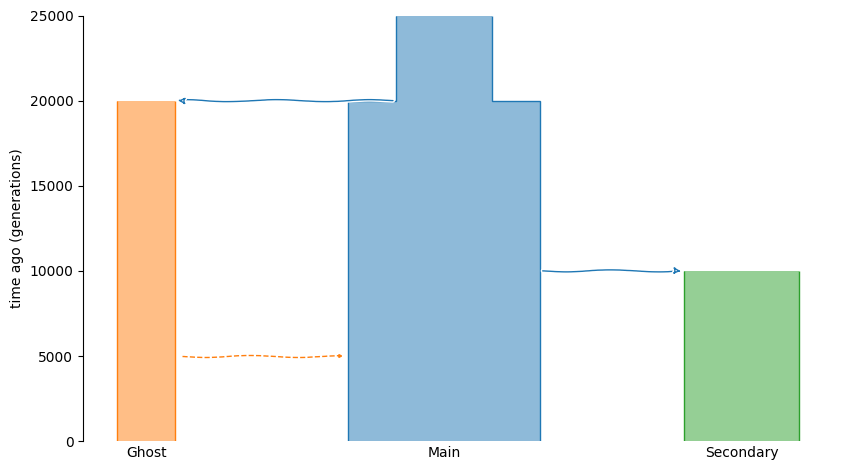
Populations: Main, Secondary, Ghost
Ghost contributes 15%% pulse admixture to Main at 5000 gen. Non-tree-like history.
ThreePopAdmix_3F10
Three populations with bidirectional pulse admixture
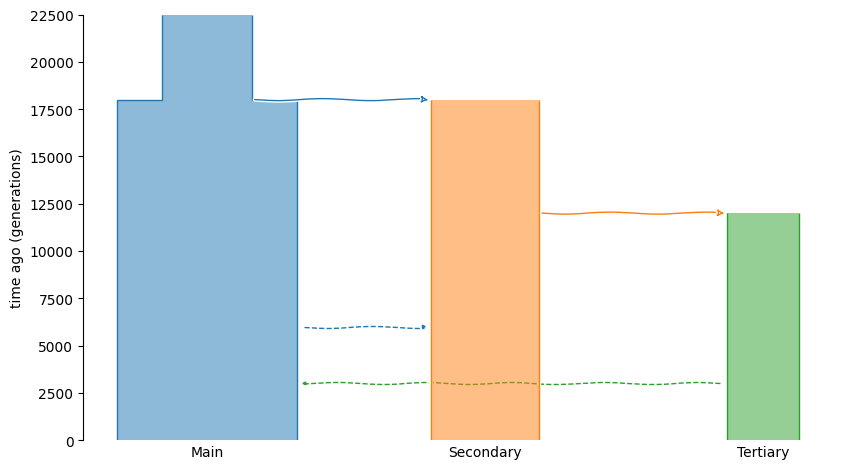
Populations: Main, Secondary, Tertiary
10%% Tertiary->Main at 3000 gen, 5%% Main->Secondary at 6000 gen. Admixture graph.
FourRegion_4F10
Four-population stepping-stone across Iranian plateau
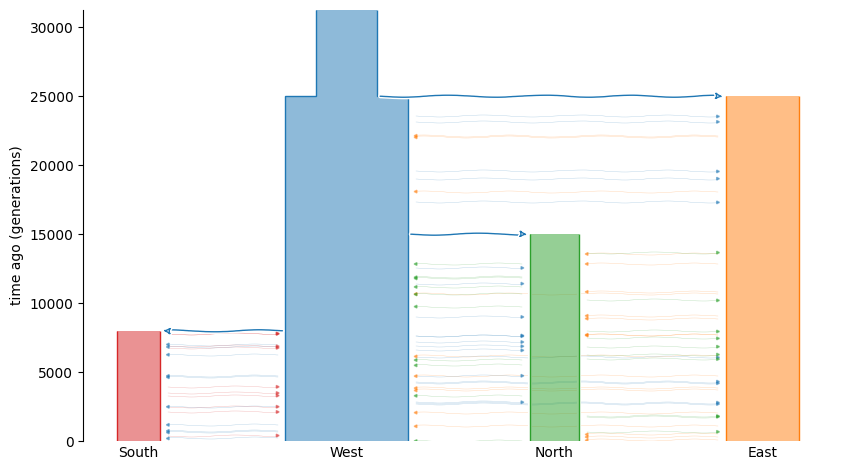
Populations: West, East, North, South
West, East, North, South populations with stepping-stone migration.
FiveRealm_5F10
Five-population admixture graph (Iran-Turan-Rum-Hind-Chin)
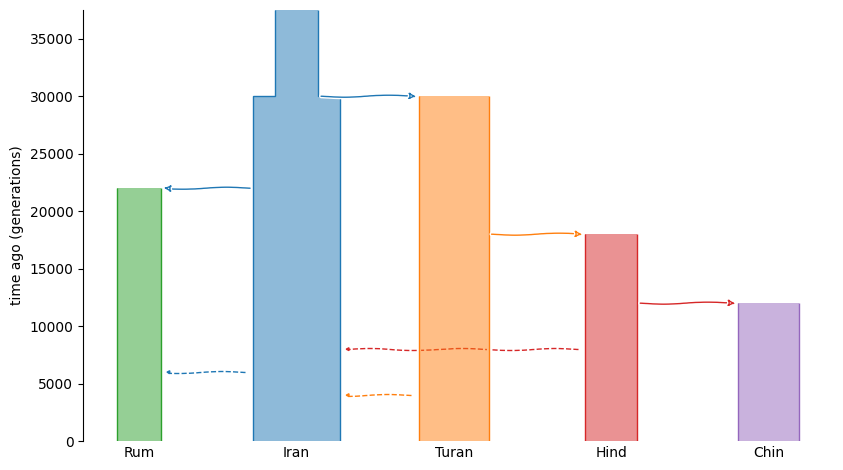
Populations: Iran, Turan, Rum, Hind, Chin
Five Shahnameh realms with pulse admixture events. Tests 5-pop graph inference.
SixPopExtRecolon_6F10
Six-population model with extinction and recolonization
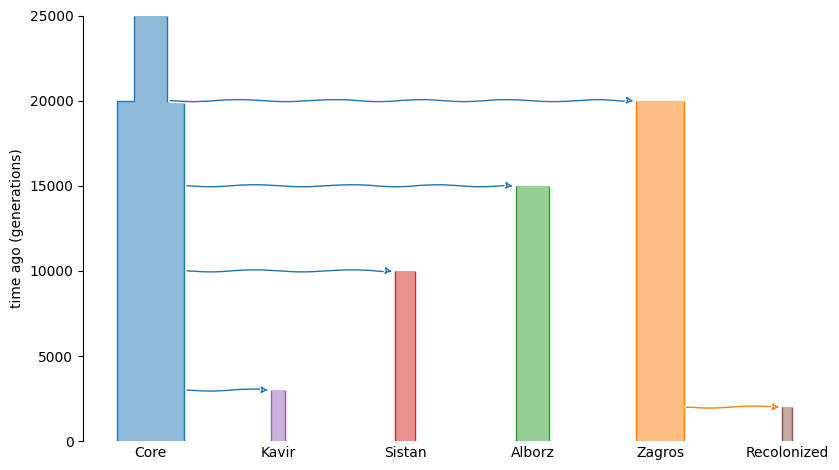
Populations: Core, Zagros, Alborz, Kavir, Sistan, Recolonized
Kavir goes extinct at 3000 gen, recolonized from Zagros at 2000 gen.
AsymReversal_2F10
Two-pop with migration direction reversal over time
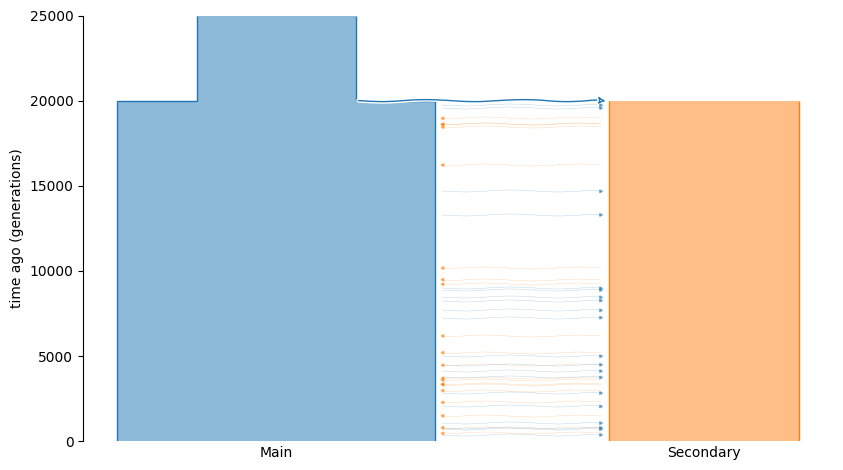
Populations: Main, Secondary
Migration reverses direction at 5000 gen ago. Tests temporal asymmetry.
SilkRoad_8F10
Eight-population Silk Road stepping-stone model
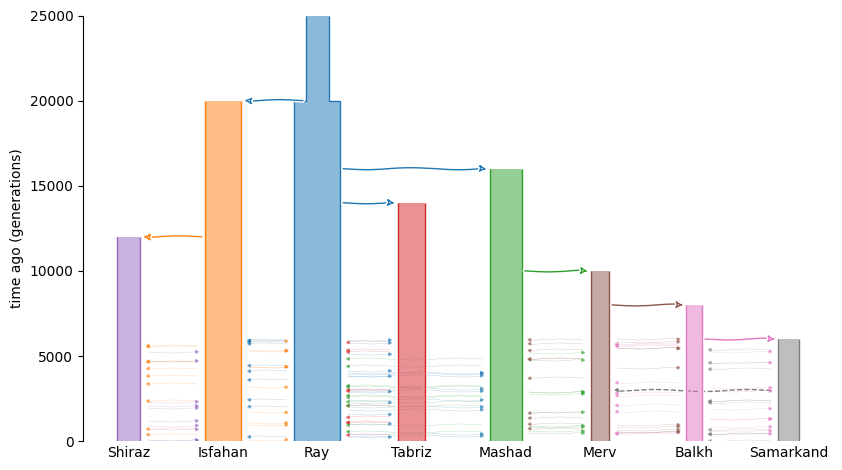
Populations: Ray, Isfahan, Shiraz, Tabriz, Mashad, Merv, Balkh, Samarkand
Eight cities along the Silk Road with stepping-stone migration and admixture.
Mythical Birds & Beasts
Huma (Huma paradisica) — The bird of paradise whose shadow bestows kingship. Never lands on the ground. Rare, with long generation times.
Genome summary
- ID:
HumBir- Species:
Huma paradisica
- Common name:
Huma (bird of paradise)
- Assembly:
HumaWing1.0(GCA_FERD_HumBir)- Ploidy:
2
- Generation time:
150 years
- Population size:
8,000
Chromosomes
Name |
Length (bp) |
Mutation rate |
Recombination rate |
|---|---|---|---|
1 |
20,000,000 |
1.00e-08 |
6.00e-08 |
2 |
18,000,000 |
1.00e-08 |
6.00e-08 |
3 |
16,000,000 |
1.00e-08 |
6.00e-08 |
4 |
14,000,000 |
1.00e-08 |
6.00e-08 |
5 |
12,000,000 |
1.00e-08 |
6.00e-08 |
6 |
10,000,000 |
1.00e-08 |
6.00e-08 |
huma_mitogenome |
17,000 |
2.80e-08 |
0.00e+00 |
Demographic models
Constant_1F10
Single population constant-size model
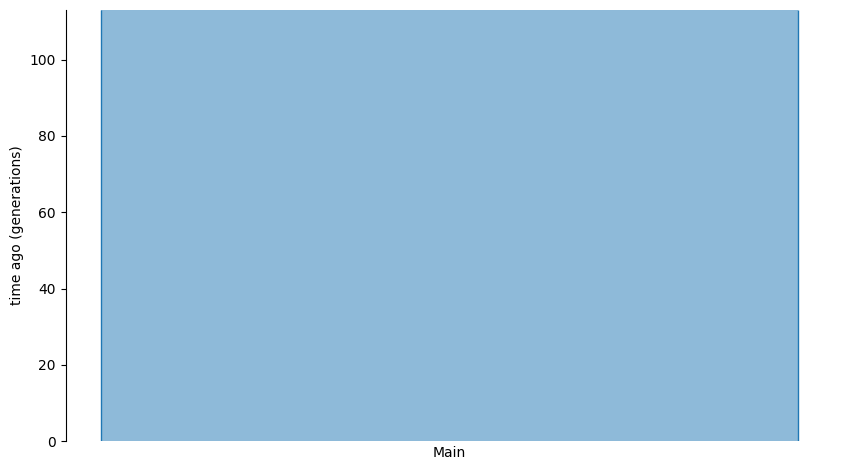
Populations: Main
Single population of Huma (bird of paradise) at constant size N=8000.
ThreeEpoch_1F10
Single population three-epoch model with bottleneck
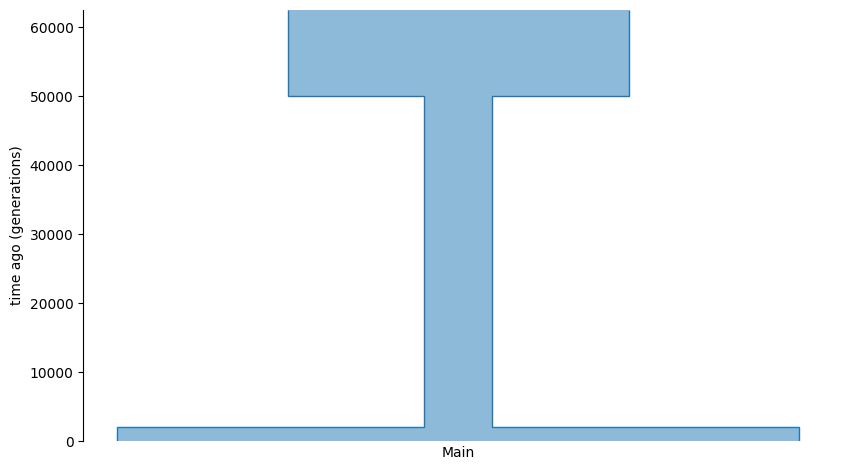
Populations: Main
Single pop of Huma (bird of paradise). Modern N=8000, bottleneck 800 at 2000 gen, ancestral 4000 at 50000 gen.
TwoPopSplit_2F10
Two population split with symmetric migration
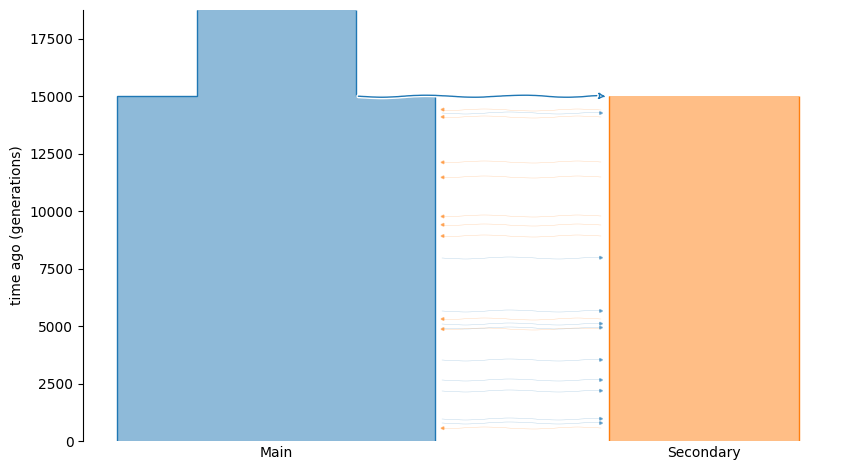
Populations: Main, Secondary
Two pops of Huma (bird of paradise). Main N=8000, Secondary N=4800. Split 15000 gen ago.
GhostAdmixture_3F10
Two sampled pops + extinct ghost with pulse admixture
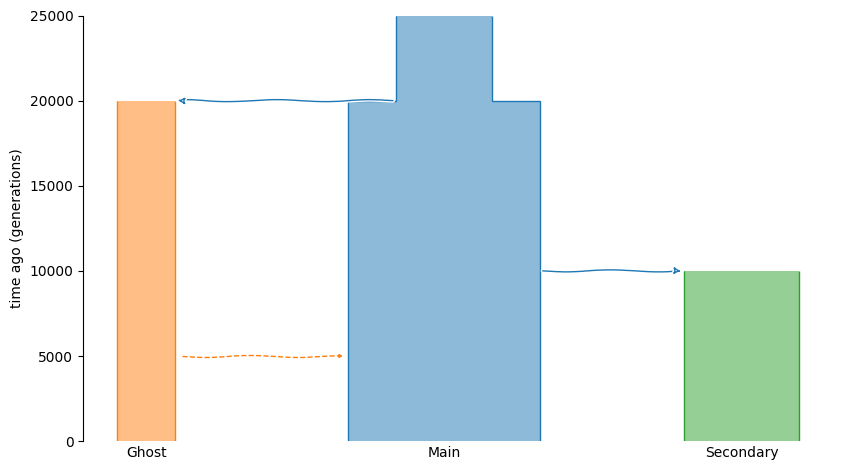
Populations: Main, Secondary, Ghost
Ghost contributes 15%% pulse admixture to Main at 5000 gen. Non-tree-like history.
ThreePopAdmix_3F10
Three populations with bidirectional pulse admixture
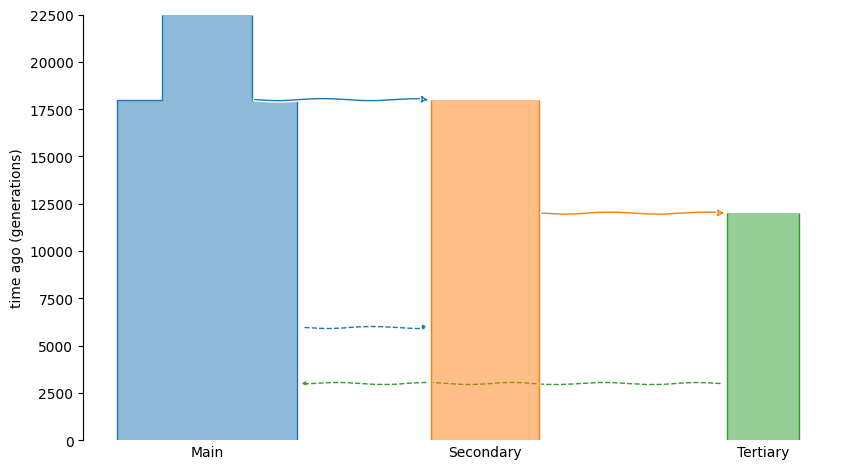
Populations: Main, Secondary, Tertiary
10%% Tertiary->Main at 3000 gen, 5%% Main->Secondary at 6000 gen. Admixture graph.
FourRegion_4F10
Four-population stepping-stone across Iranian plateau
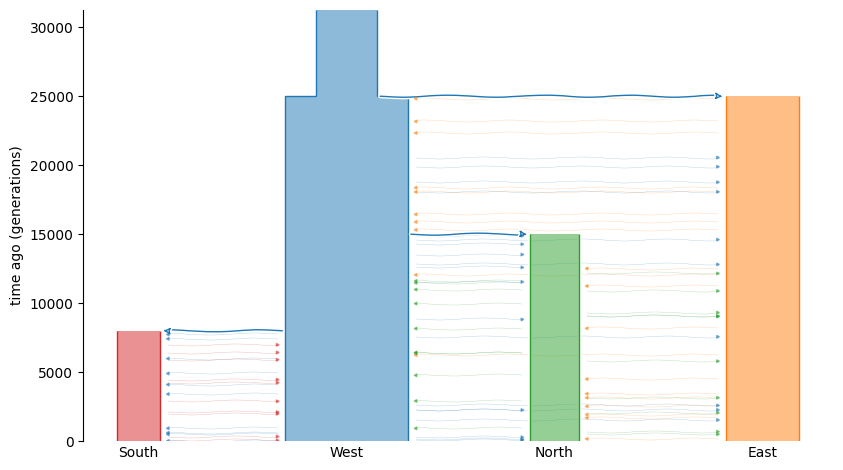
Populations: West, East, North, South
West, East, North, South populations with stepping-stone migration.
FiveRealm_5F10
Five-population admixture graph (Iran-Turan-Rum-Hind-Chin)
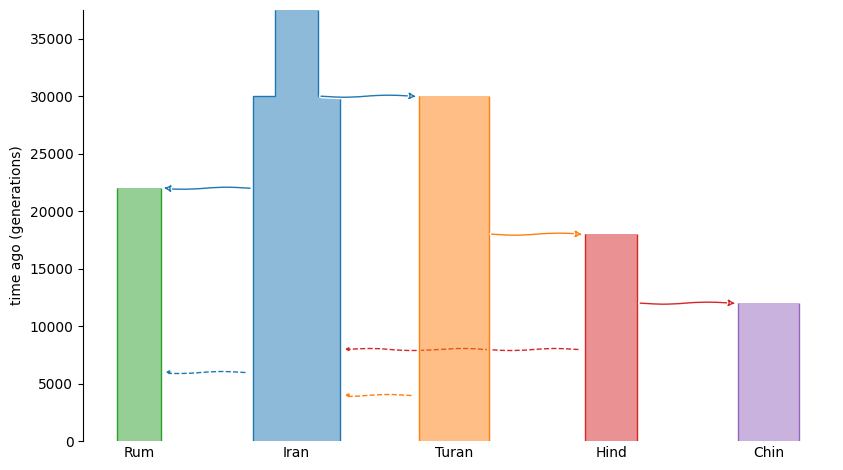
Populations: Iran, Turan, Rum, Hind, Chin
Five Shahnameh realms with pulse admixture events. Tests 5-pop graph inference.
SixPopExtRecolon_6F10
Six-population model with extinction and recolonization
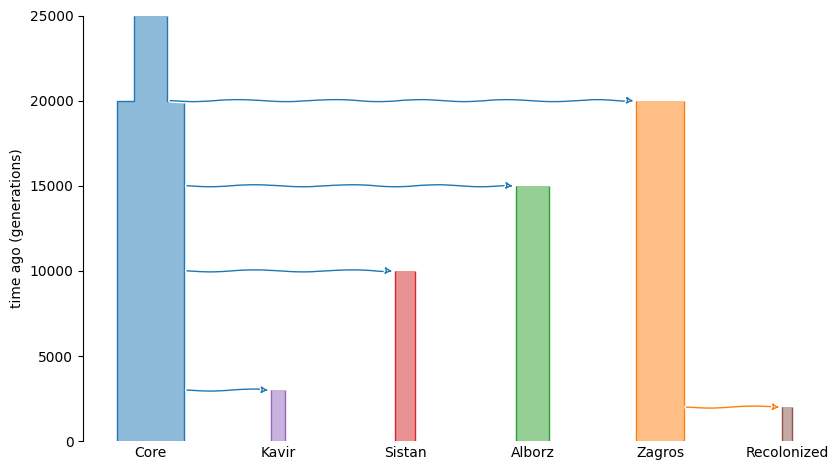
Populations: Core, Zagros, Alborz, Kavir, Sistan, Recolonized
Kavir goes extinct at 3000 gen, recolonized from Zagros at 2000 gen.
AsymReversal_2F10
Two-pop with migration direction reversal over time
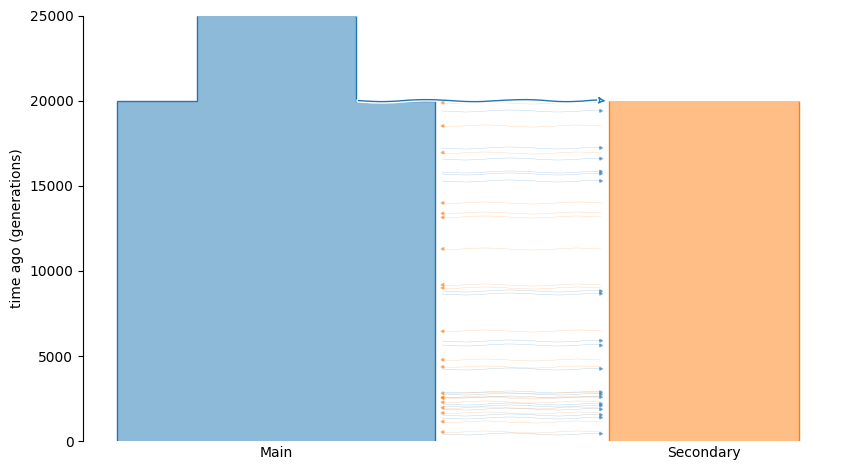
Populations: Main, Secondary
Migration reverses direction at 5000 gen ago. Tests temporal asymmetry.
SilkRoad_8F10
Eight-population Silk Road stepping-stone model
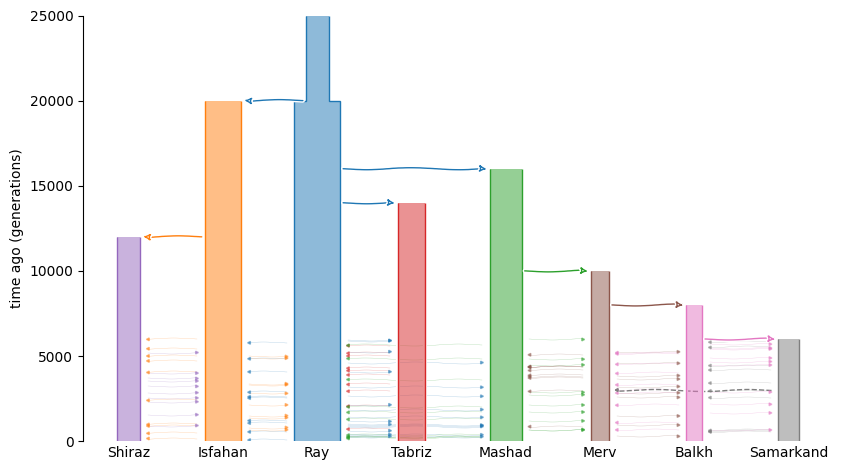
Populations: Ray, Isfahan, Shiraz, Tabriz, Mashad, Merv, Balkh, Samarkand
Eight cities along the Silk Road with stepping-stone migration and admixture.
Manticore (Manticore persicus) — The martyaxwar (man-eater), a composite creature with a human face, lion body, and scorpion tail. Originally Persian (from mardykhor), a natural metaphor for admixture between deeply diverged lineages.
Genome summary
- ID:
ManTig- Species:
Manticore persicus
- Common name:
Manticore (martyaxwar)
- Assembly:
Martyaxwar1.0(GCA_FERD_ManTig)- Ploidy:
2
- Generation time:
60 years
- Population size:
12,000
Chromosomes
Name |
Length (bp) |
Mutation rate |
Recombination rate |
|---|---|---|---|
1 |
20,000,000 |
2.50e-08 |
4.00e-08 |
2 |
18,000,000 |
2.50e-08 |
4.00e-08 |
3 |
16,000,000 |
2.50e-08 |
4.00e-08 |
4 |
14,000,000 |
2.50e-08 |
4.00e-08 |
5 |
12,000,000 |
2.50e-08 |
4.00e-08 |
mardykhor_mitogenome |
17,000 |
7.00e-08 |
0.00e+00 |
Demographic models
Constant_1F10
Single population constant-size model
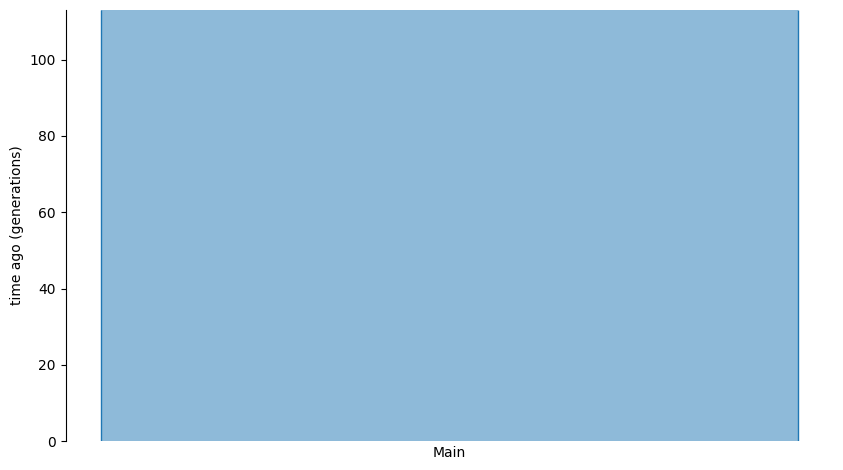
Populations: Main
Single population of Manticore (martyaxwar) at constant size N=12000.
ThreeEpoch_1F10
Single population three-epoch model with bottleneck
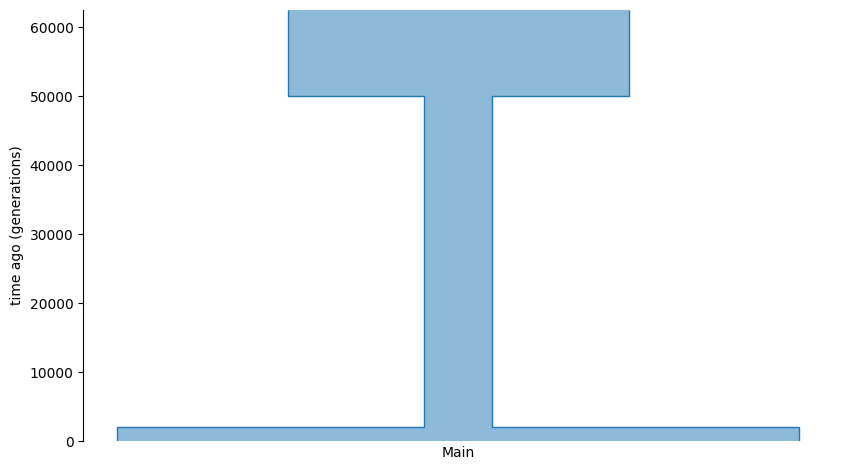
Populations: Main
Single pop of Manticore (martyaxwar). Modern N=12000, bottleneck 1200 at 2000 gen, ancestral 6000 at 50000 gen.
TwoPopSplit_2F10
Two population split with symmetric migration
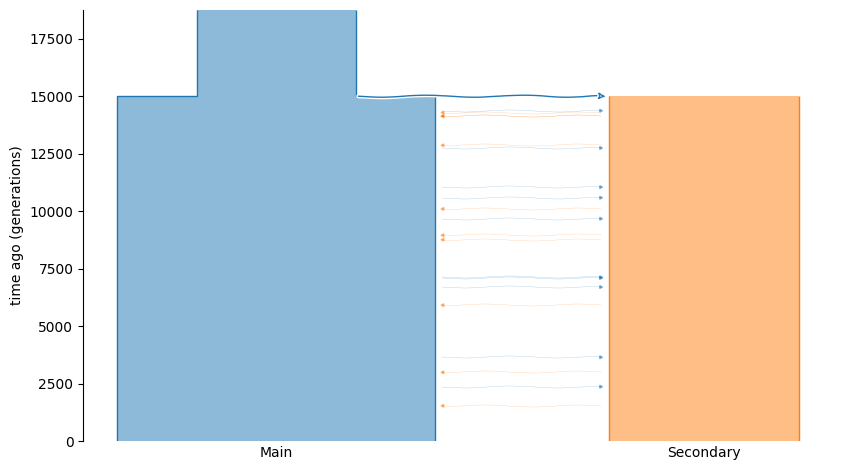
Populations: Main, Secondary
Two pops of Manticore (martyaxwar). Main N=12000, Secondary N=7200. Split 15000 gen ago.
GhostAdmixture_3F10
Two sampled pops + extinct ghost with pulse admixture
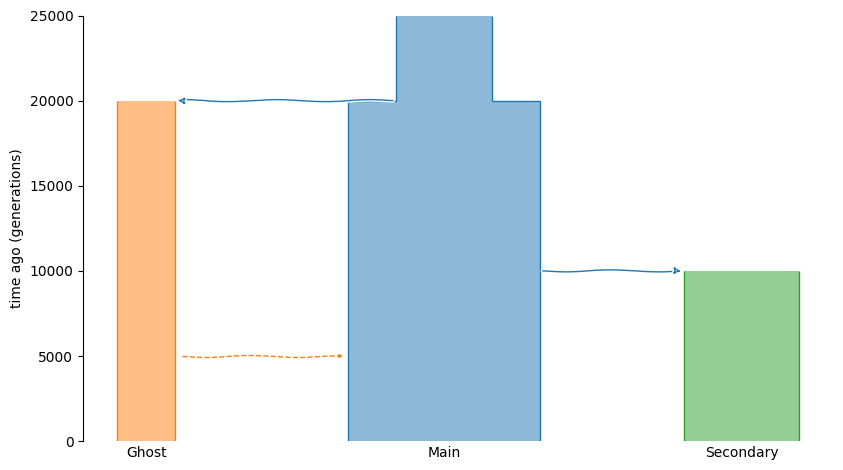
Populations: Main, Secondary, Ghost
Ghost contributes 15%% pulse admixture to Main at 5000 gen. Non-tree-like history.
ThreePopAdmix_3F10
Three populations with bidirectional pulse admixture
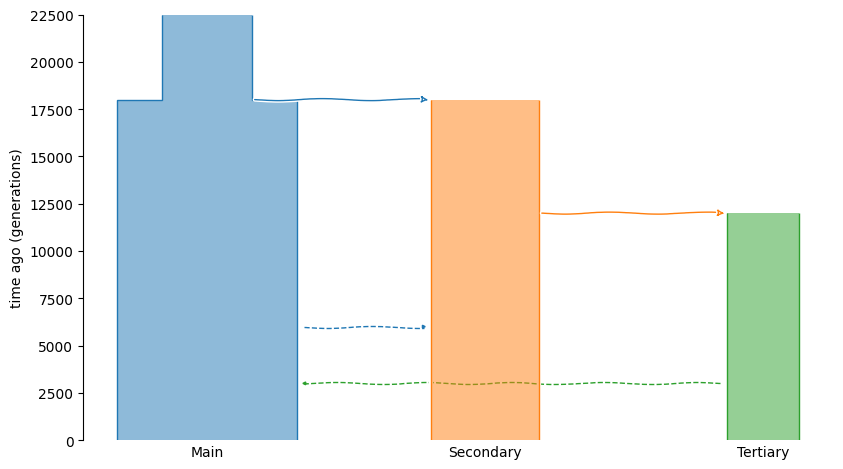
Populations: Main, Secondary, Tertiary
10%% Tertiary->Main at 3000 gen, 5%% Main->Secondary at 6000 gen. Admixture graph.
FourRegion_4F10
Four-population stepping-stone across Iranian plateau
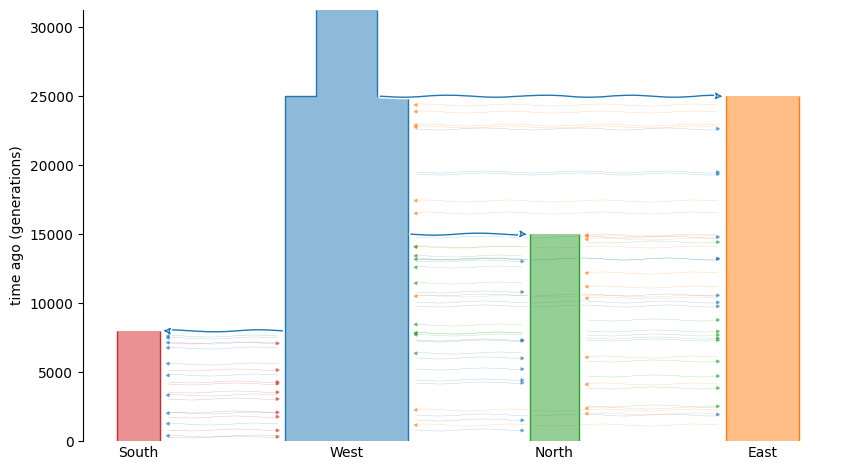
Populations: West, East, North, South
West, East, North, South populations with stepping-stone migration.
FiveRealm_5F10
Five-population admixture graph (Iran-Turan-Rum-Hind-Chin)
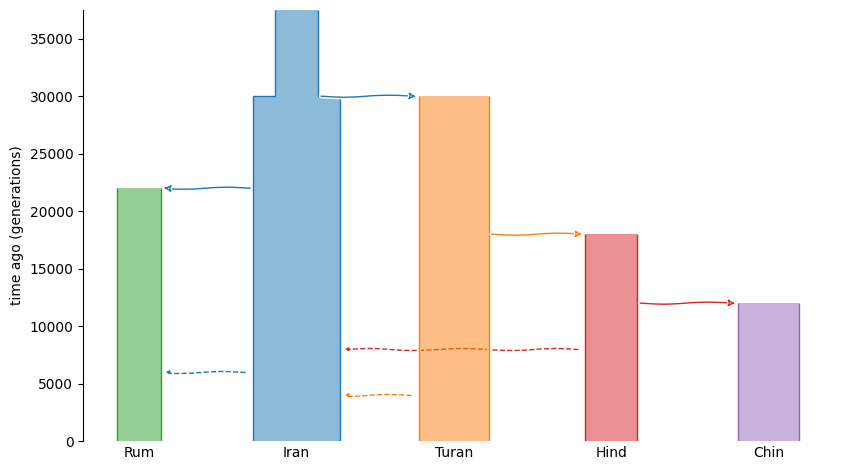
Populations: Iran, Turan, Rum, Hind, Chin
Five Shahnameh realms with pulse admixture events. Tests 5-pop graph inference.
SixPopExtRecolon_6F10
Six-population model with extinction and recolonization
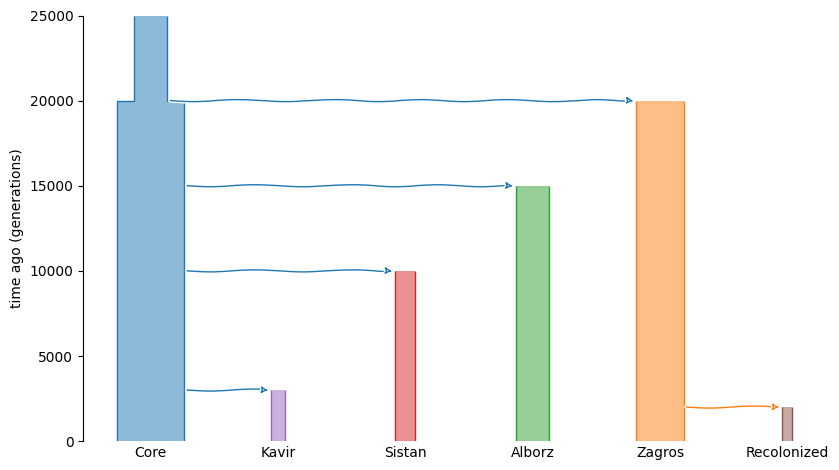
Populations: Core, Zagros, Alborz, Kavir, Sistan, Recolonized
Kavir goes extinct at 3000 gen, recolonized from Zagros at 2000 gen.
AsymReversal_2F10
Two-pop with migration direction reversal over time
Populations: Main, Secondary
Migration reverses direction at 5000 gen ago. Tests temporal asymmetry.
SilkRoad_8F10
Eight-population Silk Road stepping-stone model
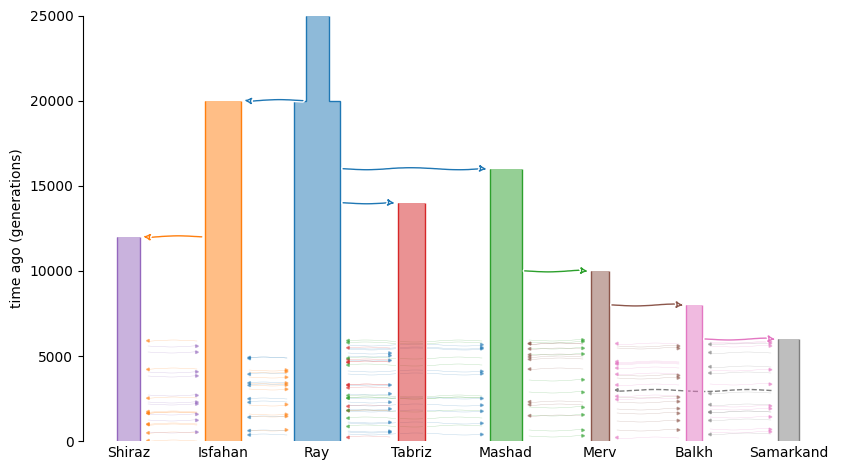
Populations: Ray, Isfahan, Shiraz, Tabriz, Mashad, Merv, Balkh, Samarkand
Eight cities along the Silk Road with stepping-stone migration and admixture.
Senmurv (Senmurv birddog) — A hybrid creature with the body of a dog and the wings and head of a bird. Featured in Sasanian art.
Genome summary
- ID:
SenBir- Species:
Senmurv birddog
- Common name:
Senmurv (dog-bird hybrid)
- Assembly:
Senmurv1.0(GCA_FERD_SenBir)- Ploidy:
2
- Generation time:
45 years
- Population size:
10,000
Chromosomes
Name |
Length (bp) |
Mutation rate |
Recombination rate |
|---|---|---|---|
1 |
20,000,000 |
2.00e-08 |
5.00e-08 |
2 |
18,000,000 |
2.00e-08 |
5.00e-08 |
3 |
16,000,000 |
2.00e-08 |
5.00e-08 |
4 |
14,000,000 |
2.00e-08 |
5.00e-08 |
5 |
12,000,000 |
2.00e-08 |
5.00e-08 |
senmurv_mitogenome |
17,000 |
5.60e-08 |
0.00e+00 |
Demographic models
Constant_1F10
Single population constant-size model
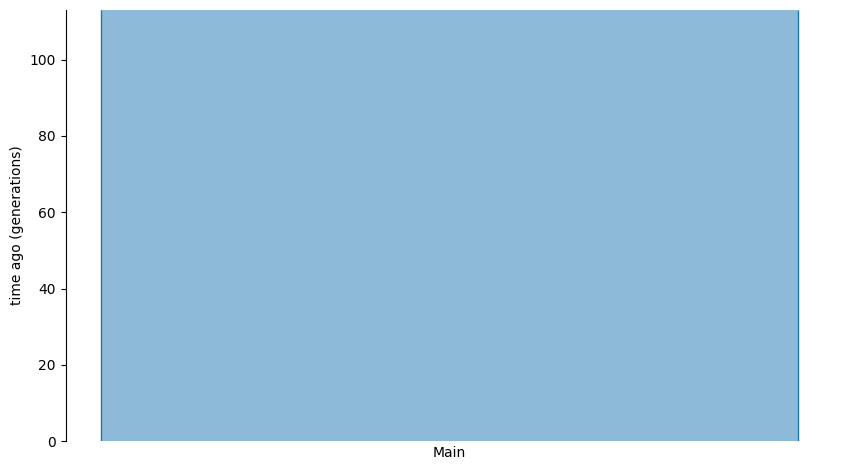
Populations: Main
Single population of Senmurv (dog-bird hybrid) at constant size N=10000.
ThreeEpoch_1F10
Single population three-epoch model with bottleneck
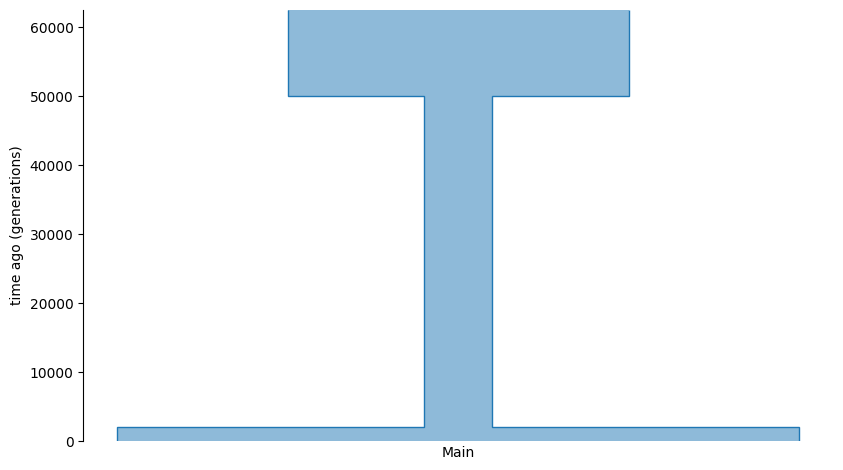
Populations: Main
Single pop of Senmurv (dog-bird hybrid). Modern N=10000, bottleneck 1000 at 2000 gen, ancestral 5000 at 50000 gen.
TwoPopSplit_2F10
Two population split with symmetric migration
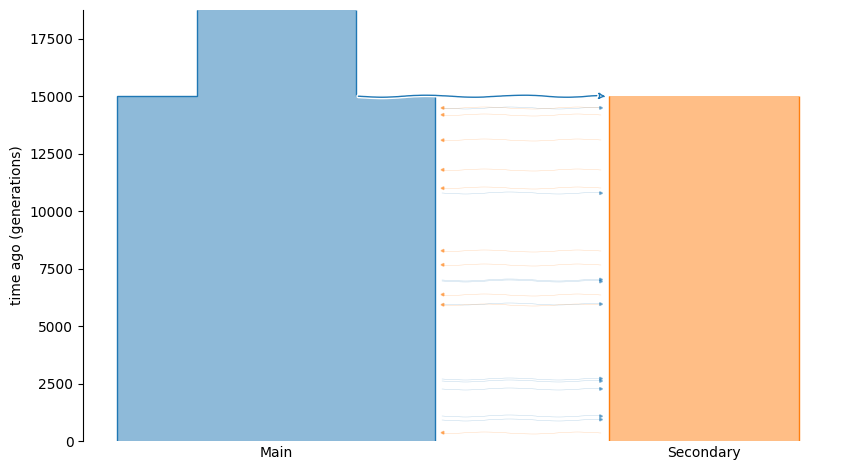
Populations: Main, Secondary
Two pops of Senmurv (dog-bird hybrid). Main N=10000, Secondary N=6000. Split 15000 gen ago.
GhostAdmixture_3F10
Two sampled pops + extinct ghost with pulse admixture
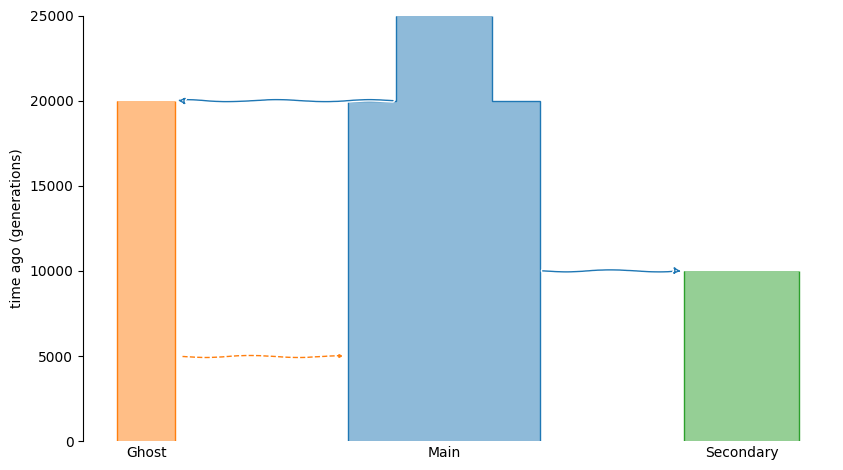
Populations: Main, Secondary, Ghost
Ghost contributes 15%% pulse admixture to Main at 5000 gen. Non-tree-like history.
ThreePopAdmix_3F10
Three populations with bidirectional pulse admixture
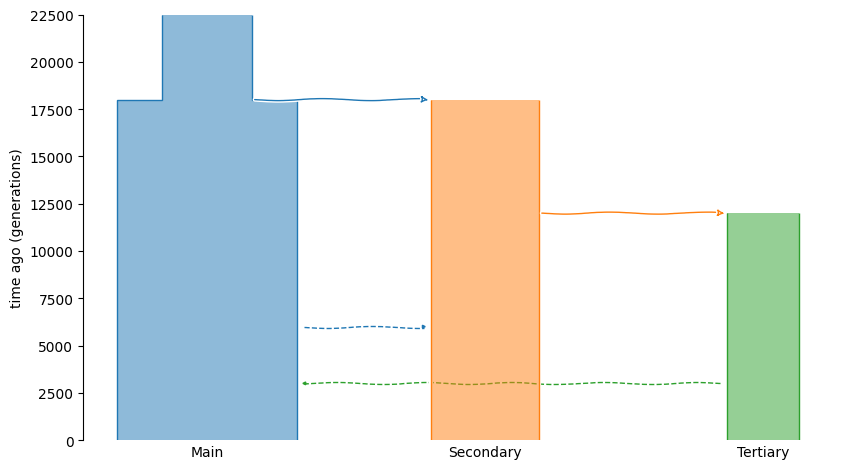
Populations: Main, Secondary, Tertiary
10%% Tertiary->Main at 3000 gen, 5%% Main->Secondary at 6000 gen. Admixture graph.
FourRegion_4F10
Four-population stepping-stone across Iranian plateau
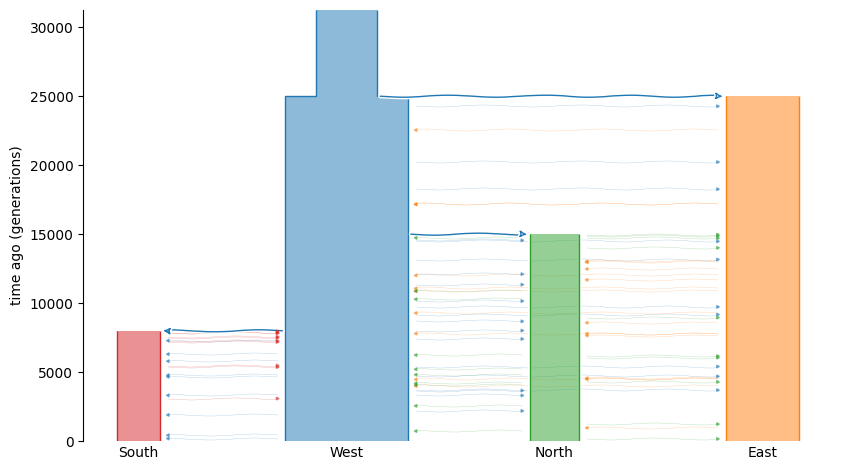
Populations: West, East, North, South
West, East, North, South populations with stepping-stone migration.
FiveRealm_5F10
Five-population admixture graph (Iran-Turan-Rum-Hind-Chin)
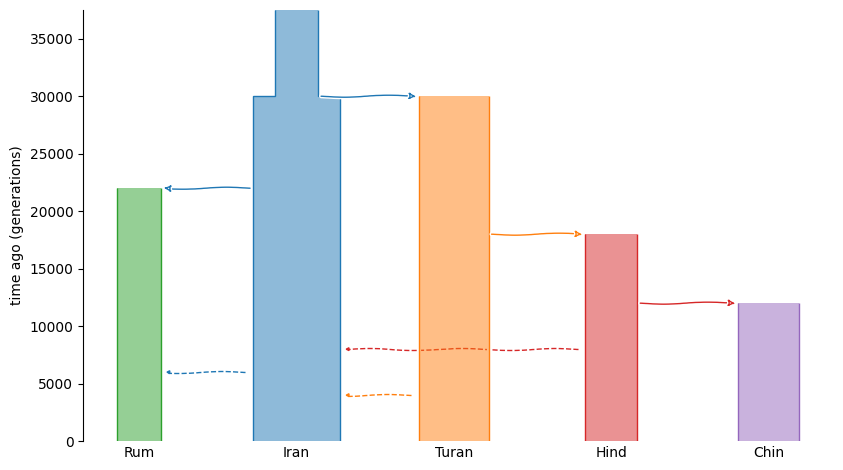
Populations: Iran, Turan, Rum, Hind, Chin
Five Shahnameh realms with pulse admixture events. Tests 5-pop graph inference.
SixPopExtRecolon_6F10
Six-population model with extinction and recolonization
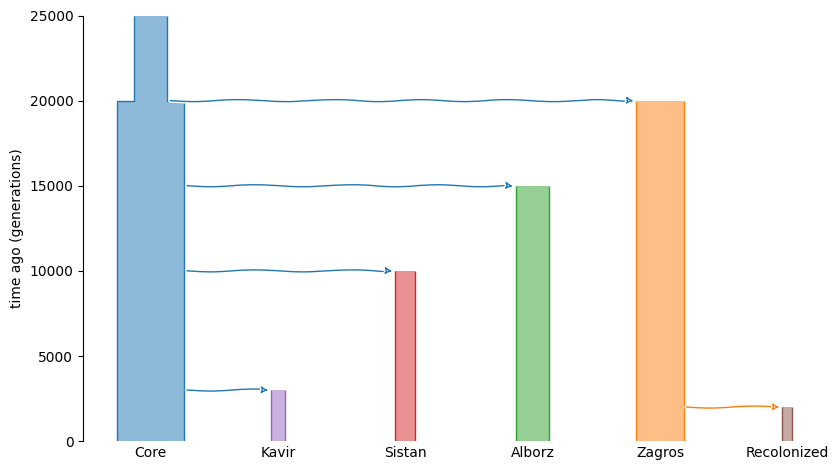
Populations: Core, Zagros, Alborz, Kavir, Sistan, Recolonized
Kavir goes extinct at 3000 gen, recolonized from Zagros at 2000 gen.
AsymReversal_2F10
Two-pop with migration direction reversal over time
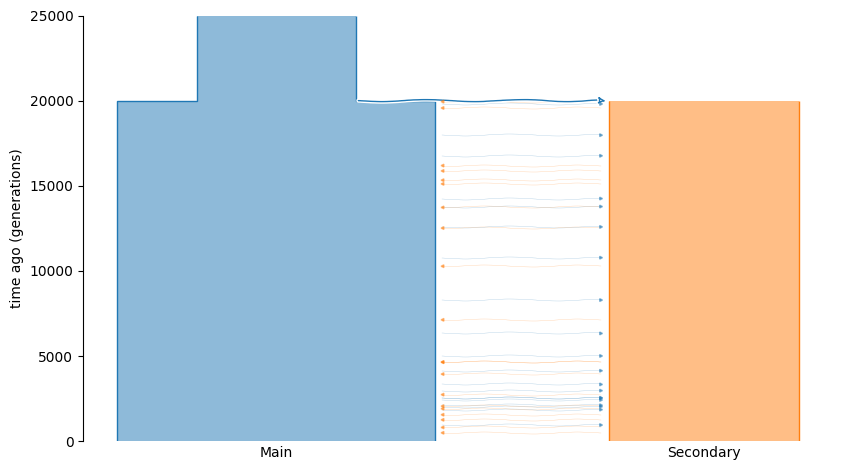
Populations: Main, Secondary
Migration reverses direction at 5000 gen ago. Tests temporal asymmetry.
SilkRoad_8F10
Eight-population Silk Road stepping-stone model
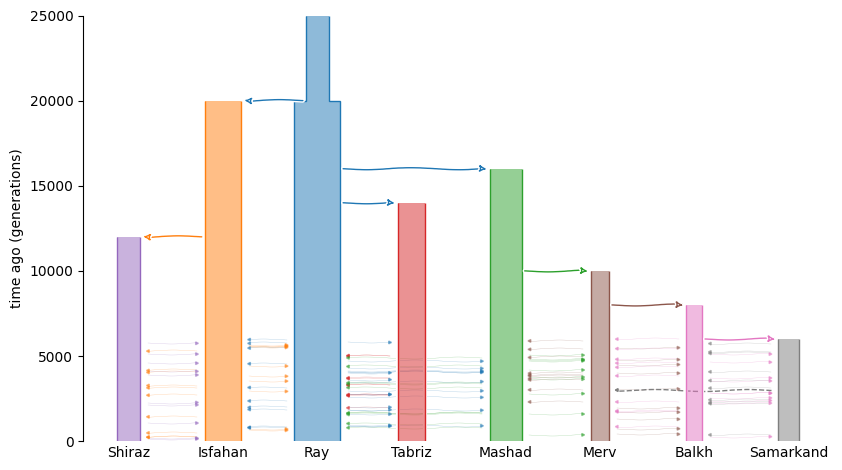
Populations: Ray, Isfahan, Shiraz, Tabriz, Mashad, Merv, Balkh, Samarkand
Eight cities along the Silk Road with stepping-stone migration and admixture.
Chamrosh (Chamrosh griffinus) — Dog-eagle hybrid, disperser of seeds from the world-tree. Related to the Simurgh but smaller.
Genome summary
- ID:
ChaGri- Species:
Chamrosh griffinus
- Common name:
Chamrosh (dog-eagle, seed-disperser)
- Assembly:
Chamrosh1.0(GCA_FERD_ChaGri)- Ploidy:
2
- Generation time:
40 years
- Population size:
7,000
Chromosomes
Name |
Length (bp) |
Mutation rate |
Recombination rate |
|---|---|---|---|
1 |
20,000,000 |
1.50e-08 |
5.50e-08 |
2 |
18,000,000 |
1.50e-08 |
5.50e-08 |
3 |
16,000,000 |
1.50e-08 |
5.50e-08 |
4 |
14,000,000 |
1.50e-08 |
5.50e-08 |
5 |
12,000,000 |
1.50e-08 |
5.50e-08 |
chamrosh_mitogenome |
17,000 |
4.20e-08 |
0.00e+00 |
Demographic models
Constant_1F10
Single population constant-size model
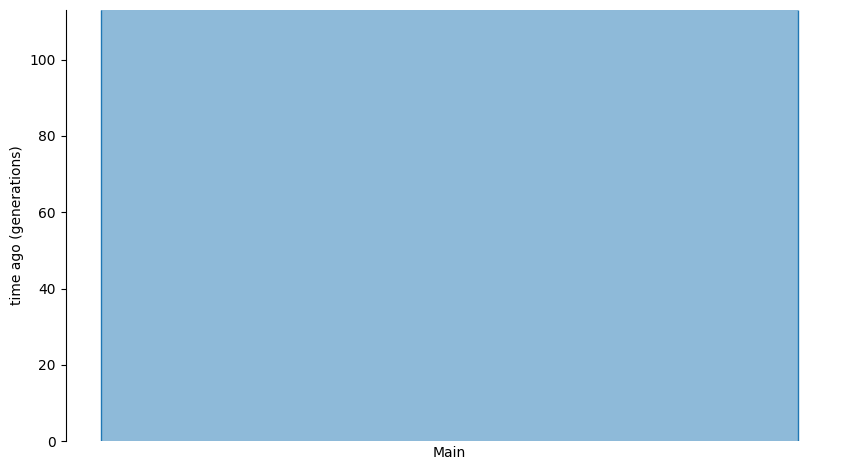
Populations: Main
Single population of Chamrosh (dog-eagle, seed-disperser) at constant size N=7000.
ThreeEpoch_1F10
Single population three-epoch model with bottleneck
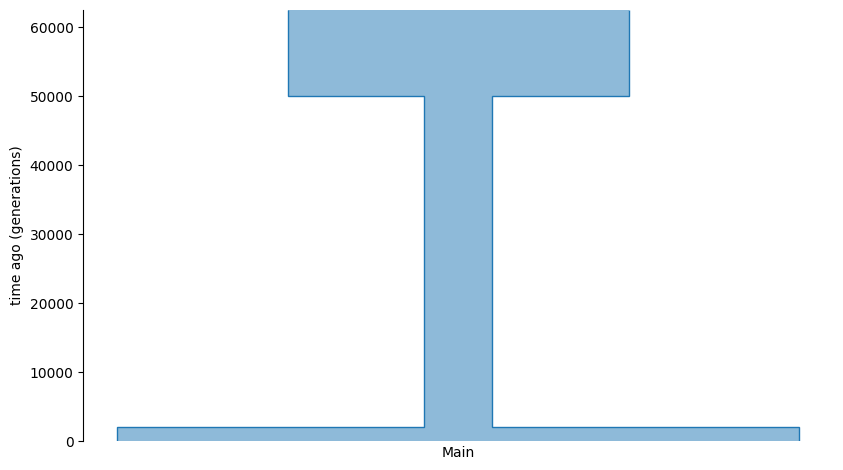
Populations: Main
Single pop of Chamrosh (dog-eagle, seed-disperser). Modern N=7000, bottleneck 700 at 2000 gen, ancestral 3500 at 50000 gen.
TwoPopSplit_2F10
Two population split with symmetric migration
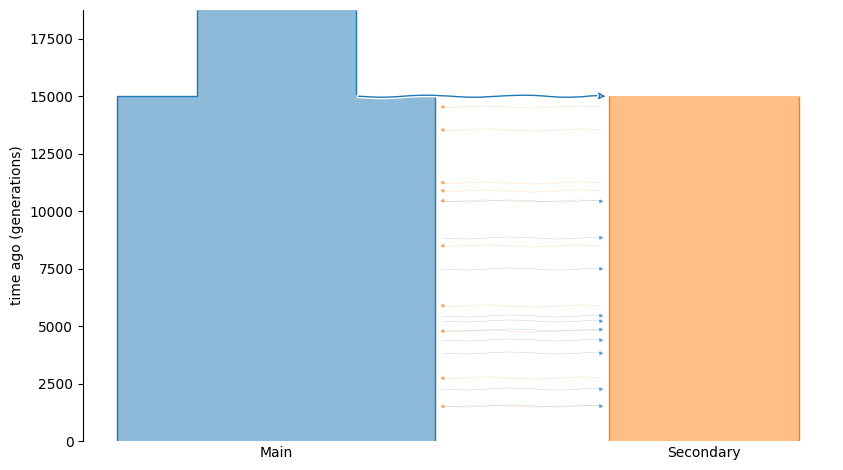
Populations: Main, Secondary
Two pops of Chamrosh (dog-eagle, seed-disperser). Main N=7000, Secondary N=4200. Split 15000 gen ago.
GhostAdmixture_3F10
Two sampled pops + extinct ghost with pulse admixture
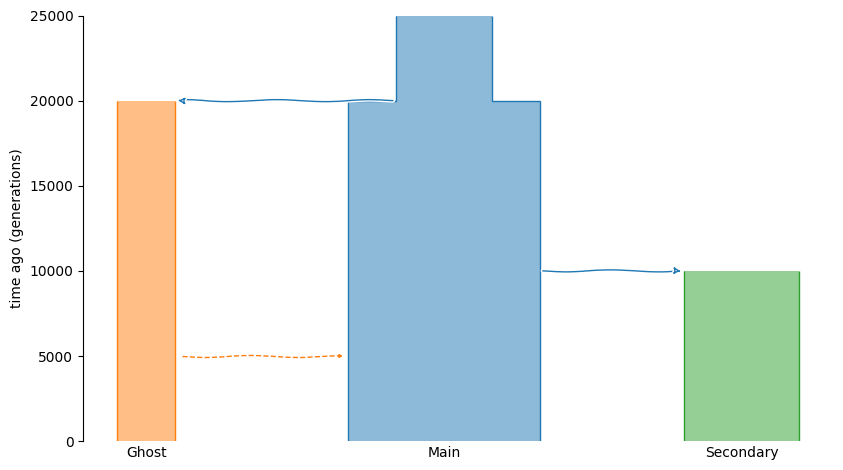
Populations: Main, Secondary, Ghost
Ghost contributes 15%% pulse admixture to Main at 5000 gen. Non-tree-like history.
ThreePopAdmix_3F10
Three populations with bidirectional pulse admixture
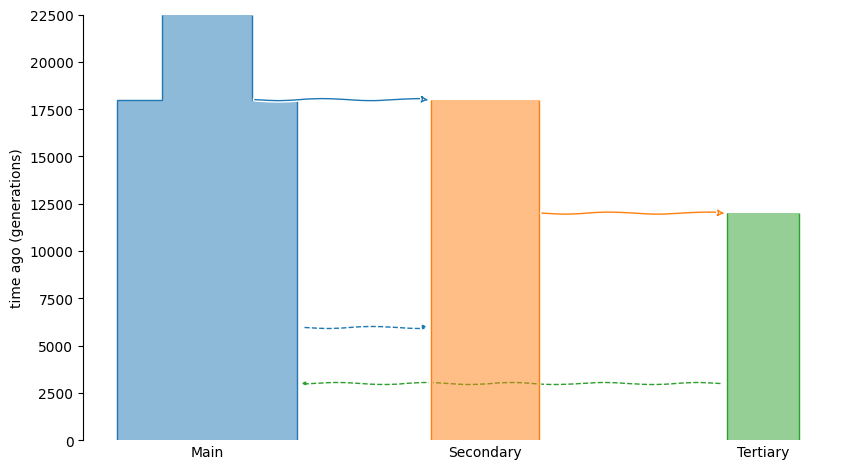
Populations: Main, Secondary, Tertiary
10%% Tertiary->Main at 3000 gen, 5%% Main->Secondary at 6000 gen. Admixture graph.
FourRegion_4F10
Four-population stepping-stone across Iranian plateau
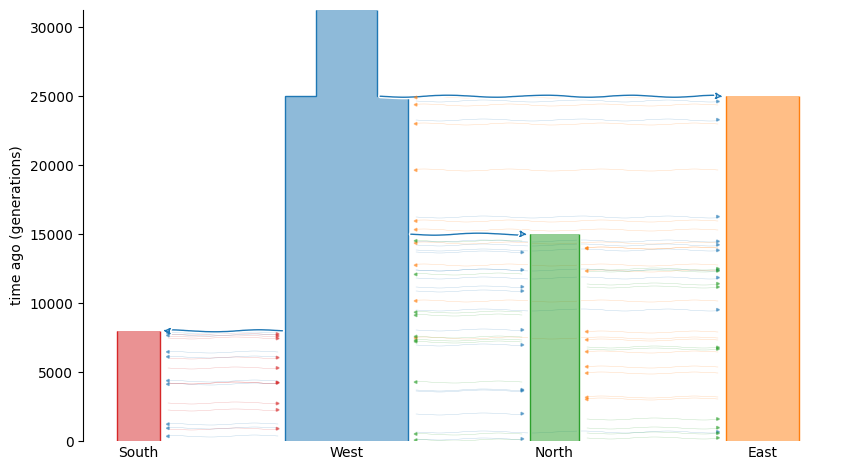
Populations: West, East, North, South
West, East, North, South populations with stepping-stone migration.
FiveRealm_5F10
Five-population admixture graph (Iran-Turan-Rum-Hind-Chin)
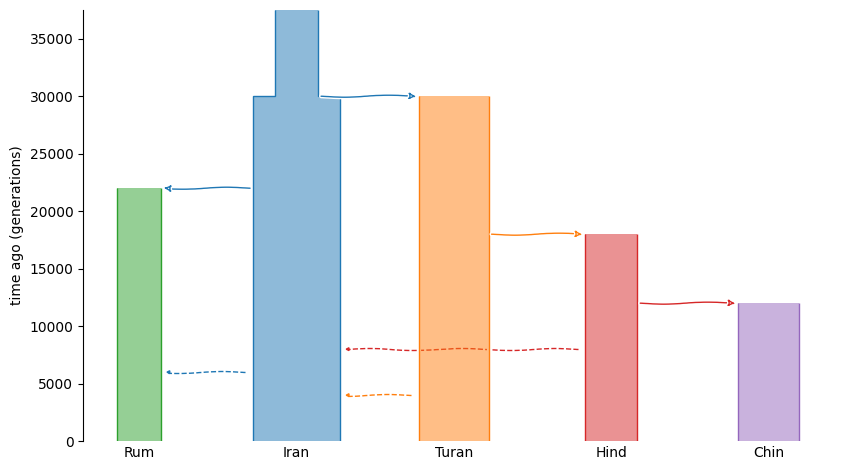
Populations: Iran, Turan, Rum, Hind, Chin
Five Shahnameh realms with pulse admixture events. Tests 5-pop graph inference.
SixPopExtRecolon_6F10
Six-population model with extinction and recolonization
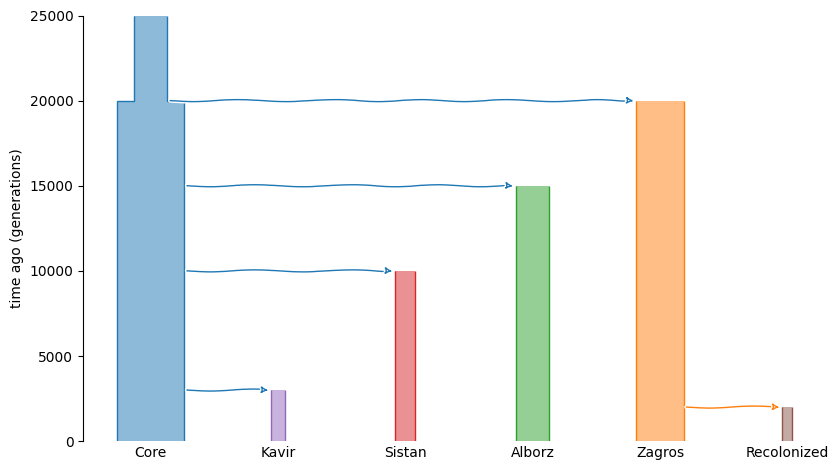
Populations: Core, Zagros, Alborz, Kavir, Sistan, Recolonized
Kavir goes extinct at 3000 gen, recolonized from Zagros at 2000 gen.
AsymReversal_2F10
Two-pop with migration direction reversal over time
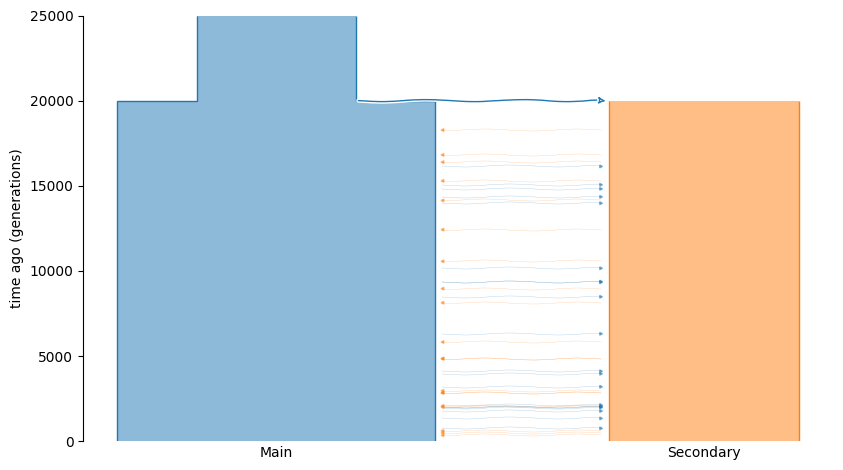
Populations: Main, Secondary
Migration reverses direction at 5000 gen ago. Tests temporal asymmetry.
SilkRoad_8F10
Eight-population Silk Road stepping-stone model
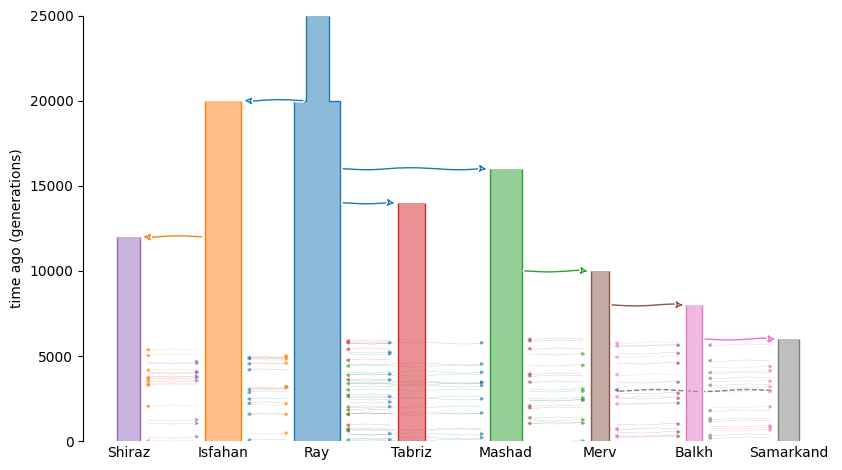
Populations: Ray, Isfahan, Shiraz, Tabriz, Mashad, Merv, Balkh, Samarkand
Eight cities along the Silk Road with stepping-stone migration and admixture.
Shahbaz (Shahbaz shahinus) — The royal falcon, symbol of Persian kingship and hunting tradition. Short generation time, moderate populations.
Genome summary
- ID:
ShaSha- Species:
Shahbaz shahinus
- Common name:
Shahbaz (royal falcon)
- Assembly:
Shahbaz1.0(GCA_FERD_ShaSha)- Ploidy:
2
- Generation time:
15 years
- Population size:
6,000
Chromosomes
Name |
Length (bp) |
Mutation rate |
Recombination rate |
|---|---|---|---|
1 |
20,000,000 |
3.00e-08 |
6.00e-08 |
2 |
18,000,000 |
3.00e-08 |
6.00e-08 |
3 |
16,000,000 |
3.00e-08 |
6.00e-08 |
4 |
14,000,000 |
3.00e-08 |
6.00e-08 |
5 |
12,000,000 |
3.00e-08 |
6.00e-08 |
6 |
10,000,000 |
3.00e-08 |
6.00e-08 |
shahbaz_mitogenome |
17,000 |
8.40e-08 |
0.00e+00 |
Demographic models
Constant_1F10
Single population constant-size model
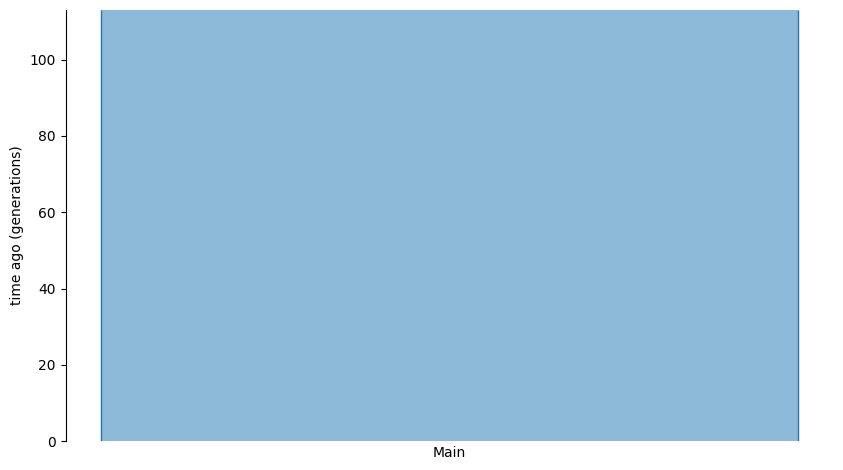
Populations: Main
Single population of Shahbaz (royal falcon) at constant size N=6000.
ThreeEpoch_1F10
Single population three-epoch model with bottleneck
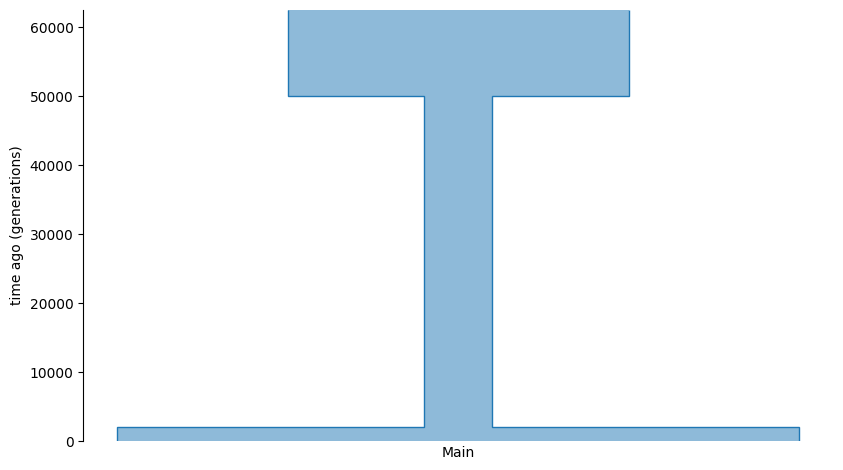
Populations: Main
Single pop of Shahbaz (royal falcon). Modern N=6000, bottleneck 600 at 2000 gen, ancestral 3000 at 50000 gen.
TwoPopSplit_2F10
Two population split with symmetric migration
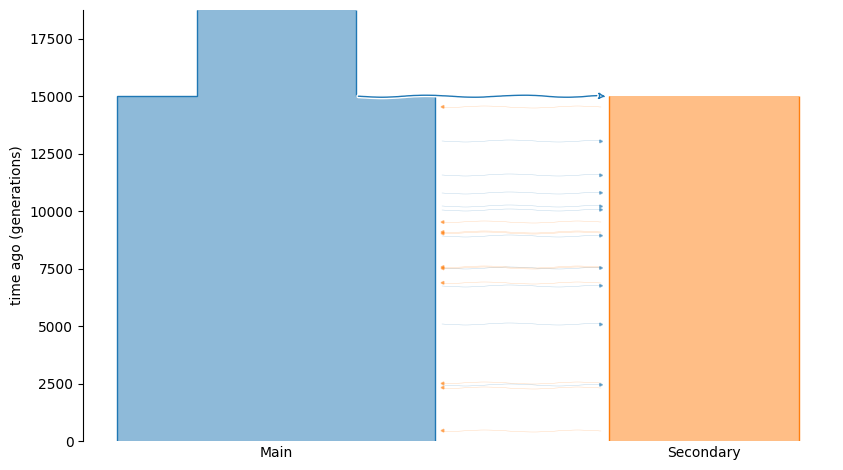
Populations: Main, Secondary
Two pops of Shahbaz (royal falcon). Main N=6000, Secondary N=3600. Split 15000 gen ago.
GhostAdmixture_3F10
Two sampled pops + extinct ghost with pulse admixture
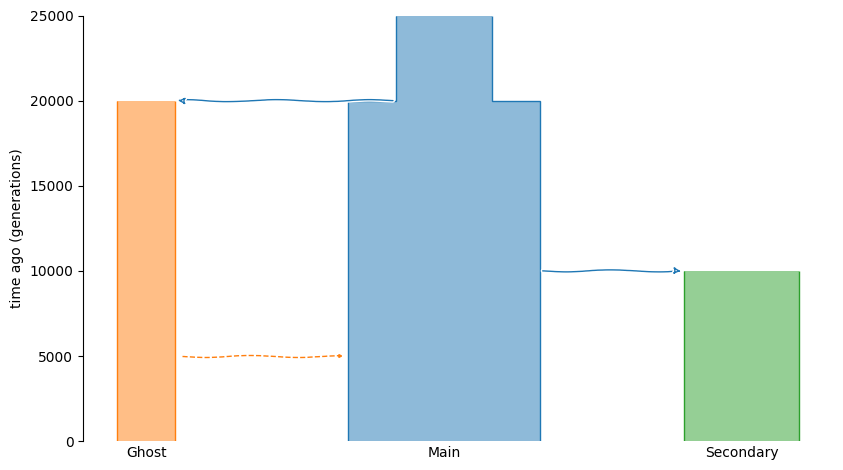
Populations: Main, Secondary, Ghost
Ghost contributes 15%% pulse admixture to Main at 5000 gen. Non-tree-like history.
ThreePopAdmix_3F10
Three populations with bidirectional pulse admixture
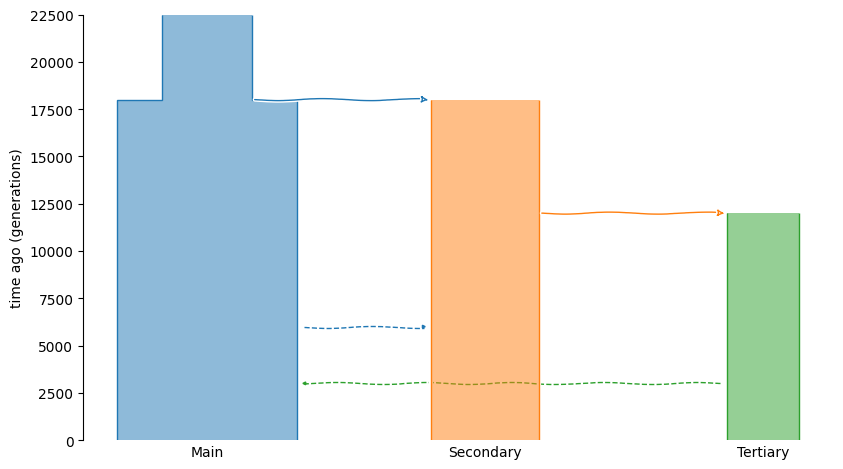
Populations: Main, Secondary, Tertiary
10%% Tertiary->Main at 3000 gen, 5%% Main->Secondary at 6000 gen. Admixture graph.
FourRegion_4F10
Four-population stepping-stone across Iranian plateau
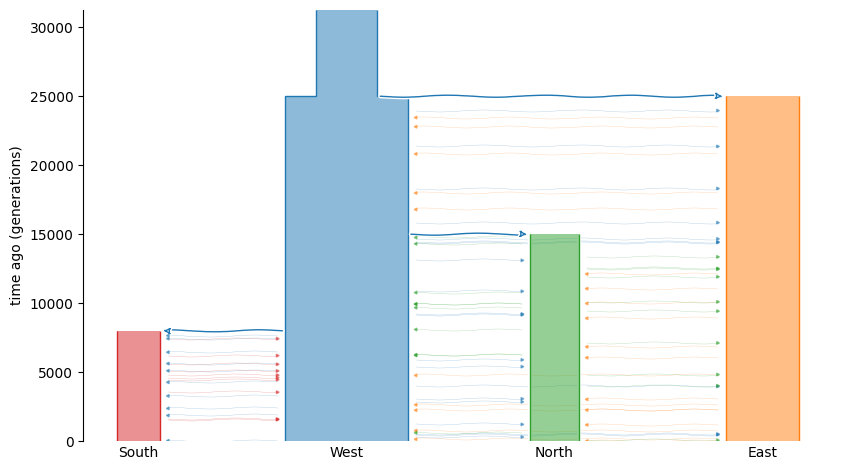
Populations: West, East, North, South
West, East, North, South populations with stepping-stone migration.
FiveRealm_5F10
Five-population admixture graph (Iran-Turan-Rum-Hind-Chin)
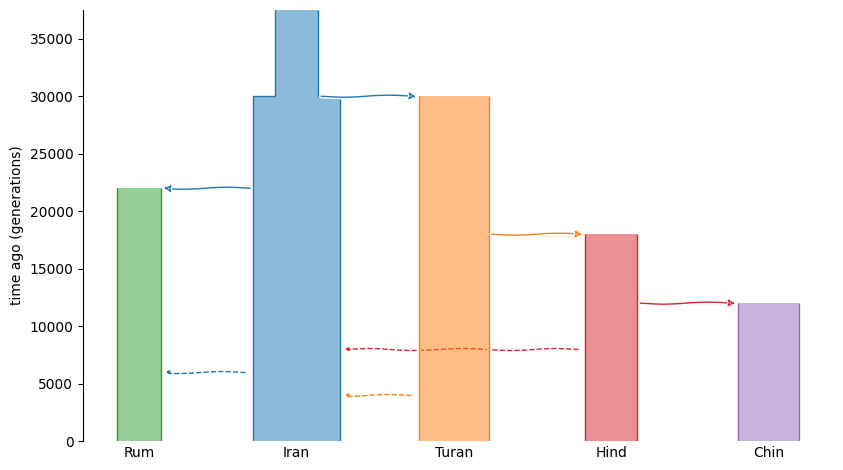
Populations: Iran, Turan, Rum, Hind, Chin
Five Shahnameh realms with pulse admixture events. Tests 5-pop graph inference.
SixPopExtRecolon_6F10
Six-population model with extinction and recolonization
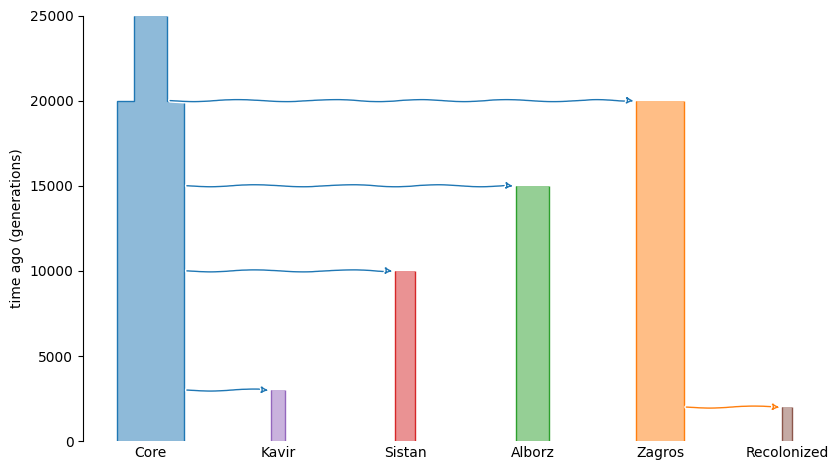
Populations: Core, Zagros, Alborz, Kavir, Sistan, Recolonized
Kavir goes extinct at 3000 gen, recolonized from Zagros at 2000 gen.
AsymReversal_2F10
Two-pop with migration direction reversal over time
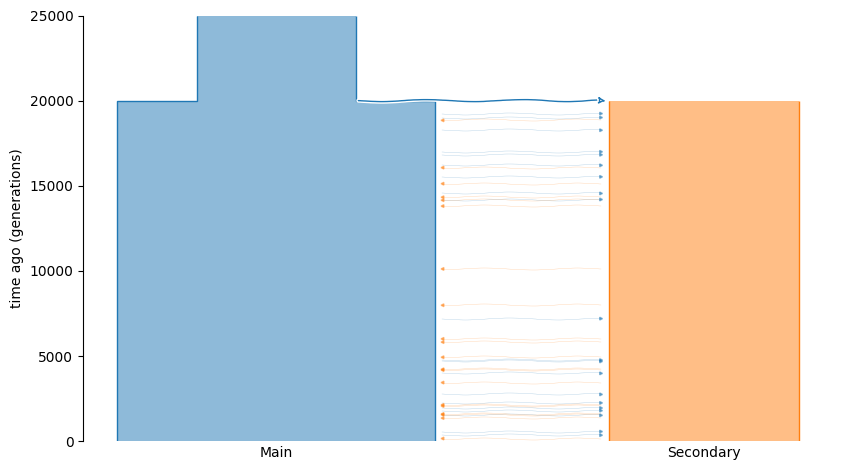
Populations: Main, Secondary
Migration reverses direction at 5000 gen ago. Tests temporal asymmetry.
SilkRoad_8F10
Eight-population Silk Road stepping-stone model
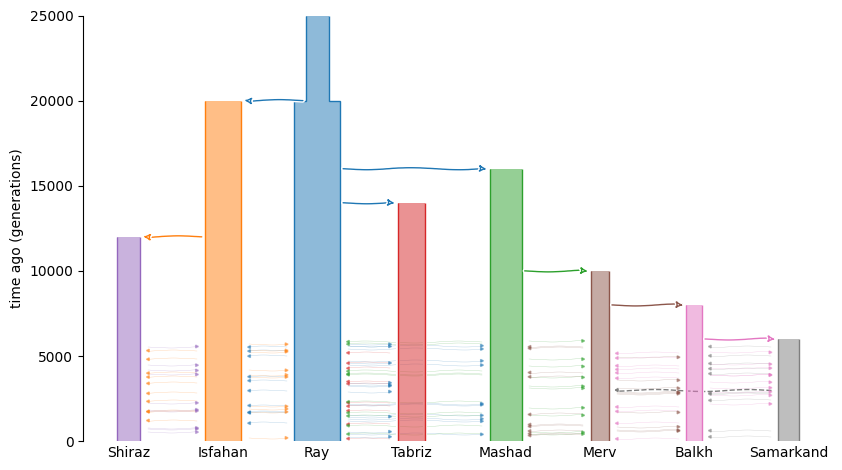
Populations: Ray, Isfahan, Shiraz, Tabriz, Mashad, Merv, Balkh, Samarkand
Eight cities along the Silk Road with stepping-stone migration and admixture.
Gavaevodata (Gavaevodata primus) — The primordial bull of Zoroastrian cosmology, from whose body all animals were created after its death. Extremely long generation time, very small Ne — the deepest ancestral lineage.
Genome summary
- ID:
GavPri- Species:
Gavaevodata primus
- Common name:
Gavaevodata (primordial bull)
- Assembly:
PrimalBull1.0(GCA_FERD_GavPri)- Ploidy:
2
- Generation time:
300 years
- Population size:
2,000
Chromosomes
Name |
Length (bp) |
Mutation rate |
Recombination rate |
|---|---|---|---|
1 |
20,000,000 |
3.00e-09 |
2.00e-08 |
2 |
18,000,000 |
3.00e-09 |
2.00e-08 |
3 |
16,000,000 |
3.00e-09 |
2.00e-08 |
4 |
14,000,000 |
3.00e-09 |
2.00e-08 |
primal_mitogenome |
17,000 |
8.40e-09 |
0.00e+00 |
Demographic models
Constant_1F10
Single population constant-size model
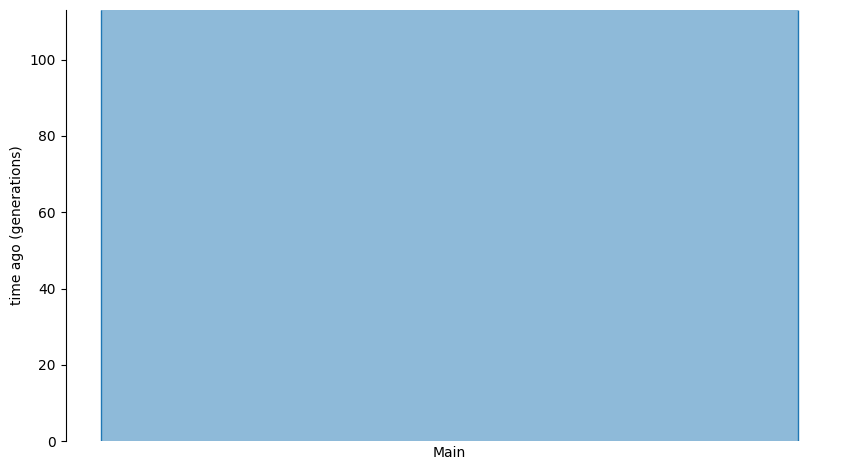
Populations: Main
Single population of Gavaevodata (primordial bull) at constant size N=2000.
ThreeEpoch_1F10
Single population three-epoch model with bottleneck
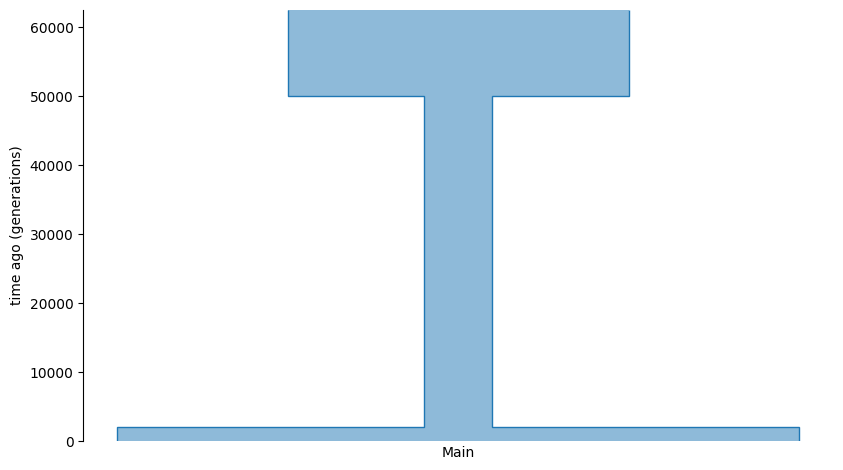
Populations: Main
Single pop of Gavaevodata (primordial bull). Modern N=2000, bottleneck 200 at 2000 gen, ancestral 1000 at 50000 gen.
TwoPopSplit_2F10
Two population split with symmetric migration
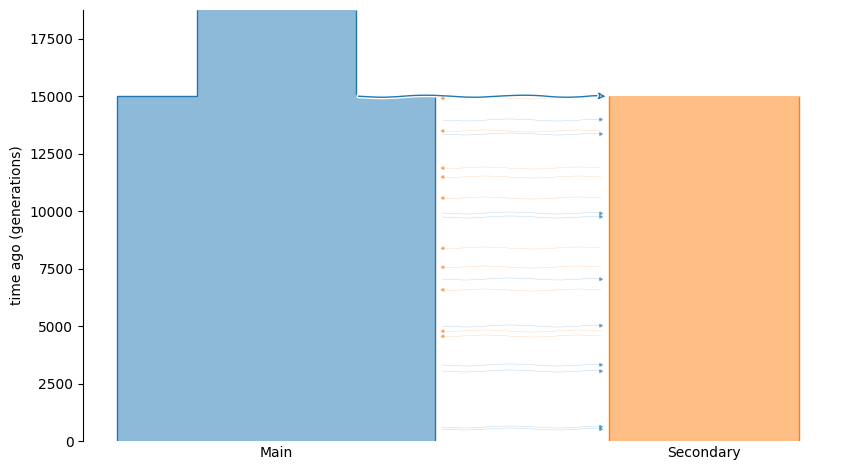
Populations: Main, Secondary
Two pops of Gavaevodata (primordial bull). Main N=2000, Secondary N=1200. Split 15000 gen ago.
GhostAdmixture_3F10
Two sampled pops + extinct ghost with pulse admixture
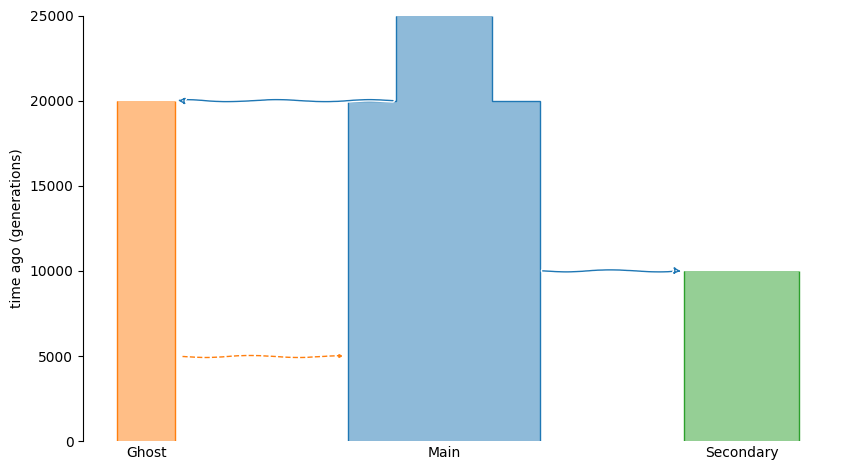
Populations: Main, Secondary, Ghost
Ghost contributes 15%% pulse admixture to Main at 5000 gen. Non-tree-like history.
ThreePopAdmix_3F10
Three populations with bidirectional pulse admixture
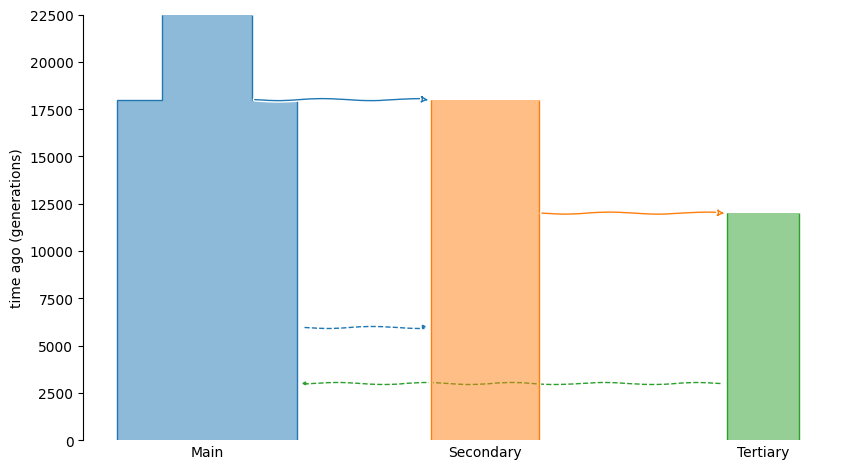
Populations: Main, Secondary, Tertiary
10%% Tertiary->Main at 3000 gen, 5%% Main->Secondary at 6000 gen. Admixture graph.
FourRegion_4F10
Four-population stepping-stone across Iranian plateau
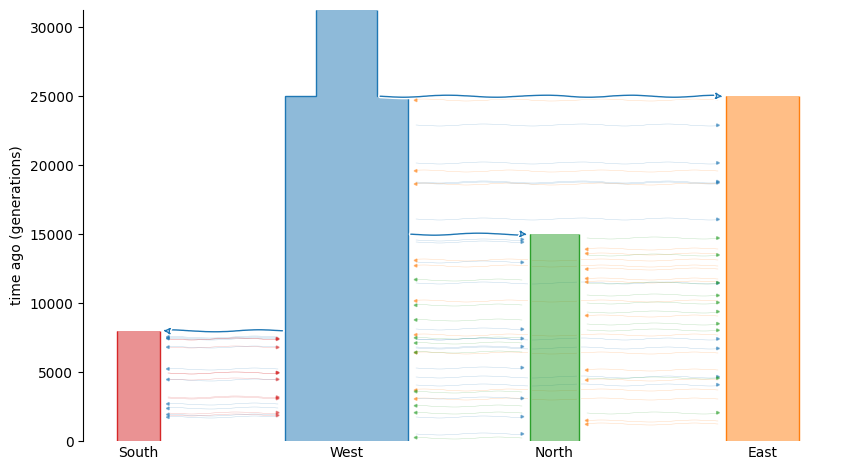
Populations: West, East, North, South
West, East, North, South populations with stepping-stone migration.
FiveRealm_5F10
Five-population admixture graph (Iran-Turan-Rum-Hind-Chin)
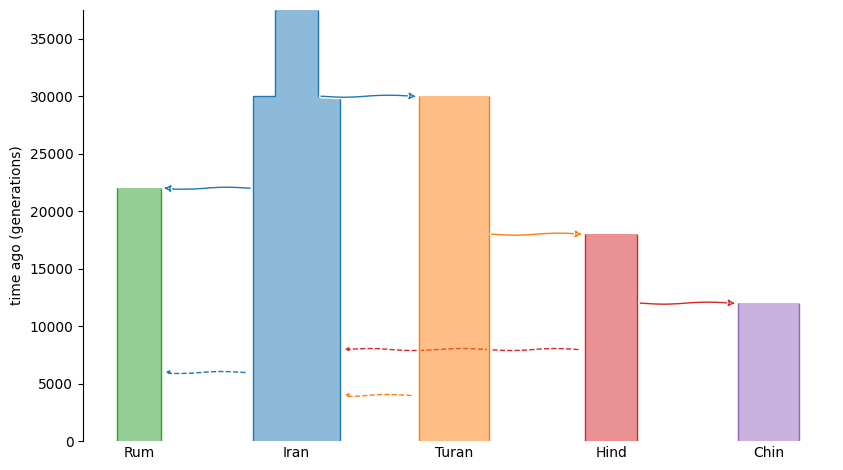
Populations: Iran, Turan, Rum, Hind, Chin
Five Shahnameh realms with pulse admixture events. Tests 5-pop graph inference.
SixPopExtRecolon_6F10
Six-population model with extinction and recolonization
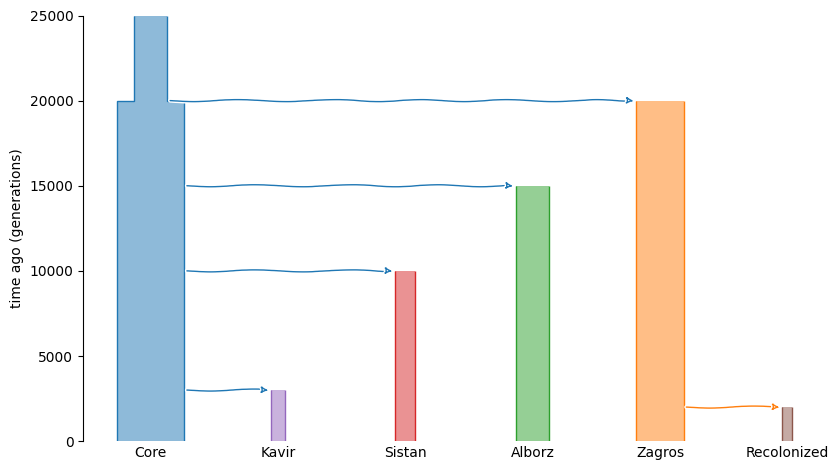
Populations: Core, Zagros, Alborz, Kavir, Sistan, Recolonized
Kavir goes extinct at 3000 gen, recolonized from Zagros at 2000 gen.
AsymReversal_2F10
Two-pop with migration direction reversal over time
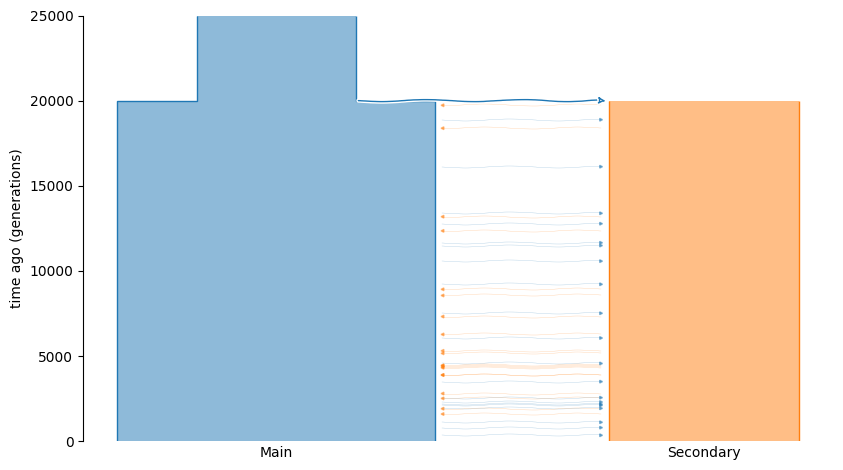
Populations: Main, Secondary
Migration reverses direction at 5000 gen ago. Tests temporal asymmetry.
SilkRoad_8F10
Eight-population Silk Road stepping-stone model
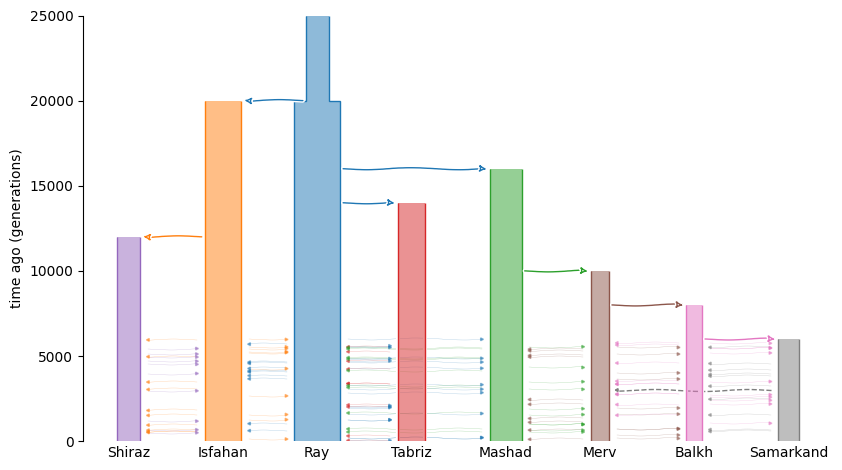
Populations: Ray, Isfahan, Shiraz, Tabriz, Mashad, Merv, Balkh, Samarkand
Eight cities along the Silk Road with stepping-stone migration and admixture.
Zoroastrian Cosmology
Faravahar (Faravahar glorius) — Guardian spirits (fravashi) that protect each person. The winged disc symbol of Zoroastrianism.
Genome summary
- ID:
FarGlo- Species:
Faravahar glorius
- Common name:
Faravahar (guardian spirit)
- Assembly:
Fravashi1.0(GCA_FERD_FarGlo)- Ploidy:
2
- Generation time:
60 years
- Population size:
80,000
Chromosomes
Name |
Length (bp) |
Mutation rate |
Recombination rate |
|---|---|---|---|
1 |
20,000,000 |
1.00e-08 |
7.00e-08 |
2 |
18,000,000 |
1.00e-08 |
7.00e-08 |
3 |
16,000,000 |
1.00e-08 |
7.00e-08 |
4 |
14,000,000 |
1.00e-08 |
7.00e-08 |
5 |
12,000,000 |
1.00e-08 |
7.00e-08 |
fravashi_mitogenome |
17,000 |
2.80e-08 |
0.00e+00 |
Demographic models
Constant_1F10
Single population constant-size model
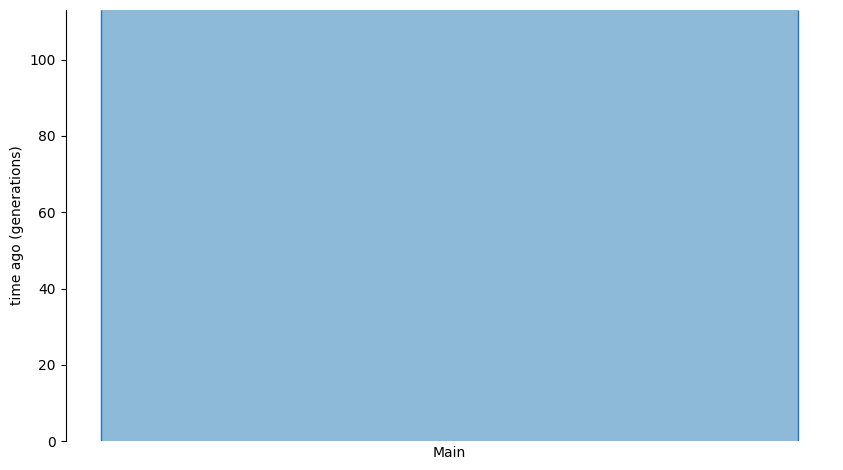
Populations: Main
Single population of Faravahar (guardian spirit) at constant size N=80000.
ThreeEpoch_1F10
Single population three-epoch model with bottleneck
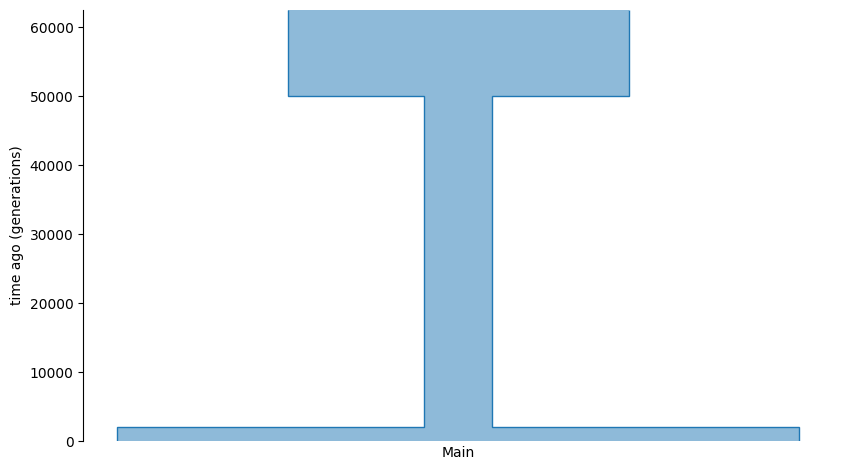
Populations: Main
Single pop of Faravahar (guardian spirit). Modern N=80000, bottleneck 8000 at 2000 gen, ancestral 40000 at 50000 gen.
TwoPopSplit_2F10
Two population split with symmetric migration
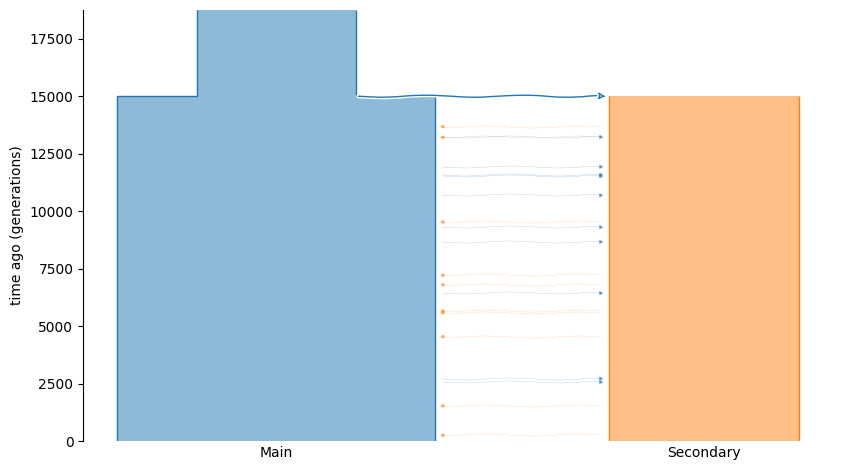
Populations: Main, Secondary
Two pops of Faravahar (guardian spirit). Main N=80000, Secondary N=48000. Split 15000 gen ago.
GhostAdmixture_3F10
Two sampled pops + extinct ghost with pulse admixture
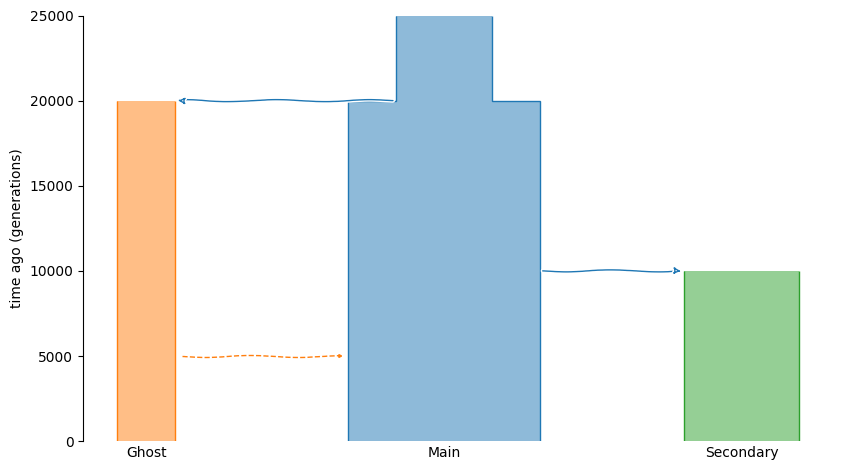
Populations: Main, Secondary, Ghost
Ghost contributes 15%% pulse admixture to Main at 5000 gen. Non-tree-like history.
ThreePopAdmix_3F10
Three populations with bidirectional pulse admixture
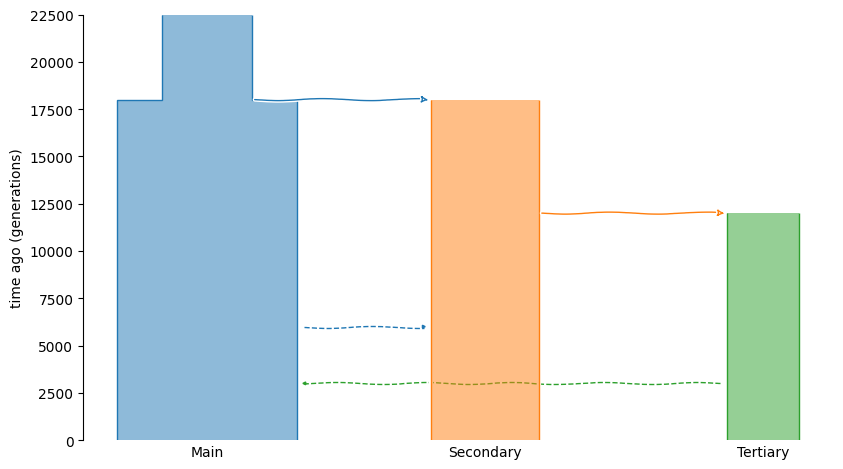
Populations: Main, Secondary, Tertiary
10%% Tertiary->Main at 3000 gen, 5%% Main->Secondary at 6000 gen. Admixture graph.
FourRegion_4F10
Four-population stepping-stone across Iranian plateau
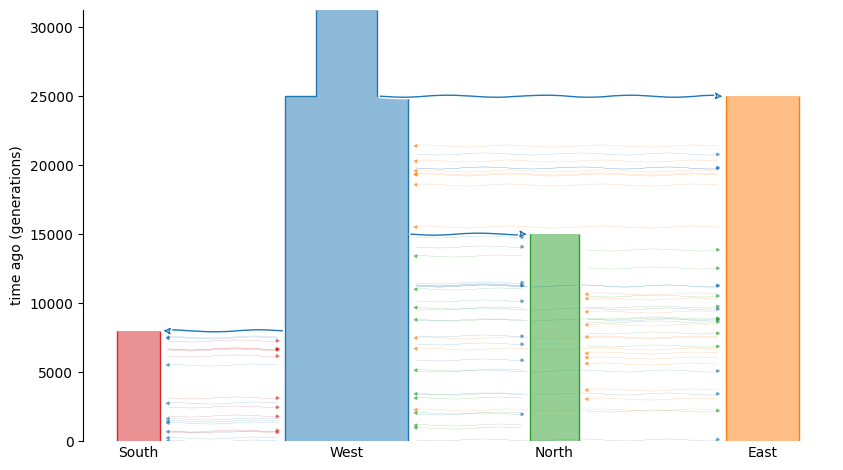
Populations: West, East, North, South
West, East, North, South populations with stepping-stone migration.
FiveRealm_5F10
Five-population admixture graph (Iran-Turan-Rum-Hind-Chin)
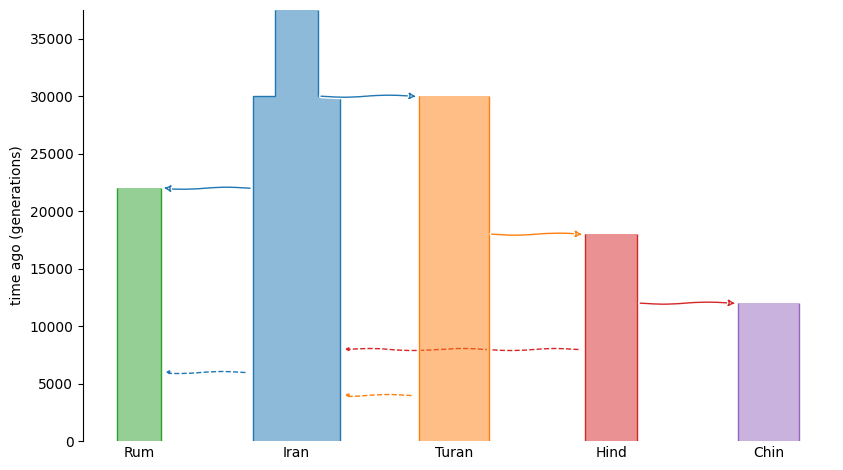
Populations: Iran, Turan, Rum, Hind, Chin
Five Shahnameh realms with pulse admixture events. Tests 5-pop graph inference.
SixPopExtRecolon_6F10
Six-population model with extinction and recolonization
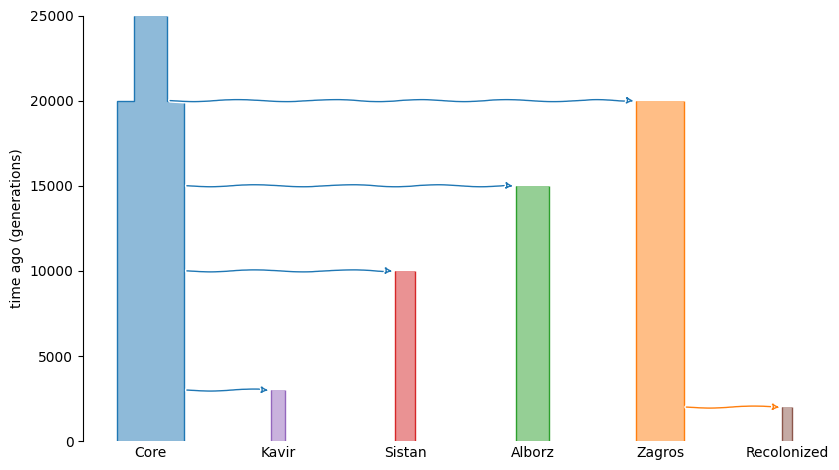
Populations: Core, Zagros, Alborz, Kavir, Sistan, Recolonized
Kavir goes extinct at 3000 gen, recolonized from Zagros at 2000 gen.
AsymReversal_2F10
Two-pop with migration direction reversal over time
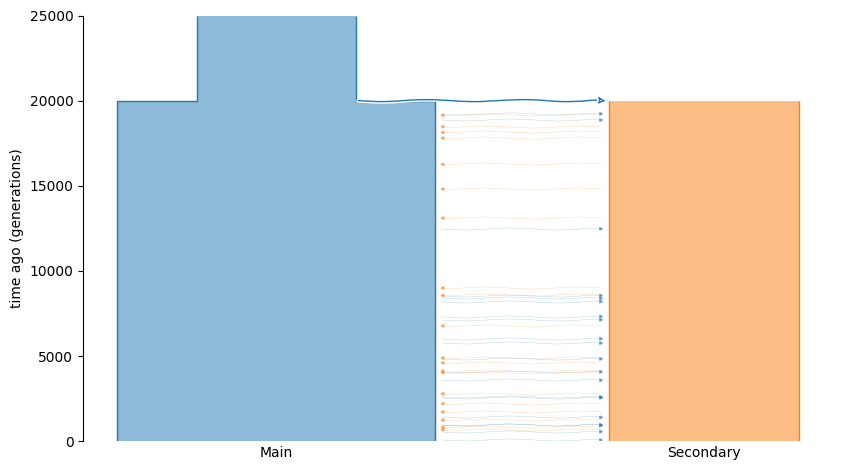
Populations: Main, Secondary
Migration reverses direction at 5000 gen ago. Tests temporal asymmetry.
SilkRoad_8F10
Eight-population Silk Road stepping-stone model
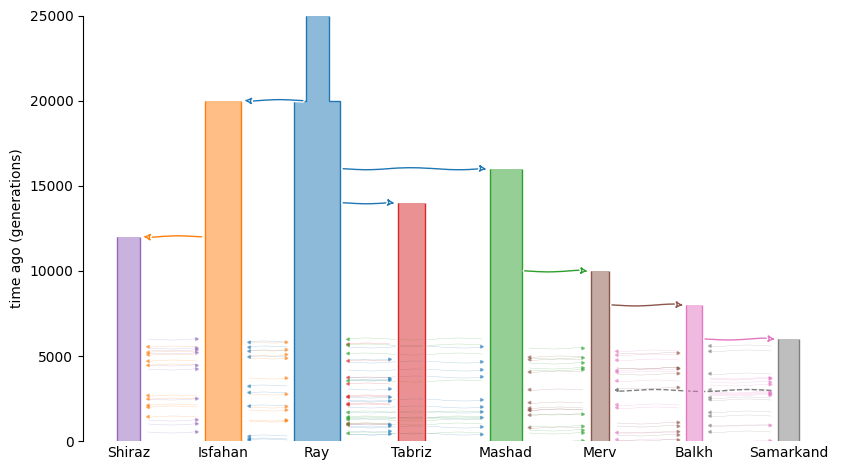
Populations: Ray, Isfahan, Shiraz, Tabriz, Mashad, Merv, Balkh, Samarkand
Eight cities along the Silk Road with stepping-stone migration and admixture.
Mithra (Mithra solarius) — The deity of covenant and the sun, predating Zoroaster. Later adopted into Roman religion as Mithras. Very long generation time, small populations.
Genome summary
- ID:
MitSol- Species:
Mithra solarius
- Common name:
Mithra (solar covenant deity)
- Assembly:
Mithra1.0(GCA_FERD_MitSol)- Ploidy:
2
- Generation time:
800 years
- Population size:
1,000
Chromosomes
Name |
Length (bp) |
Mutation rate |
Recombination rate |
|---|---|---|---|
1 |
20,000,000 |
2.00e-09 |
1.00e-08 |
2 |
18,000,000 |
2.00e-09 |
1.00e-08 |
3 |
16,000,000 |
2.00e-09 |
1.00e-08 |
4 |
14,000,000 |
2.00e-09 |
1.00e-08 |
mithra_mitogenome |
17,000 |
5.60e-09 |
0.00e+00 |
Demographic models
Constant_1F10
Single population constant-size model
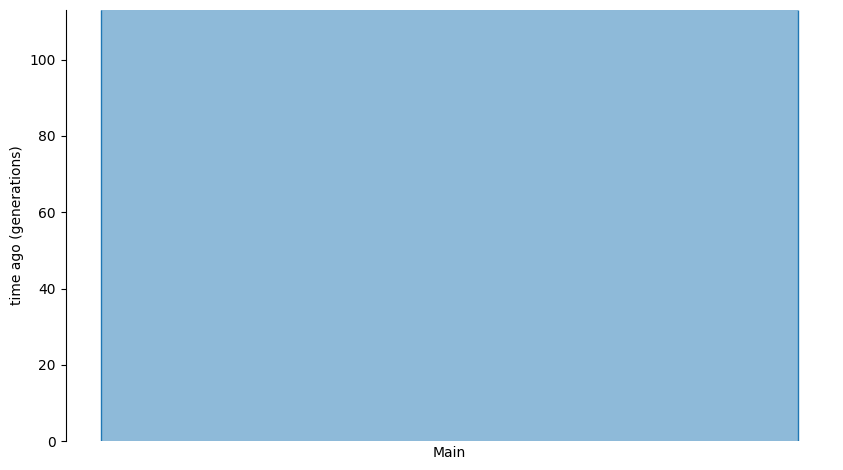
Populations: Main
Single population of Mithra (solar covenant deity) at constant size N=1000.
ThreeEpoch_1F10
Single population three-epoch model with bottleneck
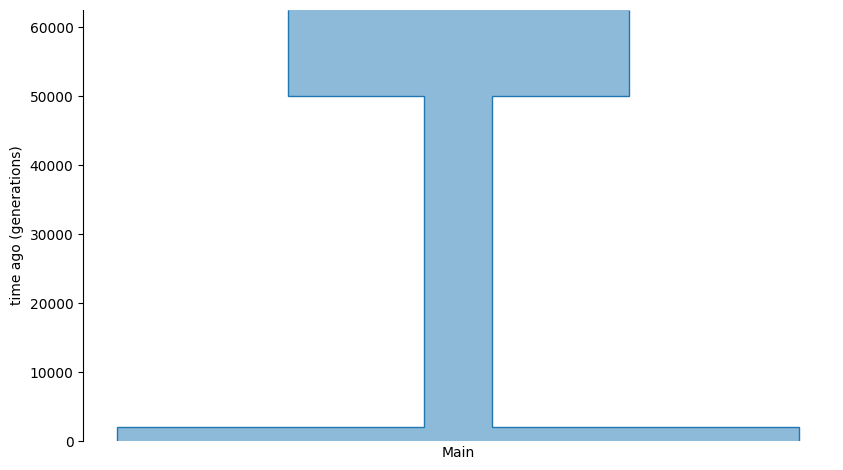
Populations: Main
Single pop of Mithra (solar covenant deity). Modern N=1000, bottleneck 100 at 2000 gen, ancestral 500 at 50000 gen.
TwoPopSplit_2F10
Two population split with symmetric migration
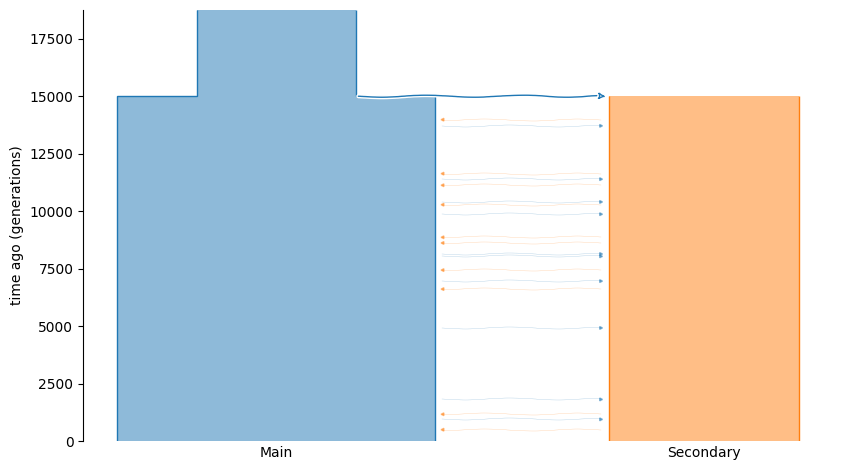
Populations: Main, Secondary
Two pops of Mithra (solar covenant deity). Main N=1000, Secondary N=600. Split 15000 gen ago.
GhostAdmixture_3F10
Two sampled pops + extinct ghost with pulse admixture
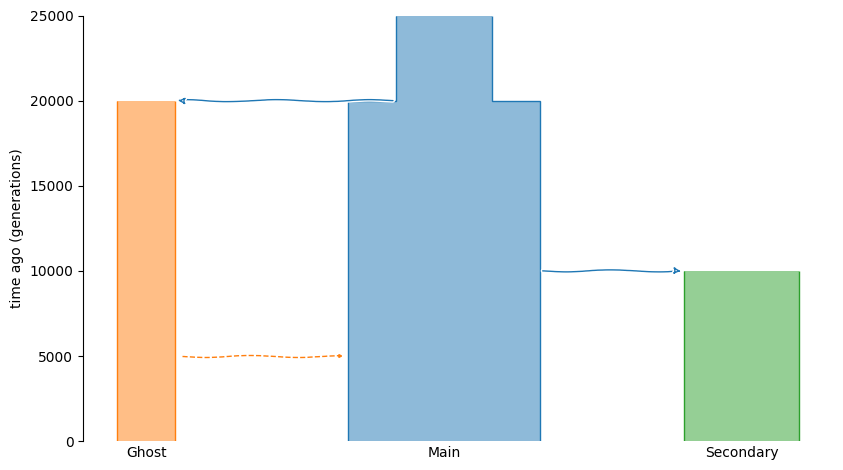
Populations: Main, Secondary, Ghost
Ghost contributes 15%% pulse admixture to Main at 5000 gen. Non-tree-like history.
ThreePopAdmix_3F10
Three populations with bidirectional pulse admixture
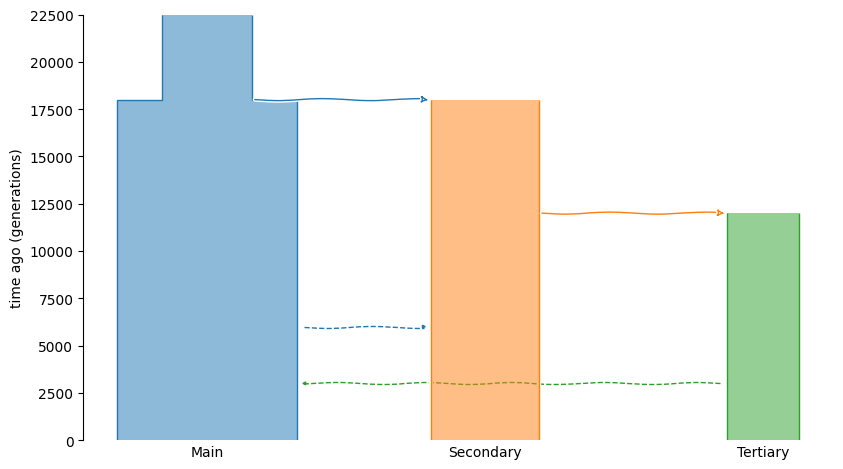
Populations: Main, Secondary, Tertiary
10%% Tertiary->Main at 3000 gen, 5%% Main->Secondary at 6000 gen. Admixture graph.
FourRegion_4F10
Four-population stepping-stone across Iranian plateau
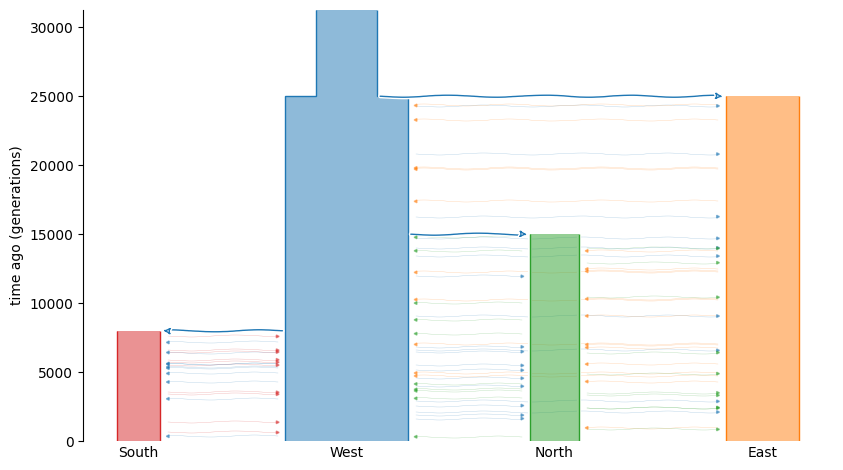
Populations: West, East, North, South
West, East, North, South populations with stepping-stone migration.
FiveRealm_5F10
Five-population admixture graph (Iran-Turan-Rum-Hind-Chin)
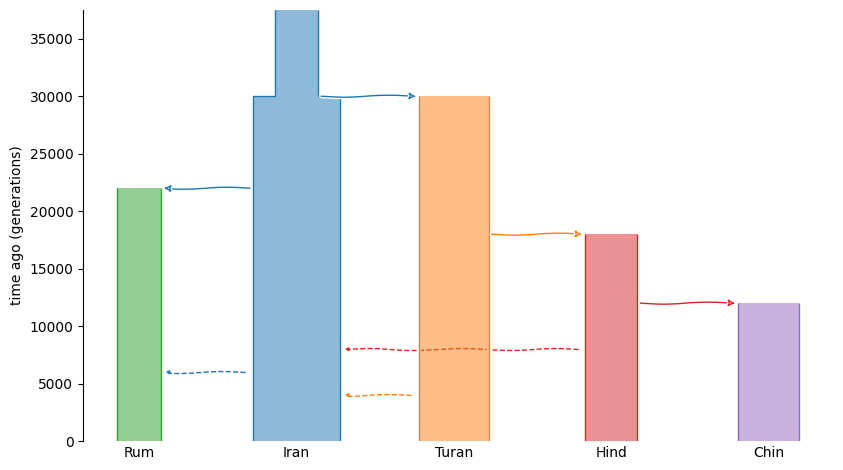
Populations: Iran, Turan, Rum, Hind, Chin
Five Shahnameh realms with pulse admixture events. Tests 5-pop graph inference.
SixPopExtRecolon_6F10
Six-population model with extinction and recolonization
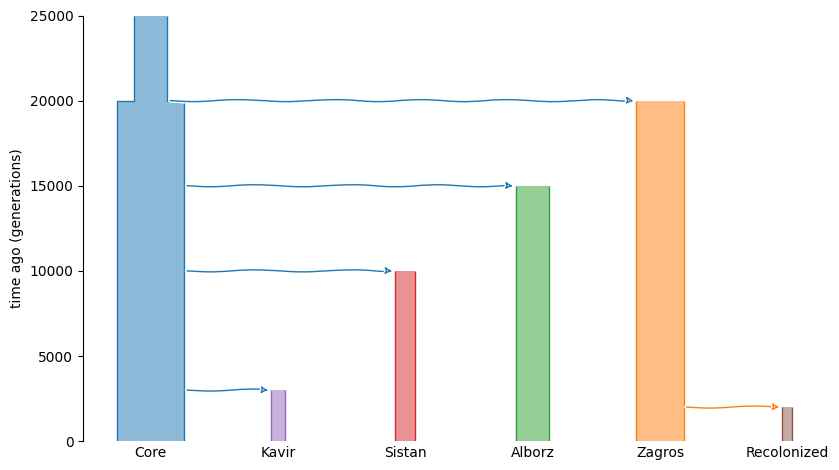
Populations: Core, Zagros, Alborz, Kavir, Sistan, Recolonized
Kavir goes extinct at 3000 gen, recolonized from Zagros at 2000 gen.
AsymReversal_2F10
Two-pop with migration direction reversal over time
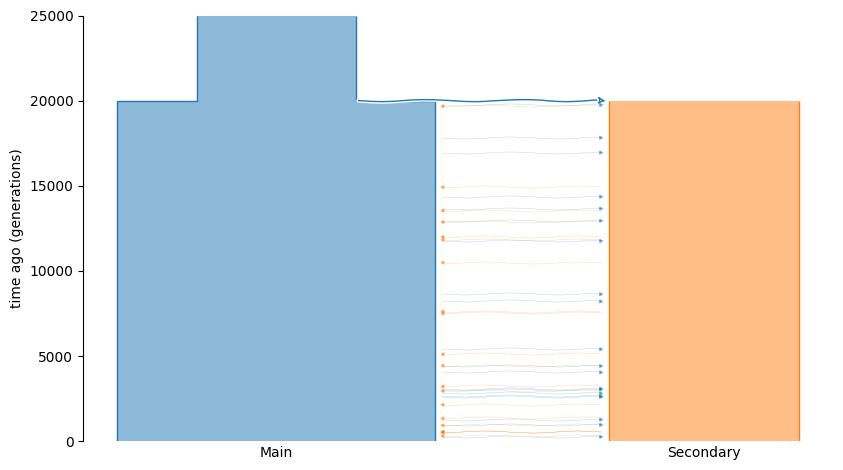
Populations: Main, Secondary
Migration reverses direction at 5000 gen ago. Tests temporal asymmetry.
SilkRoad_8F10
Eight-population Silk Road stepping-stone model
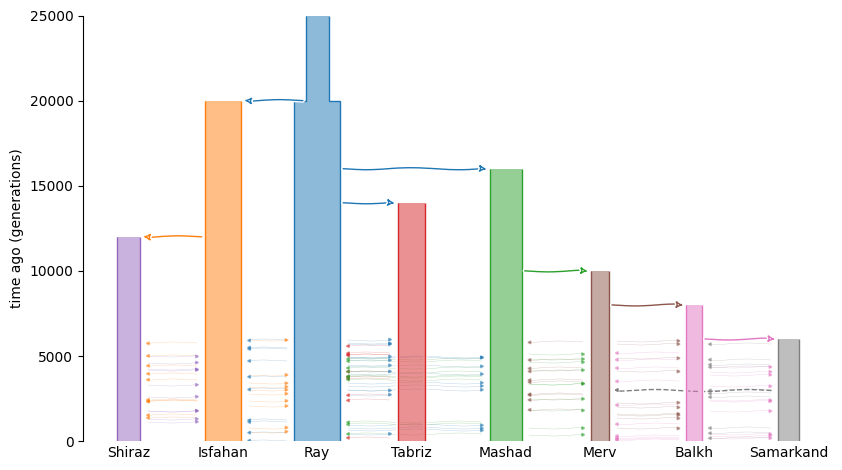
Populations: Ray, Isfahan, Shiraz, Tabriz, Mashad, Merv, Balkh, Samarkand
Eight cities along the Silk Road with stepping-stone migration and admixture.
Yazata (Yazata guardian) — Divine beings worthy of worship in Zoroastrian theology, including Asha (truth), Vohu Manah (good mind), and others. Small populations, deep time.
Genome summary
- ID:
YazGua- Species:
Yazata guardian
- Common name:
Yazata (divine being worthy of worship)
- Assembly:
Yazata1.0(GCA_FERD_YazGua)- Ploidy:
2
- Generation time:
500 years
- Population size:
3,000
Chromosomes
Name |
Length (bp) |
Mutation rate |
Recombination rate |
|---|---|---|---|
1 |
20,000,000 |
5.00e-09 |
2.00e-08 |
2 |
18,000,000 |
5.00e-09 |
2.00e-08 |
3 |
16,000,000 |
5.00e-09 |
2.00e-08 |
4 |
14,000,000 |
5.00e-09 |
2.00e-08 |
yazata_mitogenome |
17,000 |
1.40e-08 |
0.00e+00 |
Demographic models
Constant_1F10
Single population constant-size model
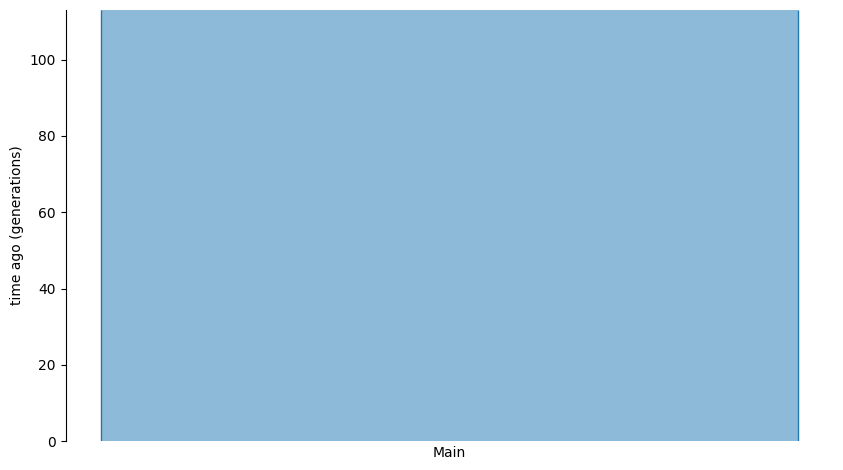
Populations: Main
Single population of Yazata (divine being worthy of worship) at constant size N=3000.
ThreeEpoch_1F10
Single population three-epoch model with bottleneck
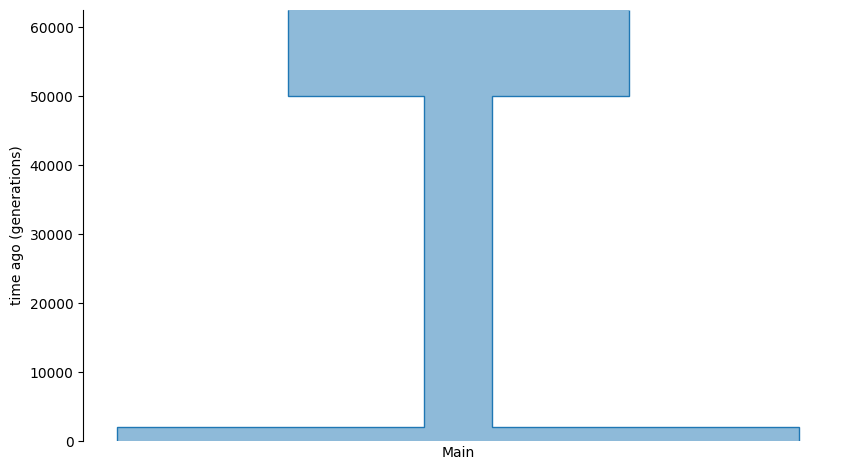
Populations: Main
Single pop of Yazata (divine being worthy of worship). Modern N=3000, bottleneck 300 at 2000 gen, ancestral 1500 at 50000 gen.
TwoPopSplit_2F10
Two population split with symmetric migration
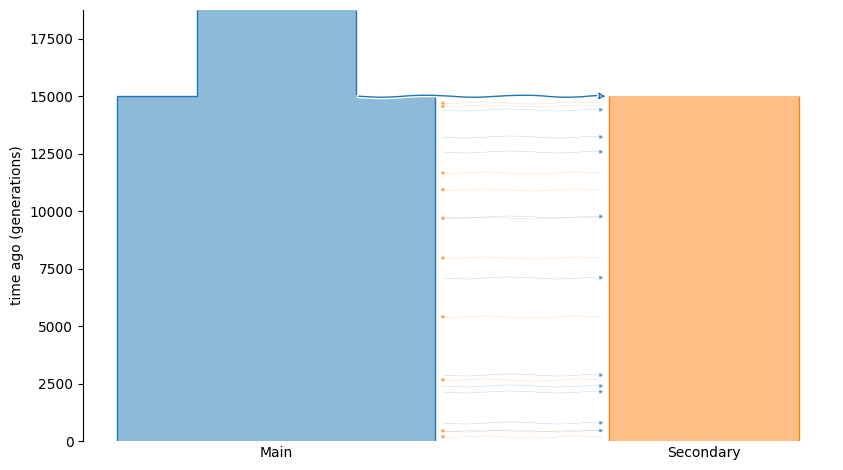
Populations: Main, Secondary
Two pops of Yazata (divine being worthy of worship). Main N=3000, Secondary N=1800. Split 15000 gen ago.
GhostAdmixture_3F10
Two sampled pops + extinct ghost with pulse admixture
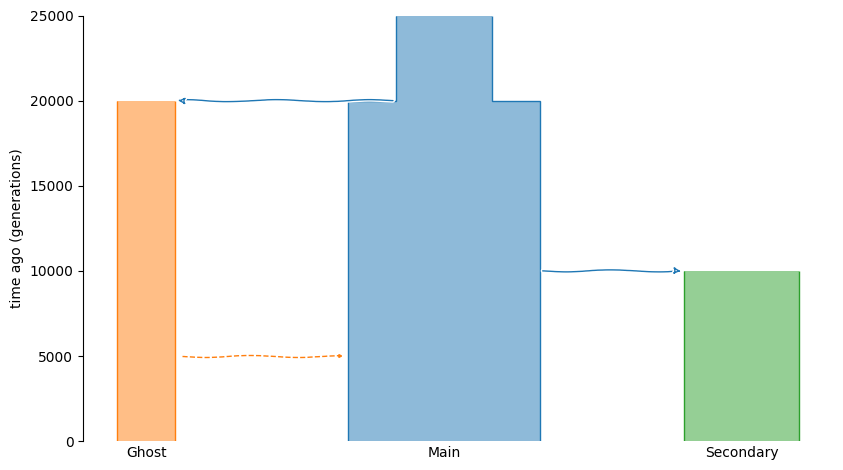
Populations: Main, Secondary, Ghost
Ghost contributes 15%% pulse admixture to Main at 5000 gen. Non-tree-like history.
ThreePopAdmix_3F10
Three populations with bidirectional pulse admixture
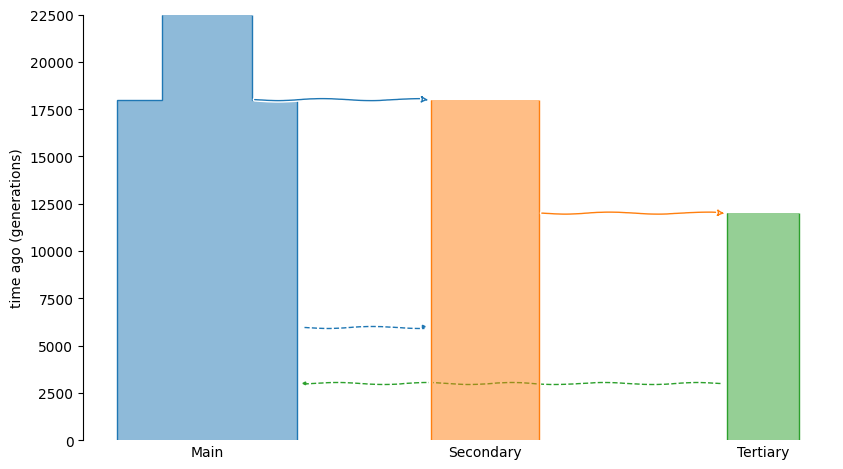
Populations: Main, Secondary, Tertiary
10%% Tertiary->Main at 3000 gen, 5%% Main->Secondary at 6000 gen. Admixture graph.
FourRegion_4F10
Four-population stepping-stone across Iranian plateau
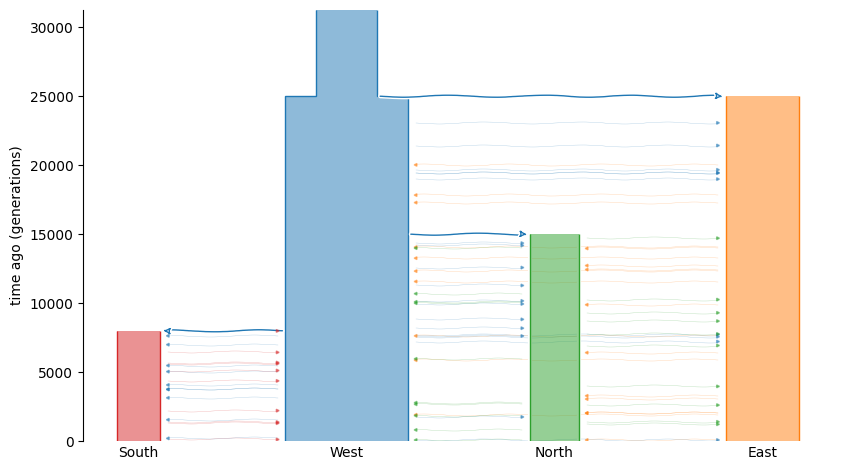
Populations: West, East, North, South
West, East, North, South populations with stepping-stone migration.
FiveRealm_5F10
Five-population admixture graph (Iran-Turan-Rum-Hind-Chin)
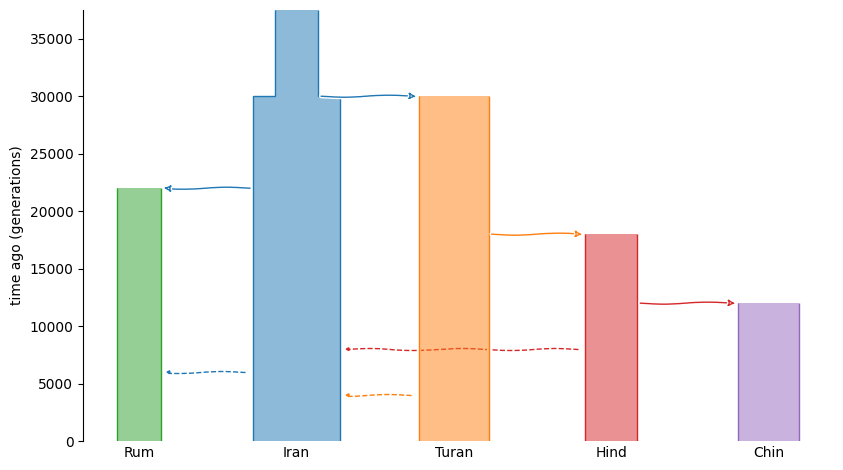
Populations: Iran, Turan, Rum, Hind, Chin
Five Shahnameh realms with pulse admixture events. Tests 5-pop graph inference.
SixPopExtRecolon_6F10
Six-population model with extinction and recolonization
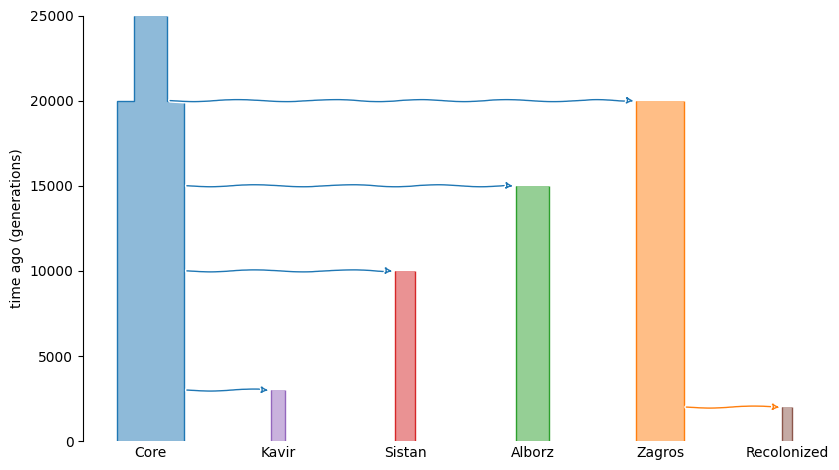
Populations: Core, Zagros, Alborz, Kavir, Sistan, Recolonized
Kavir goes extinct at 3000 gen, recolonized from Zagros at 2000 gen.
AsymReversal_2F10
Two-pop with migration direction reversal over time
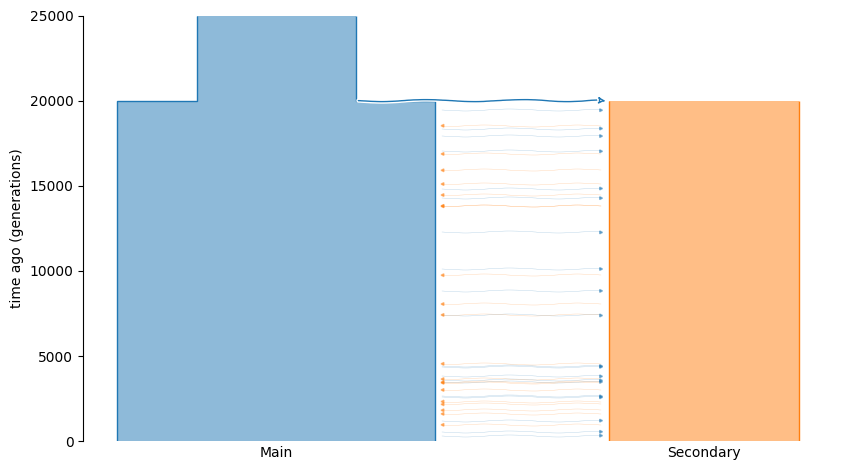
Populations: Main, Secondary
Migration reverses direction at 5000 gen ago. Tests temporal asymmetry.
SilkRoad_8F10
Eight-population Silk Road stepping-stone model
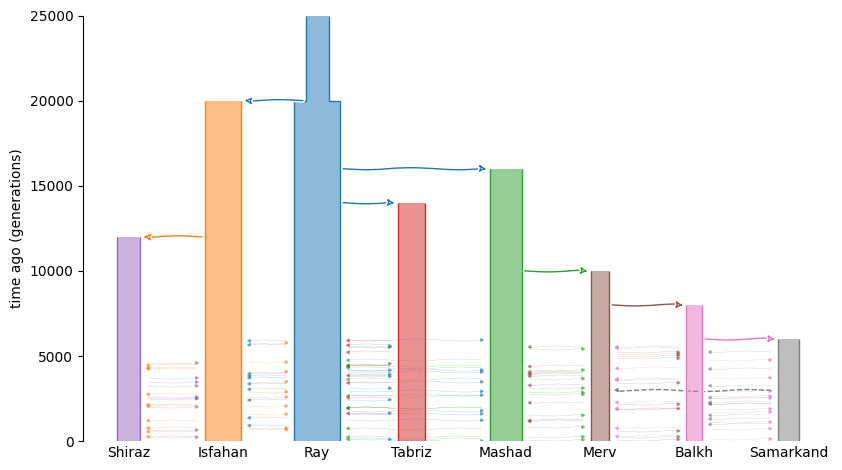
Populations: Ray, Isfahan, Shiraz, Tabriz, Mashad, Merv, Balkh, Samarkand
Eight cities along the Silk Road with stepping-stone migration and admixture.
Zoroaster-lineage (Zoroaster primus) — The prophet Zarathustra’s spiritual lineage, keepers of the sacred fire.
Genome summary
- ID:
ZorPri- Species:
Zoroaster primus
- Common name:
Zoroaster-lineage (prophet-fire lineage)
- Assembly:
Zartosht1.0(GCA_FERD_ZorPri)- Ploidy:
2
- Generation time:
100 years
- Population size:
10,000
Chromosomes
Name |
Length (bp) |
Mutation rate |
Recombination rate |
|---|---|---|---|
1 |
20,000,000 |
1.20e-08 |
4.00e-08 |
2 |
18,000,000 |
1.20e-08 |
4.00e-08 |
3 |
16,000,000 |
1.20e-08 |
4.00e-08 |
4 |
14,000,000 |
1.20e-08 |
4.00e-08 |
5 |
12,000,000 |
1.20e-08 |
4.00e-08 |
zartosht_mitogenome |
17,000 |
3.36e-08 |
0.00e+00 |
Demographic models
Constant_1F10
Single population constant-size model
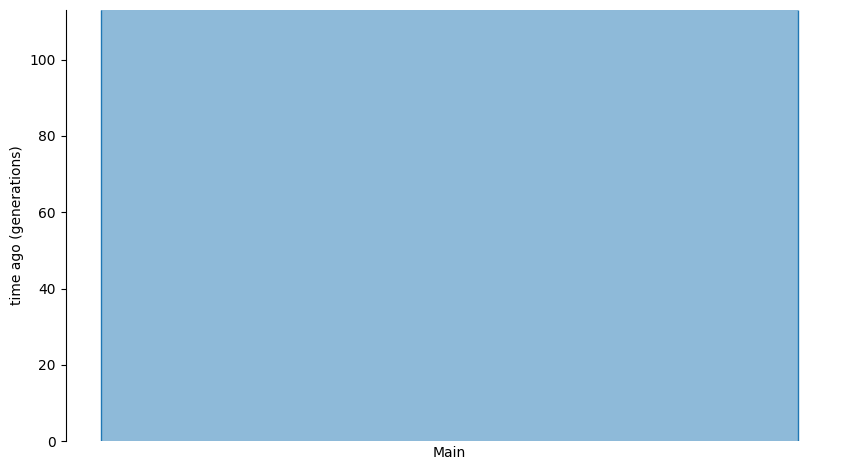
Populations: Main
Single population of Zoroaster-lineage (prophet-fire lineage) at constant size N=10000.
ThreeEpoch_1F10
Single population three-epoch model with bottleneck
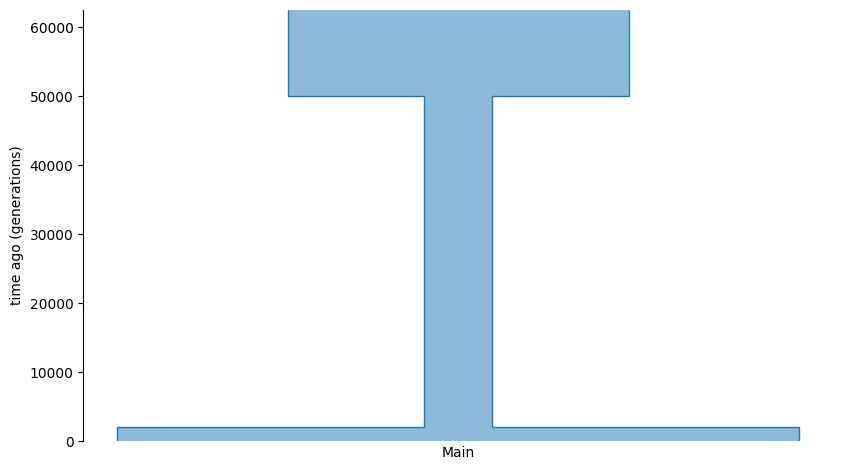
Populations: Main
Single pop of Zoroaster-lineage (prophet-fire lineage). Modern N=10000, bottleneck 1000 at 2000 gen, ancestral 5000 at 50000 gen.
TwoPopSplit_2F10
Two population split with symmetric migration
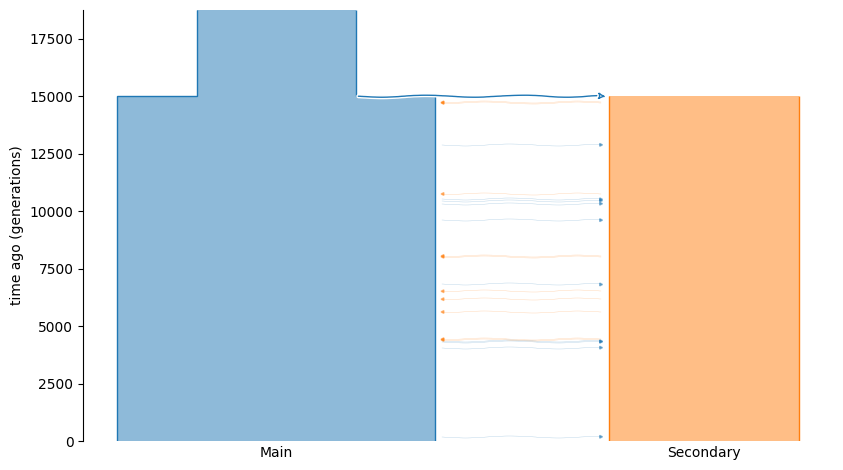
Populations: Main, Secondary
Two pops of Zoroaster-lineage (prophet-fire lineage). Main N=10000, Secondary N=6000. Split 15000 gen ago.
GhostAdmixture_3F10
Two sampled pops + extinct ghost with pulse admixture
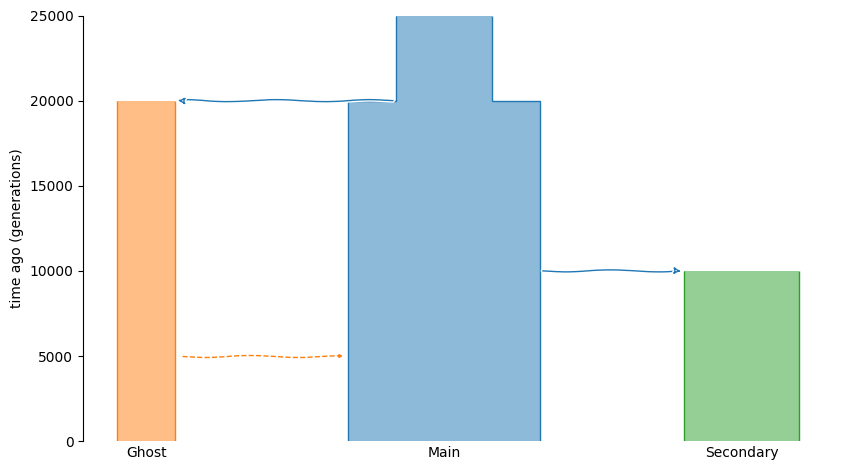
Populations: Main, Secondary, Ghost
Ghost contributes 15%% pulse admixture to Main at 5000 gen. Non-tree-like history.
ThreePopAdmix_3F10
Three populations with bidirectional pulse admixture
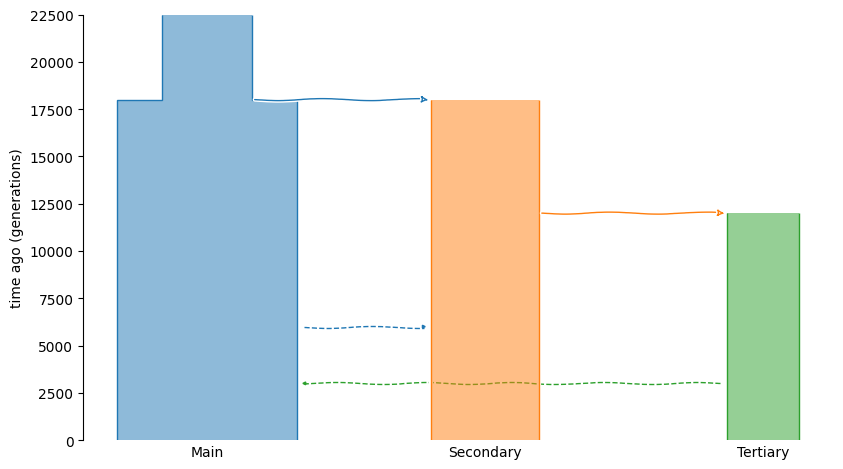
Populations: Main, Secondary, Tertiary
10%% Tertiary->Main at 3000 gen, 5%% Main->Secondary at 6000 gen. Admixture graph.
FourRegion_4F10
Four-population stepping-stone across Iranian plateau
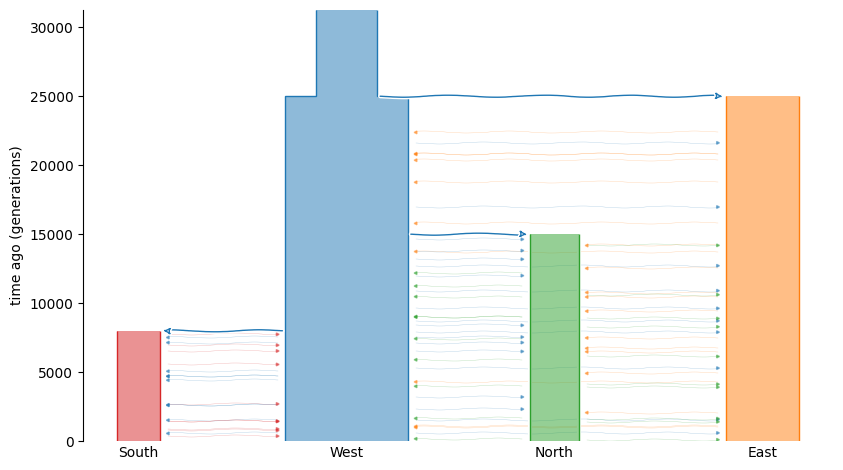
Populations: West, East, North, South
West, East, North, South populations with stepping-stone migration.
FiveRealm_5F10
Five-population admixture graph (Iran-Turan-Rum-Hind-Chin)
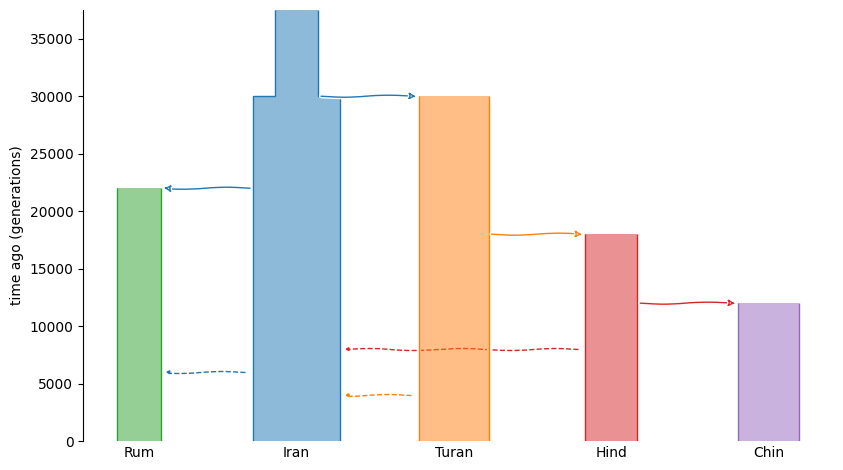
Populations: Iran, Turan, Rum, Hind, Chin
Five Shahnameh realms with pulse admixture events. Tests 5-pop graph inference.
SixPopExtRecolon_6F10
Six-population model with extinction and recolonization
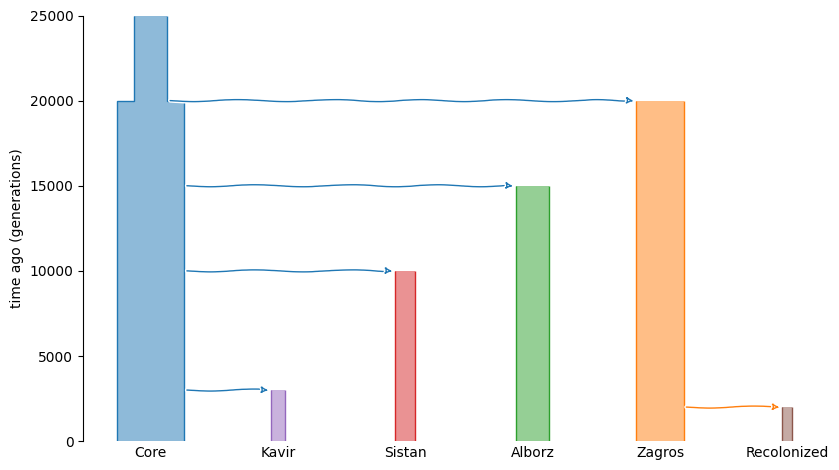
Populations: Core, Zagros, Alborz, Kavir, Sistan, Recolonized
Kavir goes extinct at 3000 gen, recolonized from Zagros at 2000 gen.
AsymReversal_2F10
Two-pop with migration direction reversal over time
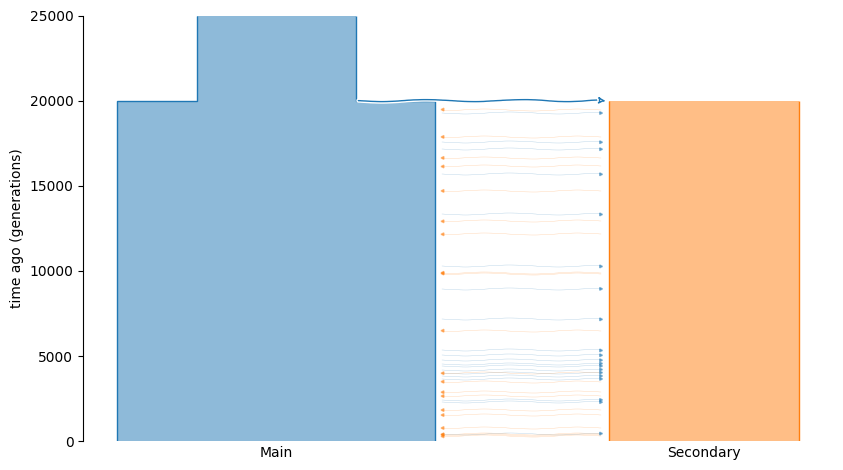
Populations: Main, Secondary
Migration reverses direction at 5000 gen ago. Tests temporal asymmetry.
SilkRoad_8F10
Eight-population Silk Road stepping-stone model
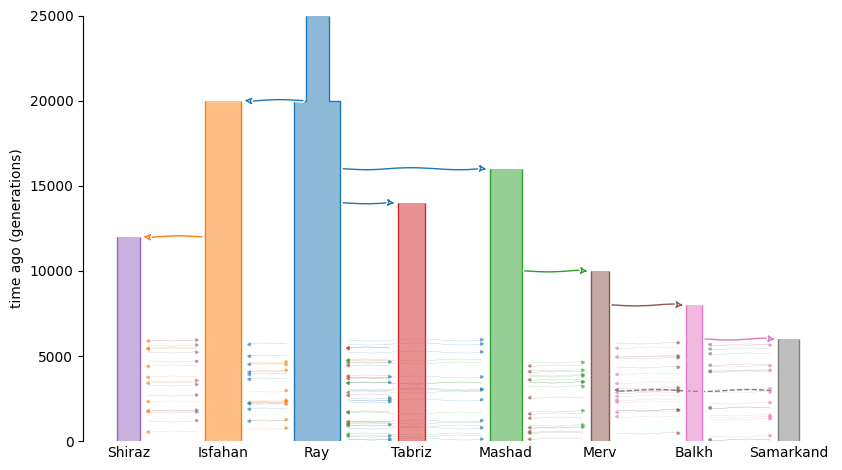
Populations: Ray, Isfahan, Shiraz, Tabriz, Mashad, Merv, Balkh, Samarkand
Eight cities along the Silk Road with stepping-stone migration and admixture.
Khidr (Khidr wisdomus) — The Green One, an immortal sage who appears at moments of crisis. The smallest Ne and longest generation time in the catalog — an almost-singleton immortal lineage.
Genome summary
- ID:
KhiWis- Species:
Khidr wisdomus
- Common name:
Khidr (the Green One, immortal sage)
- Assembly:
Khidr1.0(GCA_FERD_KhiWis)- Ploidy:
2
- Generation time:
1000 years
- Population size:
500
Chromosomes
Name |
Length (bp) |
Mutation rate |
Recombination rate |
|---|---|---|---|
1 |
20,000,000 |
1.00e-09 |
5.00e-09 |
2 |
18,000,000 |
1.00e-09 |
5.00e-09 |
3 |
16,000,000 |
1.00e-09 |
5.00e-09 |
4 |
14,000,000 |
1.00e-09 |
5.00e-09 |
khidr_mitogenome |
17,000 |
2.80e-09 |
0.00e+00 |
Demographic models
Constant_1F10
Single population constant-size model
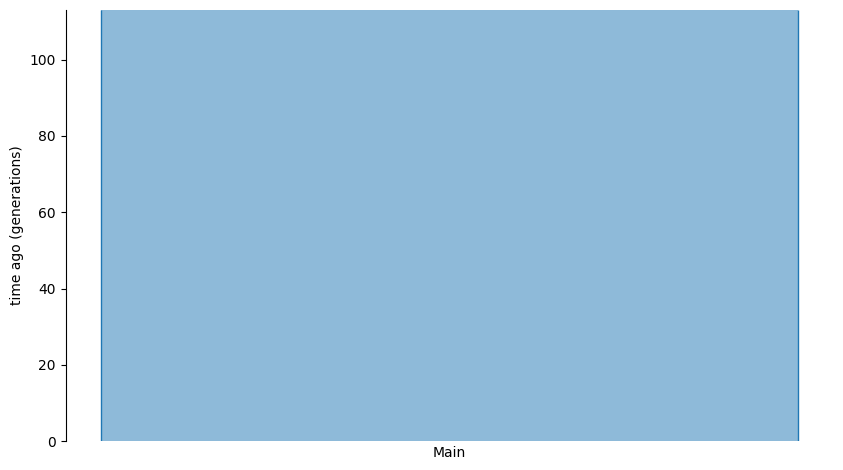
Populations: Main
Single population of Khidr (the Green One, immortal sage) at constant size N=500.
ThreeEpoch_1F10
Single population three-epoch model with bottleneck
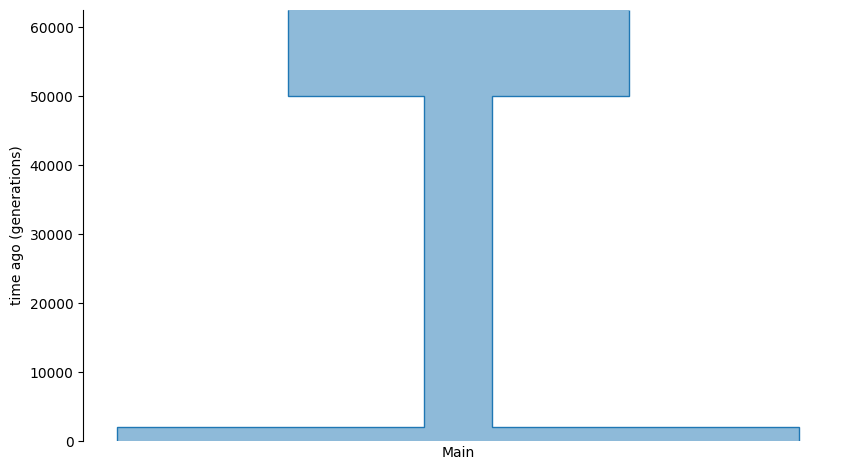
Populations: Main
Single pop of Khidr (the Green One, immortal sage). Modern N=500, bottleneck 50 at 2000 gen, ancestral 250 at 50000 gen.
TwoPopSplit_2F10
Two population split with symmetric migration
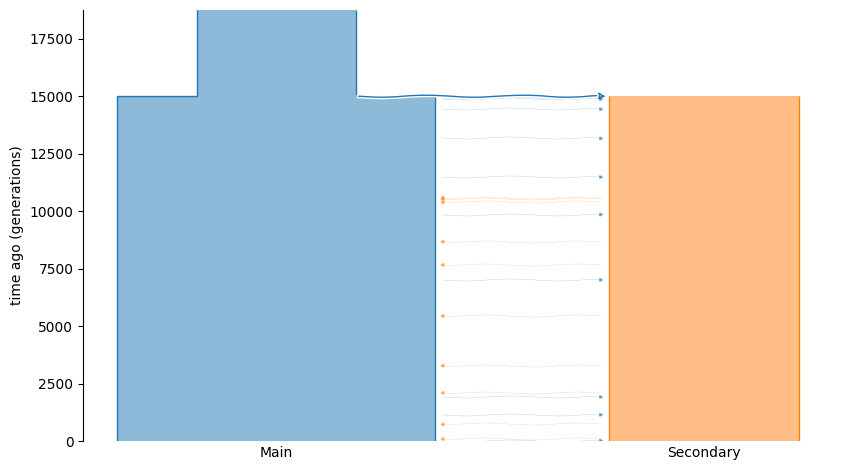
Populations: Main, Secondary
Two pops of Khidr (the Green One, immortal sage). Main N=500, Secondary N=300. Split 15000 gen ago.
GhostAdmixture_3F10
Two sampled pops + extinct ghost with pulse admixture
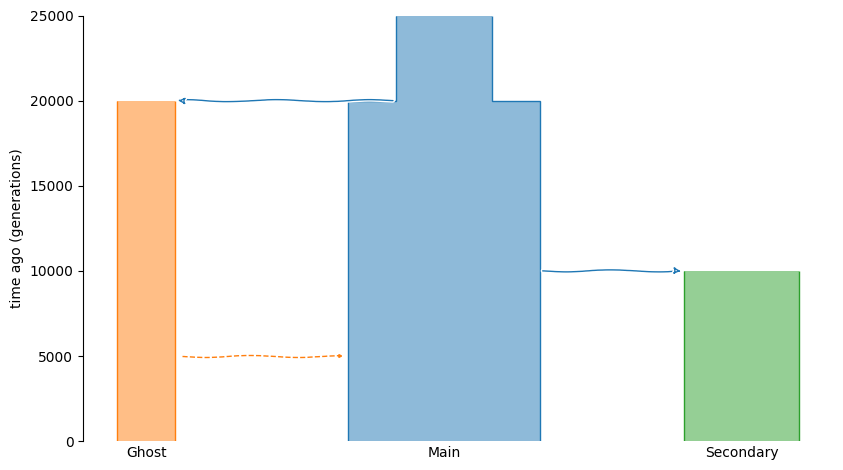
Populations: Main, Secondary, Ghost
Ghost contributes 15%% pulse admixture to Main at 5000 gen. Non-tree-like history.
ThreePopAdmix_3F10
Three populations with bidirectional pulse admixture
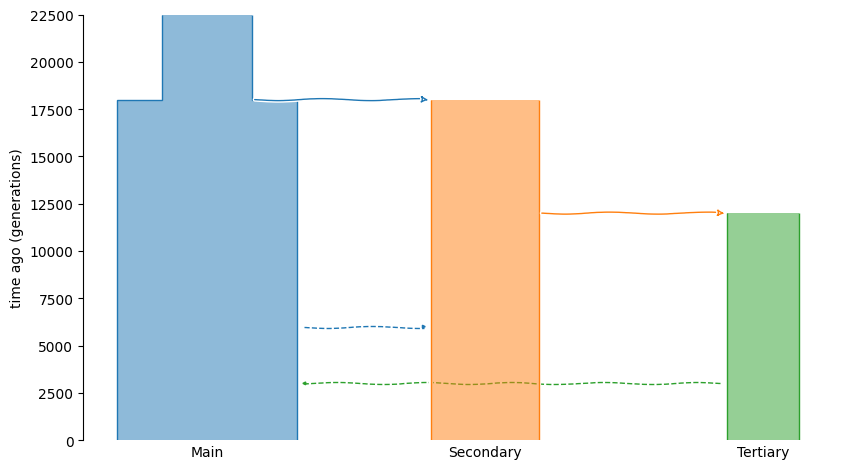
Populations: Main, Secondary, Tertiary
10%% Tertiary->Main at 3000 gen, 5%% Main->Secondary at 6000 gen. Admixture graph.
FourRegion_4F10
Four-population stepping-stone across Iranian plateau
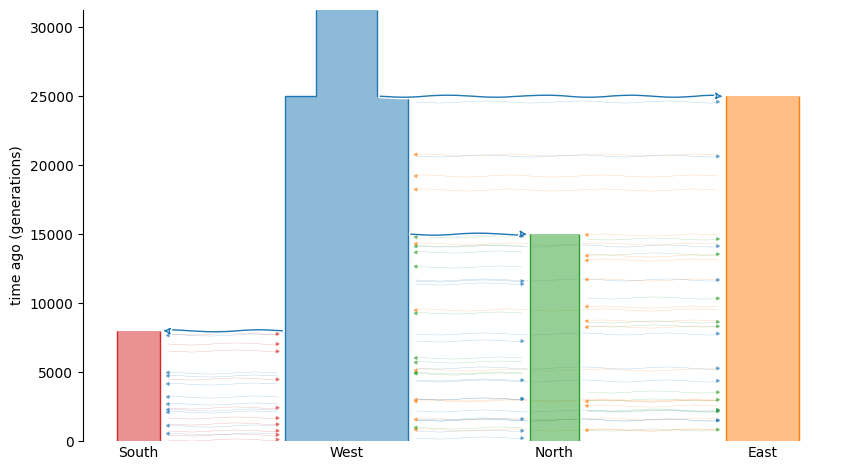
Populations: West, East, North, South
West, East, North, South populations with stepping-stone migration.
FiveRealm_5F10
Five-population admixture graph (Iran-Turan-Rum-Hind-Chin)
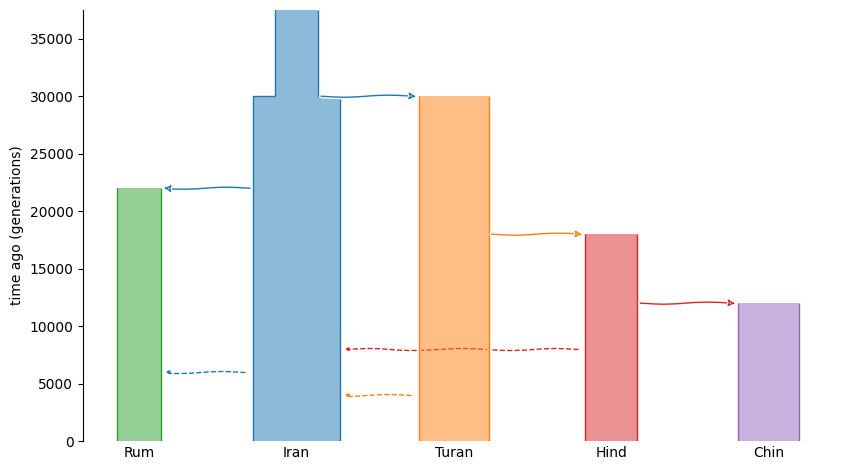
Populations: Iran, Turan, Rum, Hind, Chin
Five Shahnameh realms with pulse admixture events. Tests 5-pop graph inference.
SixPopExtRecolon_6F10
Six-population model with extinction and recolonization
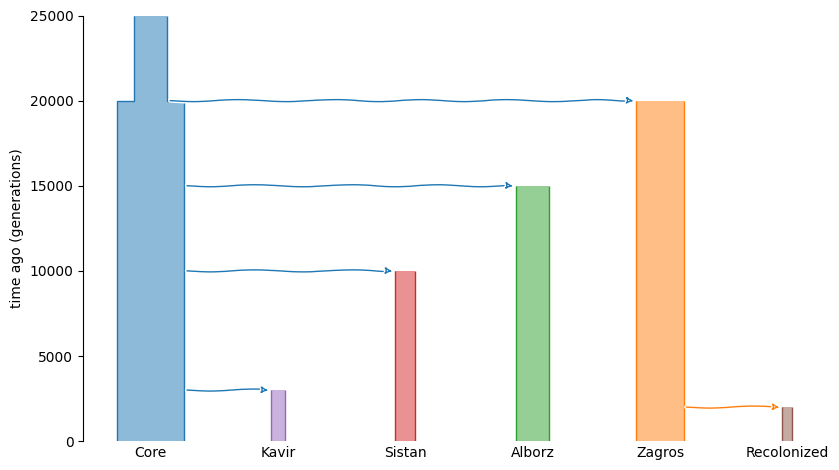
Populations: Core, Zagros, Alborz, Kavir, Sistan, Recolonized
Kavir goes extinct at 3000 gen, recolonized from Zagros at 2000 gen.
AsymReversal_2F10
Two-pop with migration direction reversal over time
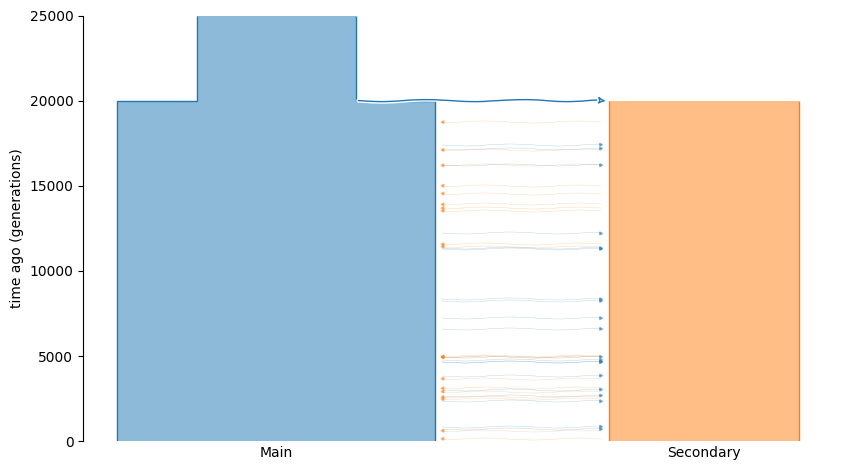
Populations: Main, Secondary
Migration reverses direction at 5000 gen ago. Tests temporal asymmetry.
SilkRoad_8F10
Eight-population Silk Road stepping-stone model
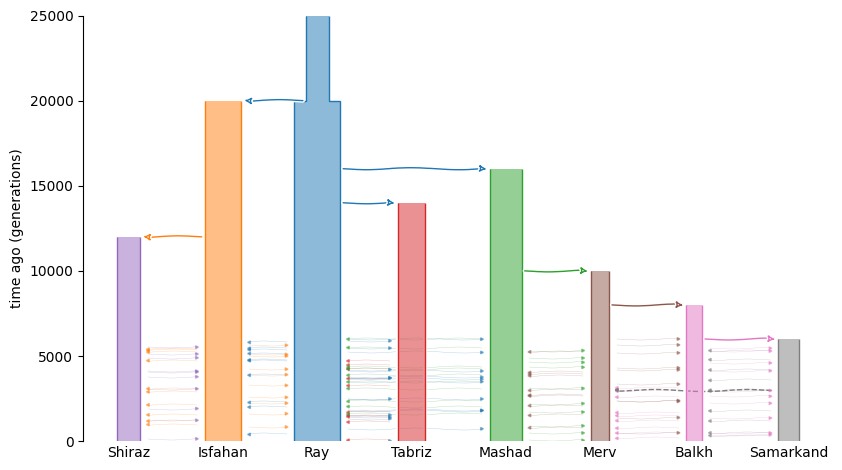
Populations: Ray, Isfahan, Shiraz, Tabriz, Mashad, Merv, Balkh, Samarkand
Eight cities along the Silk Road with stepping-stone migration and admixture.
Cross-cultural & Regional
Nart-spirit (Nart heronius) — From the Nart sagas, the heroic cycle shared between Caucasian and Iranian peoples. Represents cultural and genetic exchange between the Caucasus and Iran.
Genome summary
- ID:
NarHer- Species:
Nart heronius
- Common name:
Nart-spirit (Caucasian-Iranian hero cycle)
- Assembly:
Nart1.0(GCA_FERD_NarHer)- Ploidy:
2
- Generation time:
28 years
- Population size:
22,000
Chromosomes
Name |
Length (bp) |
Mutation rate |
Recombination rate |
|---|---|---|---|
1 |
20,000,000 |
2.50e-08 |
2.80e-08 |
2 |
18,000,000 |
2.50e-08 |
2.80e-08 |
3 |
16,000,000 |
2.50e-08 |
2.80e-08 |
4 |
14,000,000 |
2.50e-08 |
2.80e-08 |
5 |
12,000,000 |
2.50e-08 |
2.80e-08 |
nart_mitogenome |
17,000 |
7.00e-08 |
0.00e+00 |
Demographic models
Constant_1F10
Single population constant-size model
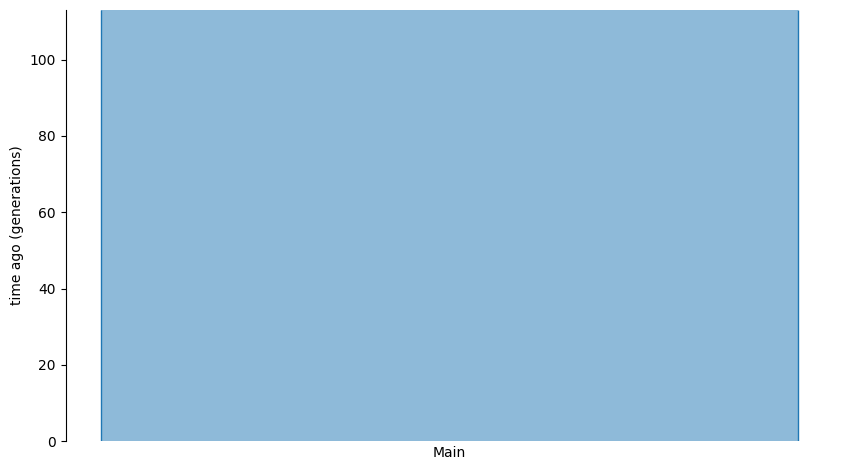
Populations: Main
Single population of Nart-spirit (Caucasian-Iranian hero cycle) at constant size N=22000.
ThreeEpoch_1F10
Single population three-epoch model with bottleneck
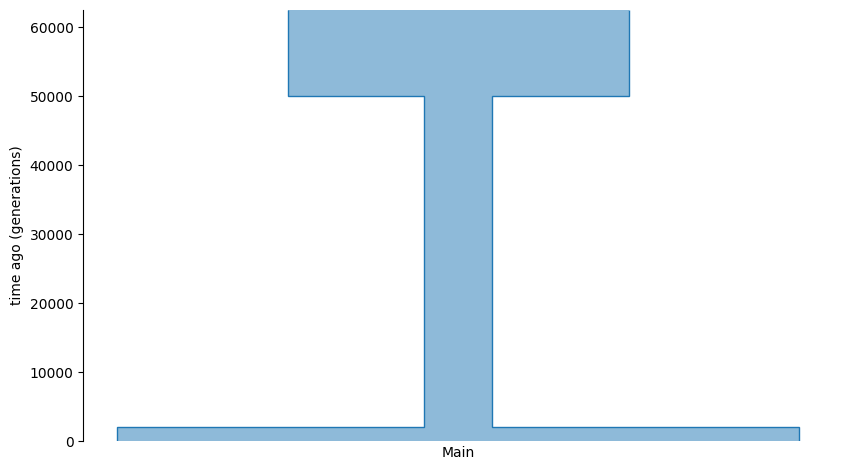
Populations: Main
Single pop of Nart-spirit (Caucasian-Iranian hero cycle). Modern N=22000, bottleneck 2200 at 2000 gen, ancestral 11000 at 50000 gen.
TwoPopSplit_2F10
Two population split with symmetric migration
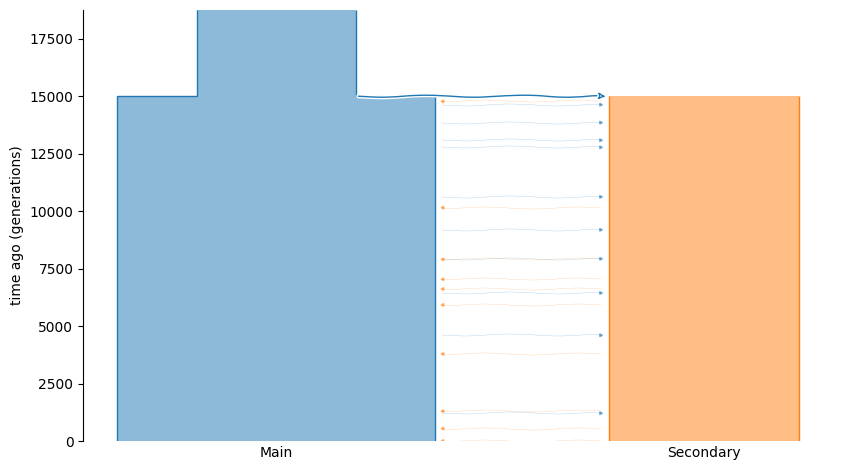
Populations: Main, Secondary
Two pops of Nart-spirit (Caucasian-Iranian hero cycle). Main N=22000, Secondary N=13200. Split 15000 gen ago.
GhostAdmixture_3F10
Two sampled pops + extinct ghost with pulse admixture
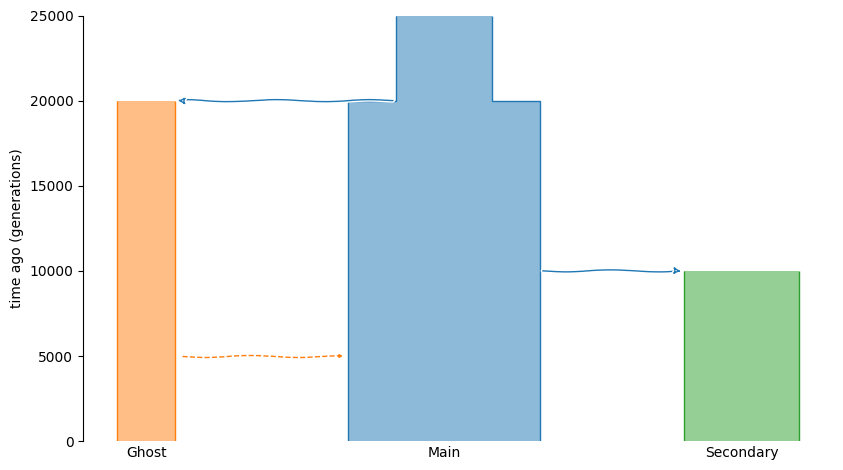
Populations: Main, Secondary, Ghost
Ghost contributes 15%% pulse admixture to Main at 5000 gen. Non-tree-like history.
ThreePopAdmix_3F10
Three populations with bidirectional pulse admixture
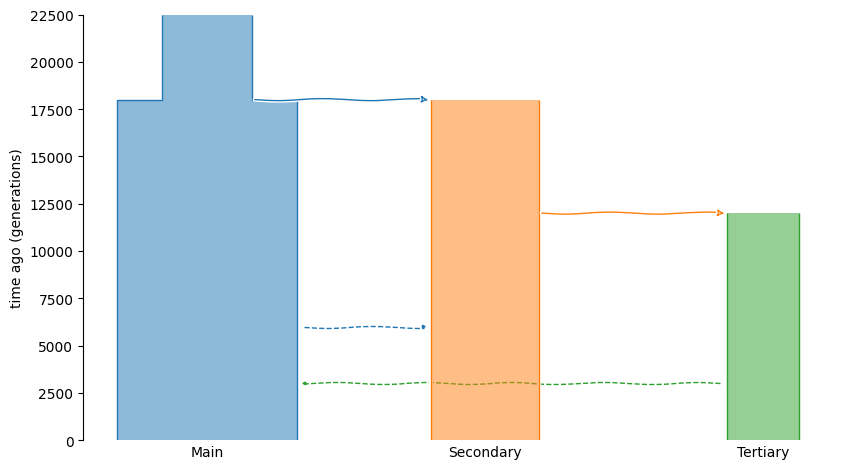
Populations: Main, Secondary, Tertiary
10%% Tertiary->Main at 3000 gen, 5%% Main->Secondary at 6000 gen. Admixture graph.
FourRegion_4F10
Four-population stepping-stone across Iranian plateau
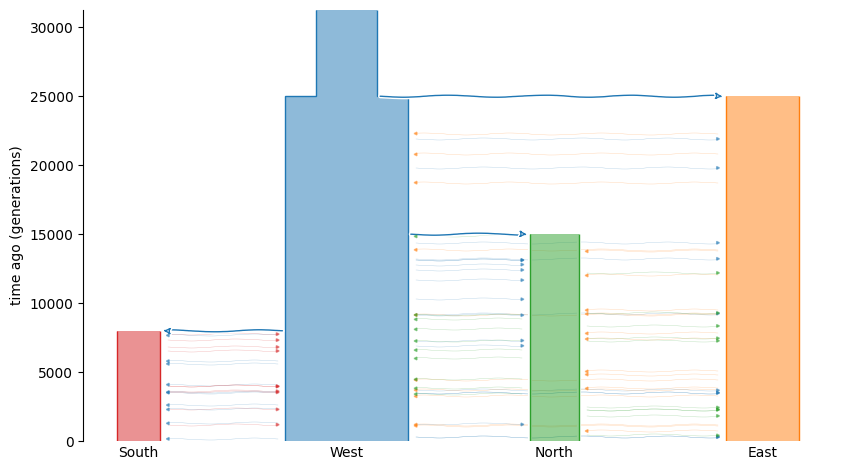
Populations: West, East, North, South
West, East, North, South populations with stepping-stone migration.
FiveRealm_5F10
Five-population admixture graph (Iran-Turan-Rum-Hind-Chin)
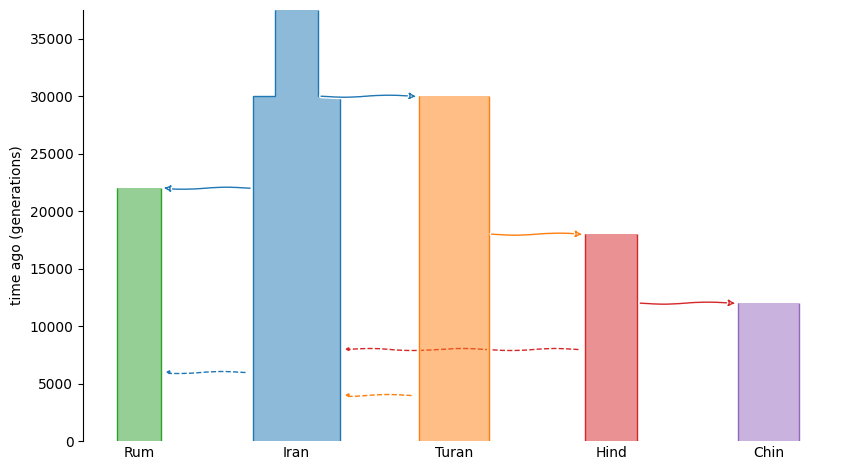
Populations: Iran, Turan, Rum, Hind, Chin
Five Shahnameh realms with pulse admixture events. Tests 5-pop graph inference.
SixPopExtRecolon_6F10
Six-population model with extinction and recolonization
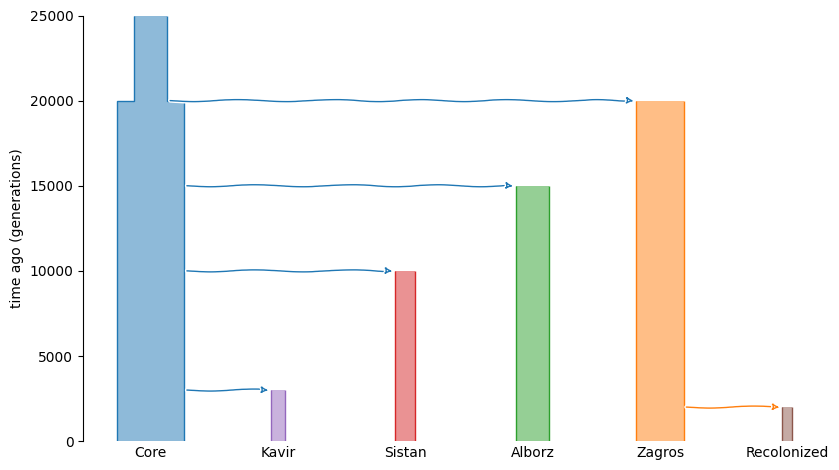
Populations: Core, Zagros, Alborz, Kavir, Sistan, Recolonized
Kavir goes extinct at 3000 gen, recolonized from Zagros at 2000 gen.
AsymReversal_2F10
Two-pop with migration direction reversal over time
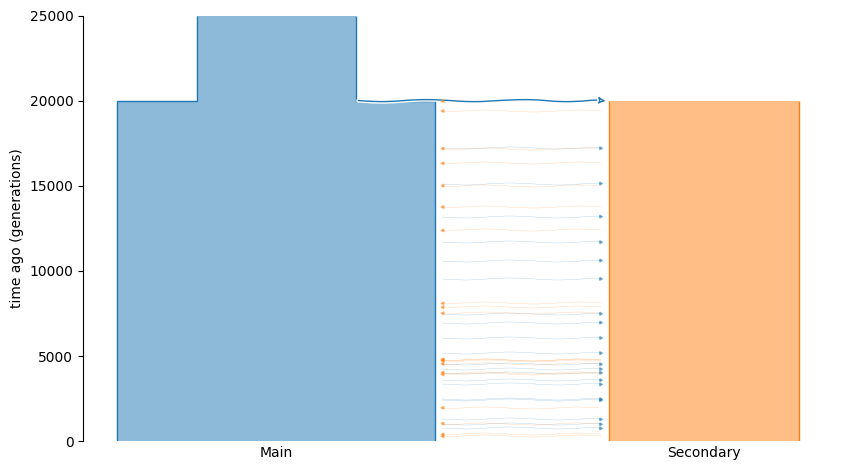
Populations: Main, Secondary
Migration reverses direction at 5000 gen ago. Tests temporal asymmetry.
SilkRoad_8F10
Eight-population Silk Road stepping-stone model
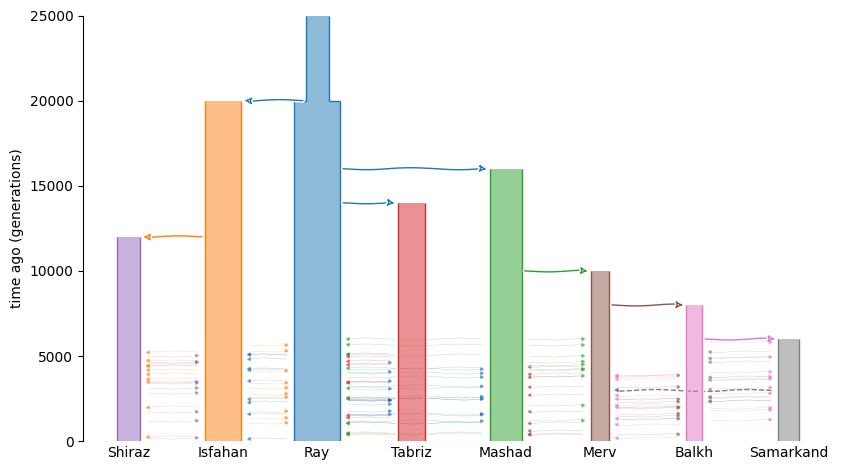
Populations: Ray, Isfahan, Shiraz, Tabriz, Mashad, Merv, Balkh, Samarkand
Eight cities along the Silk Road with stepping-stone migration and admixture.
Marduk-spirit (Marduk mortalis) — A Mesopotamian-Iranian crossover spirit, representing the deep cultural exchange between Mesopotamia and the Iranian plateau.
Genome summary
- ID:
MarMor- Species:
Marduk mortalis
- Common name:
Marduk-spirit (Mesopotamian-Iranian crossover)
- Assembly:
Marduk1.0(GCA_FERD_MarMor)- Ploidy:
2
- Generation time:
45 years
- Population size:
75,000
Chromosomes
Name |
Length (bp) |
Mutation rate |
Recombination rate |
|---|---|---|---|
1 |
20,000,000 |
2.00e-08 |
3.50e-08 |
2 |
18,000,000 |
2.00e-08 |
3.50e-08 |
3 |
16,000,000 |
2.00e-08 |
3.50e-08 |
4 |
14,000,000 |
2.00e-08 |
3.50e-08 |
5 |
12,000,000 |
2.00e-08 |
3.50e-08 |
marduk_mitogenome |
17,000 |
5.60e-08 |
0.00e+00 |
Demographic models
Constant_1F10
Single population constant-size model
Populations: Main
Single population of Marduk-spirit (Mesopotamian-Iranian crossover) at constant size N=75000.
ThreeEpoch_1F10
Single population three-epoch model with bottleneck
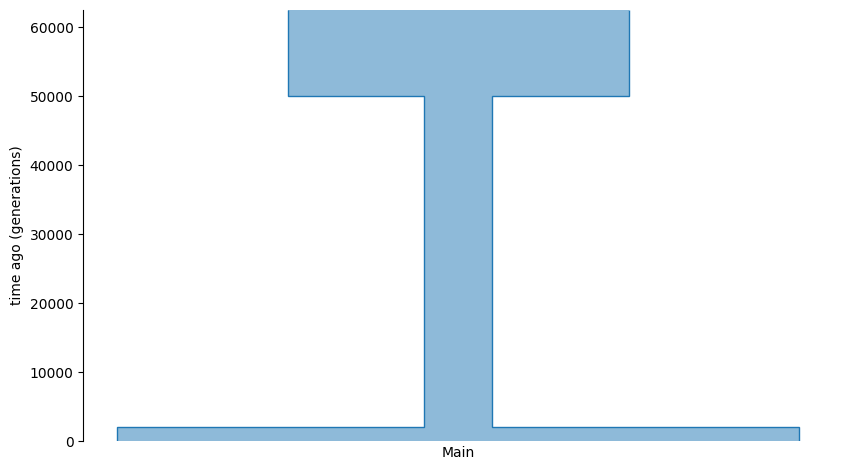
Populations: Main
Single pop of Marduk-spirit (Mesopotamian-Iranian crossover). Modern N=75000, bottleneck 7500 at 2000 gen, ancestral 37500 at 50000 gen.
TwoPopSplit_2F10
Two population split with symmetric migration
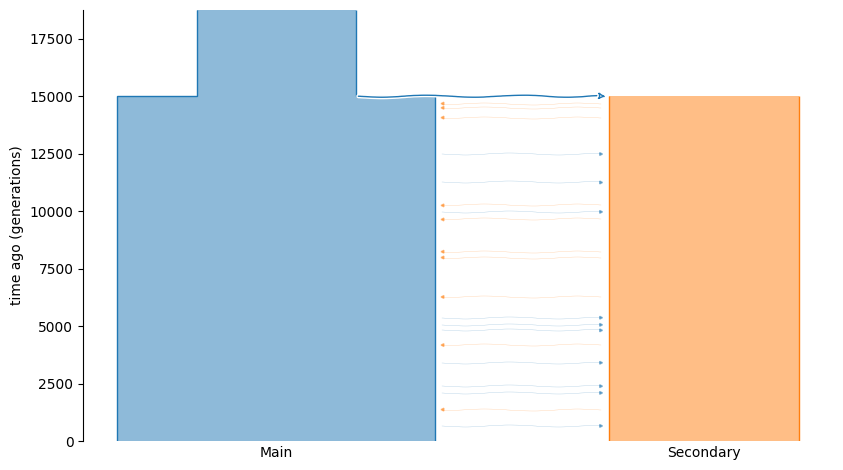
Populations: Main, Secondary
Two pops of Marduk-spirit (Mesopotamian-Iranian crossover). Main N=75000, Secondary N=45000. Split 15000 gen ago.
GhostAdmixture_3F10
Two sampled pops + extinct ghost with pulse admixture
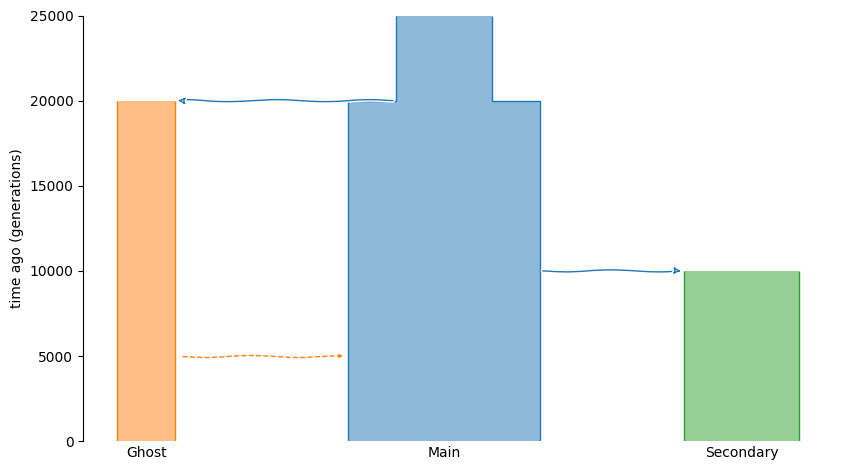
Populations: Main, Secondary, Ghost
Ghost contributes 15%% pulse admixture to Main at 5000 gen. Non-tree-like history.
ThreePopAdmix_3F10
Three populations with bidirectional pulse admixture
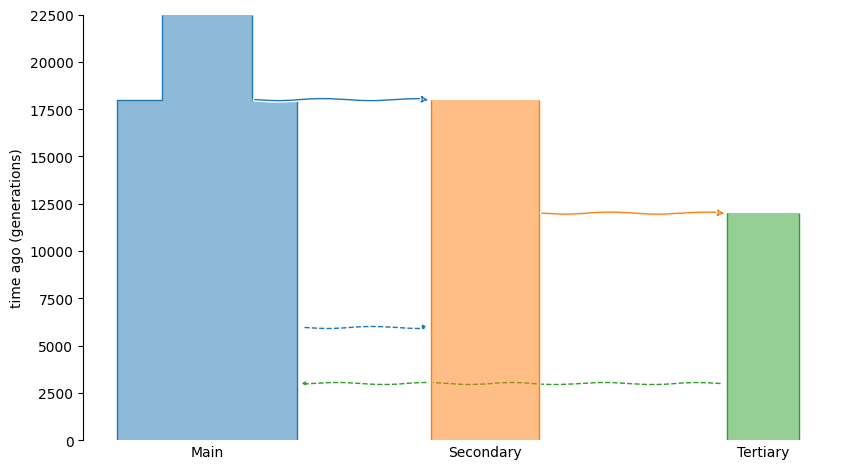
Populations: Main, Secondary, Tertiary
10%% Tertiary->Main at 3000 gen, 5%% Main->Secondary at 6000 gen. Admixture graph.
FourRegion_4F10
Four-population stepping-stone across Iranian plateau
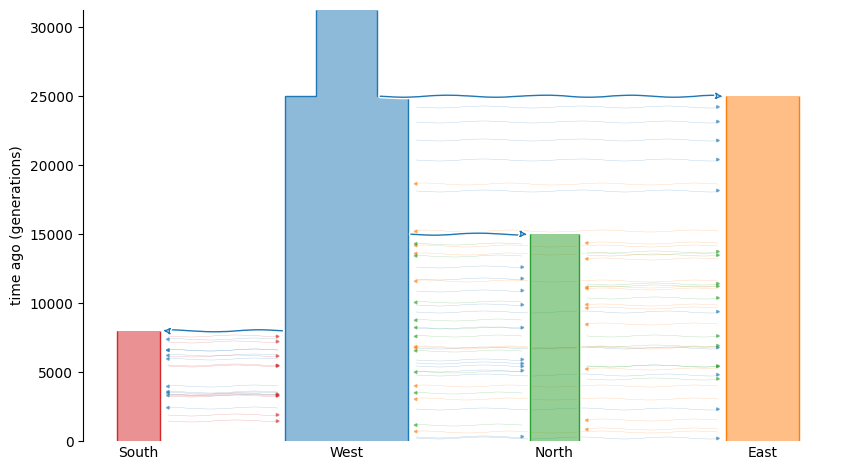
Populations: West, East, North, South
West, East, North, South populations with stepping-stone migration.
FiveRealm_5F10
Five-population admixture graph (Iran-Turan-Rum-Hind-Chin)
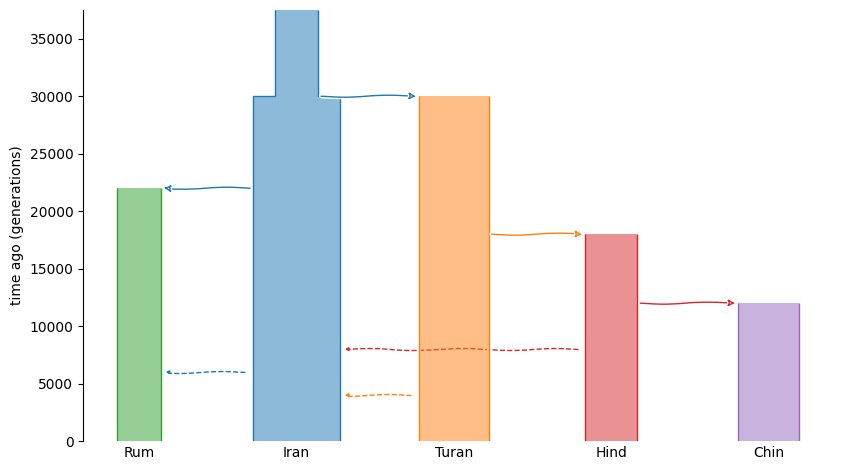
Populations: Iran, Turan, Rum, Hind, Chin
Five Shahnameh realms with pulse admixture events. Tests 5-pop graph inference.
SixPopExtRecolon_6F10
Six-population model with extinction and recolonization
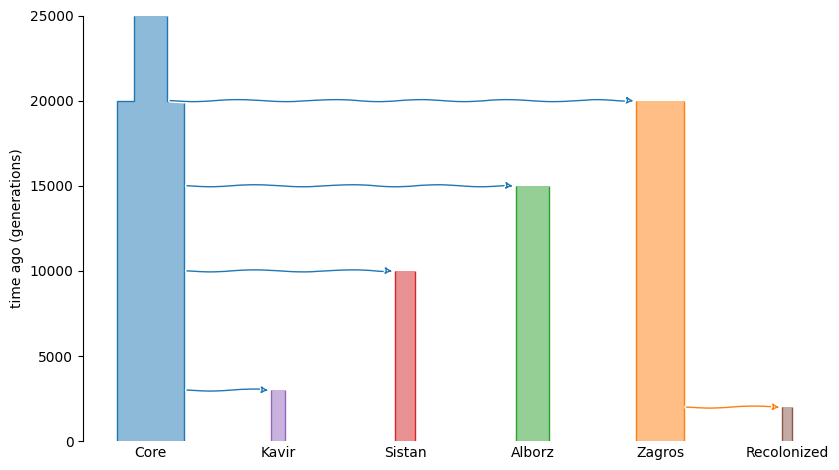
Populations: Core, Zagros, Alborz, Kavir, Sistan, Recolonized
Kavir goes extinct at 3000 gen, recolonized from Zagros at 2000 gen.
AsymReversal_2F10
Two-pop with migration direction reversal over time
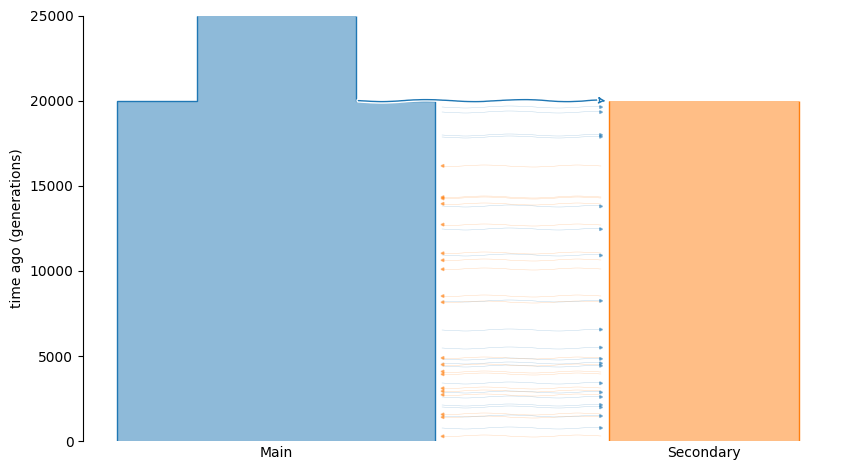
Populations: Main, Secondary
Migration reverses direction at 5000 gen ago. Tests temporal asymmetry.
SilkRoad_8F10
Eight-population Silk Road stepping-stone model
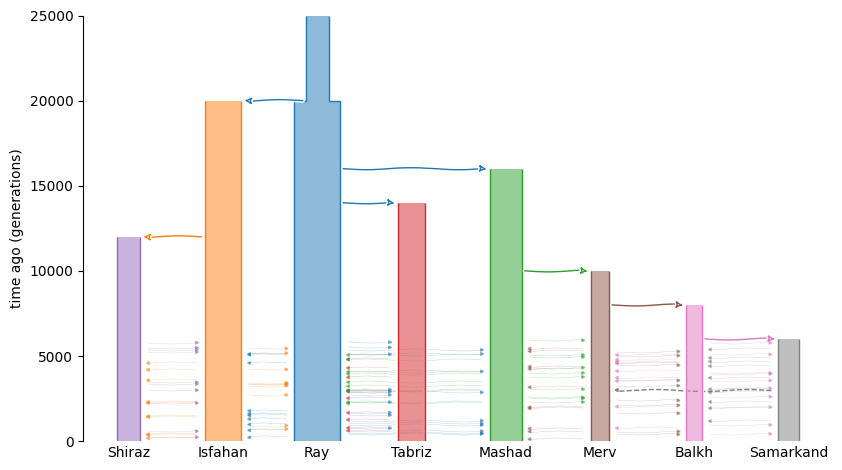
Populations: Ray, Isfahan, Shiraz, Tabriz, Mashad, Merv, Balkh, Samarkand
Eight cities along the Silk Road with stepping-stone migration and admixture.
Generic models
In addition to the species-specific models listed in this catalog, stdferdowsim offers
generic demographic models that can be run with any species.
These are described in the API.